QUESTION IMAGE
Question
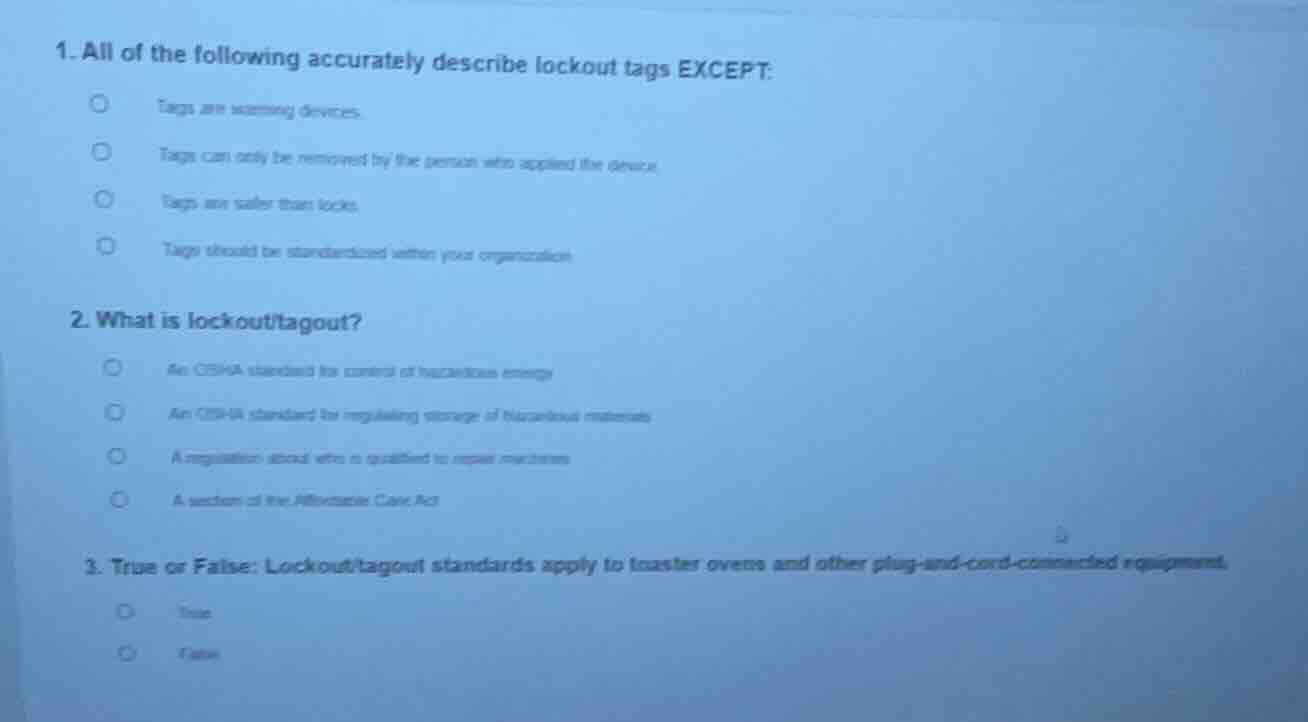
- all of the following accurately describe lockout tags except:
tags are warning devices.
tags can only be removed by the person who applied the device.
tags are safer than locks.
tags should be standardized within your organization
- what is lockout/tagout?
an osha standard for control of hazardous energy
an osha standard for regulating storage of hazardous materials
a regulation about who is qualified to repair machines
a section of the affirmative care act
- true or false: lockout/tagout standards apply to toaster ovens and other plug-and-cord-connected equipment.
true
false
Question 1
- Tags are warning devices (correct, as lockout tags serve as warnings).
- Tags can only be removed by the applier (correct, per lockout/tagout protocols).
- Tags are safer than locks (incorrect, locks are more secure than tags in lockout/tagout; tags are supplementary warnings, not more secure than locks).
- Tags should be standardized (correct, for consistency in organizations). So the exception is "Tags are safer than locks".
- Lockout/tagout (LOTO) is an OSHA standard (1910.147) for controlling hazardous energy to prevent accidental startup during maintenance/repair.
- The second option is about hazardous materials storage (not LOTO).
- The third is about who repairs machines (not LOTO).
- The fourth is about the Affirmative Action Act (unrelated). So the correct answer is "An OSHA standard for control of hazardous energy".
Lockout/tagout standards (OSHA 1910.147) generally apply to equipment with hazardous energy sources that could cause injury if unexpected startup occurs. Toaster ovens and plug - and - cord - connected equipment (small - scale, low - hazard in typical use for minor maintenance) are usually exempt as they don’t pose significant hazardous energy risks requiring LOTO for normal servicing. So the answer is False.

Snap & solve any problem in the app
Get step-by-step solutions on Sovi AI
Photo-based solutions with guided steps
Explore more problems and detailed explanations
The option "Tags are safer than locks" (the third option)