QUESTION IMAGE
Question
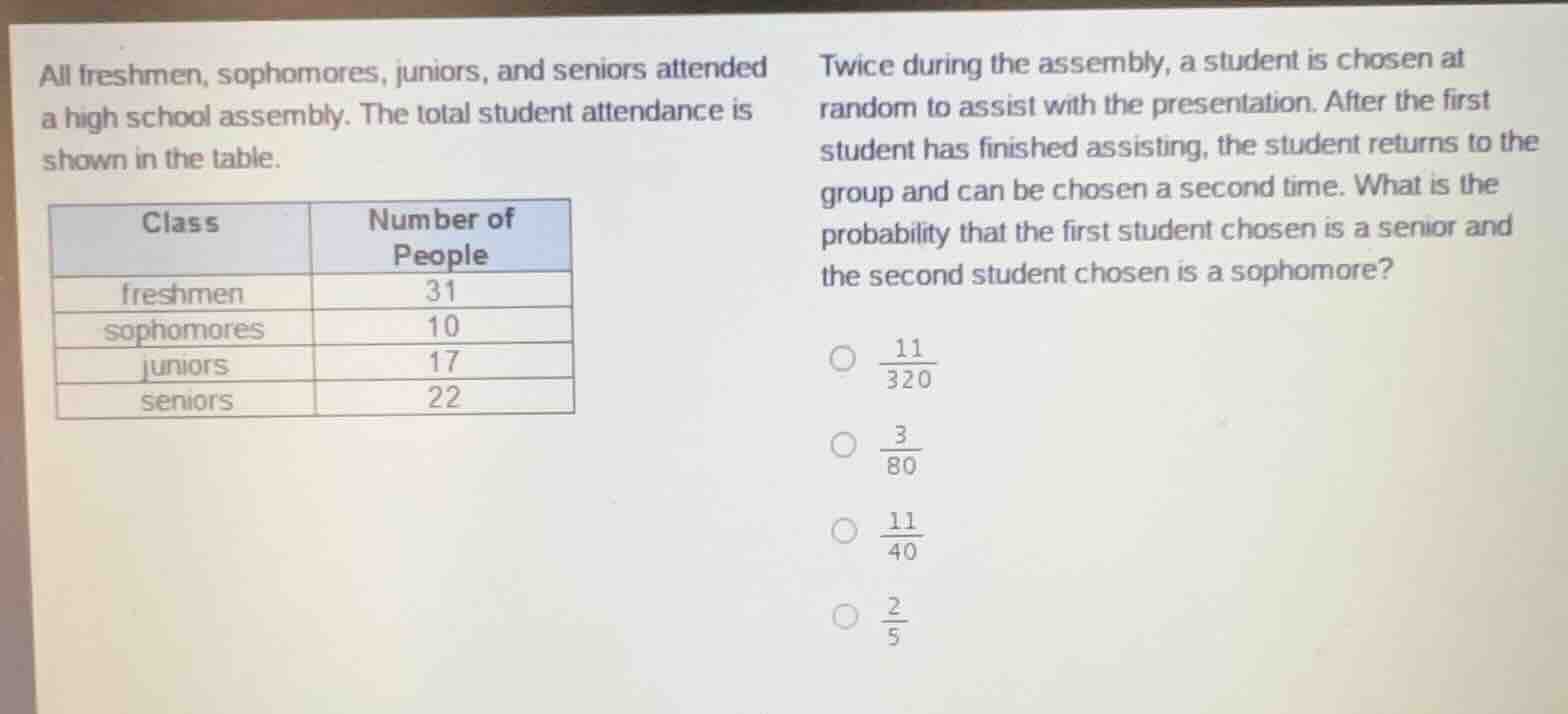
all freshmen, sophomores, juniors, and seniors attended a high school assembly. the total student attendance is shown in the table.
| class | number of people |
|---|---|
| sophomores | 10 |
| juniors | 17 |
| seniors | 22 |
twice during the assembly, a student is chosen at random to assist with the presentation. after the first student has finished assisting, the student returns to the group and can be chosen a second time. what is the probability that the first student chosen is a senior and the second student chosen is a sophomore?
- \\(\frac{11}{320}\\)
- \\(\frac{3}{80}\\)
- \\(\frac{11}{40}\\)
- \\(\frac{2}{5}\\)
Step1: Calculate total number of students
First, we find the total number of students by adding the number of freshmen, sophomores, juniors, and seniors.
The number of freshmen is 31, sophomores is 10, juniors is 17, and seniors is 22. So the total number of students \( N = 31 + 10 + 17 + 22 \).
Calculating that: \( 31+10 = 41 \), \( 41 + 17 = 58 \), \( 58 + 22 = 80 \). So \( N = 80 \).
Step2: Probability of choosing a senior first
The probability of choosing a senior first, \( P(\text{senior}) \), is the number of seniors divided by the total number of students. The number of seniors is 22, so \( P(\text{senior})=\frac{22}{80} \).
Step3: Probability of choosing a sophomore second
Since the student returns to the group (with replacement), the probability of choosing a sophomore second, \( P(\text{sophomore}) \), is the number of sophomores divided by the total number of students. The number of sophomores is 10, so \( P(\text{sophomore})=\frac{10}{80} \).
Step4: Probability of both events happening
Since the two events (choosing a senior first and a sophomore second) are independent (because of replacement), we multiply the two probabilities. So the probability \( P = P(\text{senior}) \times P(\text{sophomore})=\frac{22}{80} \times \frac{10}{80} \).
Simplifying \( \frac{22}{80} \times \frac{10}{80}=\frac{22\times10}{80\times80}=\frac{220}{6400} \). We can simplify this fraction by dividing numerator and denominator by 20: \( \frac{220\div20}{6400\div20}=\frac{11}{320} \).

Snap & solve any problem in the app
Get step-by-step solutions on Sovi AI
Photo-based solutions with guided steps
Explore more problems and detailed explanations
\(\frac{11}{320}\) (corresponding to the first option)