QUESTION IMAGE
Question
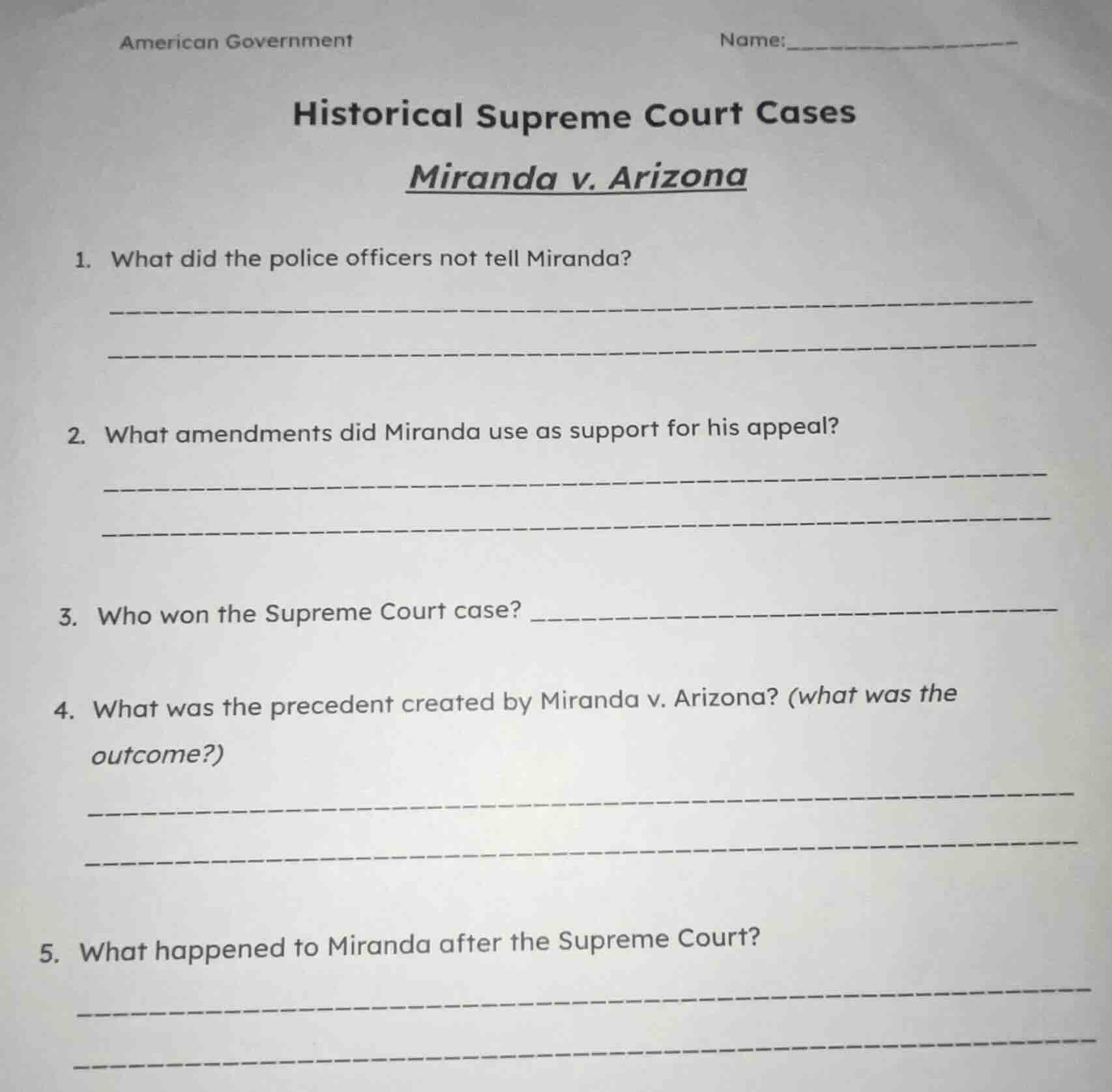
american government
name:_________
historical supreme court cases
miranda v. arizona
- what did the police officers not tell miranda?
_________________________
_________________________
- what amendments did miranda use as support for his appeal?
_________________________
_________________________
- who won the supreme court case? _________________________
- what was the precedent created by miranda v. arizona? (what was the outcome?)
_________________________
_________________________
- what happened to miranda after the supreme court?
_________________________
_________________________
Brief Explanations
- The police failed to inform Miranda of his constitutional rights before interrogation.
- Miranda cited the 5th Amendment (right against self-incrimination) and 6th Amendment (right to an attorney) for his appeal.
- The Supreme Court ruled in favor of Miranda.
- The case established that law enforcement must inform suspects of their Miranda Rights (right to remain silent, right to an attorney, that statements can be used against them, and that an attorney will be provided if they cannot afford one) before custodial interrogation.
- Miranda was retried after the Supreme Court decision, convicted based on other evidence, served his prison sentence, and was killed in a bar fight after his release.

Snap & solve any problem in the app
Get step-by-step solutions on Sovi AI
Photo-based solutions with guided steps
Explore more problems and detailed explanations
- They did not tell him his constitutional rights: the right to remain silent, the right to have an attorney present during questioning, that anything he says can be used against him in court, and that an attorney will be provided for him if he cannot afford one.
- The 5th Amendment (protection against self-incrimination) and the 6th Amendment (right to legal counsel).
- Ernesto Miranda (the defendant) won the Supreme Court case.
- The precedent established that law enforcement officers must read criminal suspects their Miranda Rights (the specific set of constitutional rights) before conducting a custodial interrogation; if these rights are not communicated, any statements the suspect makes cannot be used as evidence in court.
- Miranda was retried, convicted using evidence unrelated to his un-Mirandized confession, served his prison sentence, and was fatally stabbed in a bar in 1976 after his release.