QUESTION IMAGE
Question
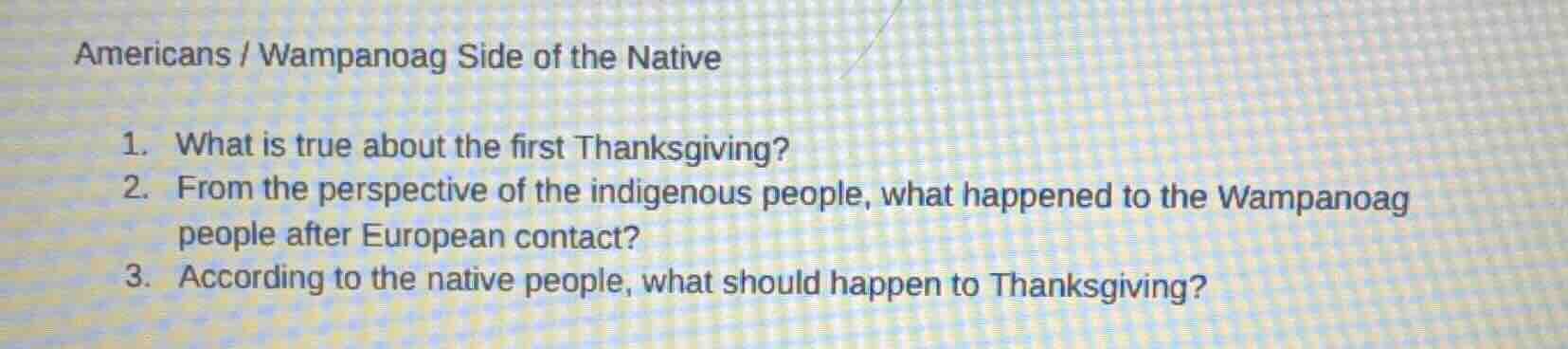
americans / wampanoag side of the native
- what is true about the first thanksgiving?
- from the perspective of the indigenous people, what happened to the wampanoag people after european contact?
- according to the native people, what should happen to thanksgiving?
Brief Explanations
- For the first question: The 1621 gathering between English colonists (Pilgrims) and Wampanoag people was a harvest feast, not an official "Thanksgiving" holiday at the time. It was a mutual, temporary alliance-focused meal, not a recurring national celebration.
- For the second question: After European contact, the Wampanoag faced violent land seizure, forced displacement, introduction of deadly European diseases that decimated their population, cultural erasure, and loss of sovereignty as colonizers expanded their settlements.
- For the third question: Many Wampanoag and other Indigenous people view Thanksgiving as a day of mourning and remembrance of the genocide and dispossession their peoples endured. Some call for reorienting the holiday to center Indigenous history, truth-telling, and honoring Indigenous sovereignty, rather than the mythologized feast narrative.

Snap & solve any problem in the app
Get step-by-step solutions on Sovi AI
Photo-based solutions with guided steps
Explore more problems and detailed explanations
- The 1621 gathering was a harvest feast between Pilgrims and Wampanoag, a temporary alliance meal, not an official, recurring Thanksgiving holiday.
- The Wampanoag suffered massive population loss from European diseases, violent land theft, displacement, cultural erasure, and loss of sovereignty as colonizers expanded.
- Many Indigenous people (including Wampanoag) frame it as a day of mourning; they advocate for centering Indigenous truth, history, and sovereignty in how the holiday is recognized, rather than the mythologized feast story.