QUESTION IMAGE
Question
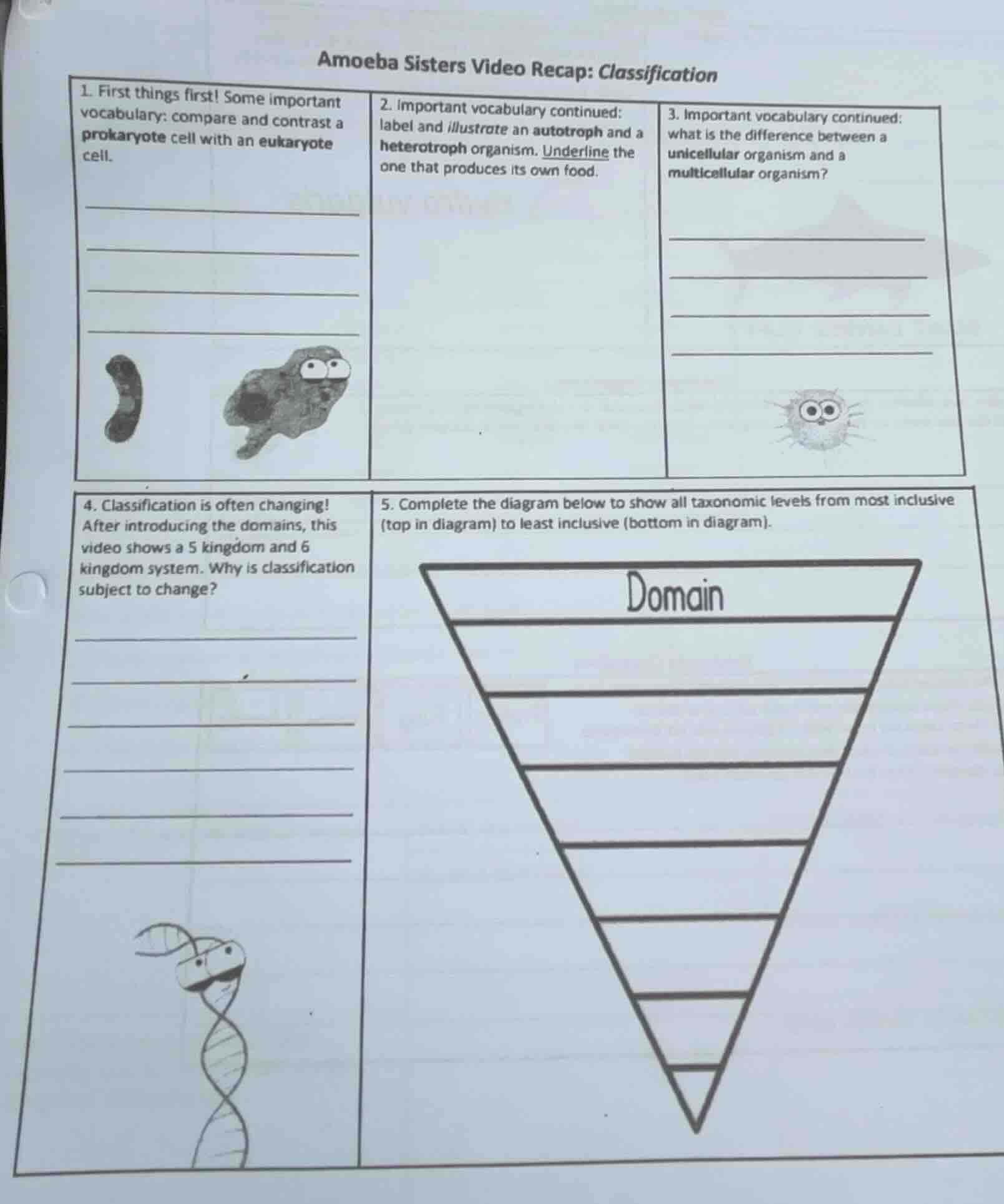
amoeba sisters video recap: classification
- first things first! some important vocabulary: compare and contrast a prokaryote cell with an eukaryote cell.
- important vocabulary continued: label and illustrate an autotroph and a heterotroph organism. underline the one that produces its own food.
- important vocabulary continued: what is the difference between a unicellular organism and a multicellular organism?
- classification is often changing! after introducing the domains, this video shows a 5 kingdom and 6 kingdom system. why is classification subject to change?
- complete the diagram below to show all taxonomic levels from most inclusive (top in diagram) to least inclusive (bottom in diagram).
domain
Brief Explanations
- Question 1: Prokaryotes lack a membrane-bound nucleus and organelles; eukaryotes have both. The left image is a prokaryote (bacterium), right is a eukaryote (amoeba).
- Question 2: Autotrophs produce their own food (e.g., a plant, underlined); heterotrophs consume other organisms (e.g., a rabbit).
- Question 3: Unicellular organisms are made of one cell (e.g., the pictured bacterium); multicellular organisms are made of many specialized cells.
- Question 4: Classification changes as new genetic, fossil, and molecular evidence is discovered, refining how we group organisms.
- Question 5: Taxonomic levels from most to least inclusive follow the standard hierarchical order.

Snap & solve any problem in the app
Get step-by-step solutions on Sovi AI
Photo-based solutions with guided steps
Explore more problems and detailed explanations
- Prokaryote cell: No membrane-bound nucleus or organelles; DNA is in a nucleoid region (matches left image, a bacterium). Eukaryote cell: Has a membrane-bound nucleus and organelles (matches right image, an amoeba). Both have cell membranes and cytoplasm.
- Autotroph (underlined): Draw a plant with a label "Autotroph - makes own food via photosynthesis". Heterotroph: Draw a rabbit with a label "Heterotroph - eats other organisms for food".
- A unicellular organism consists of only one single cell that carries out all life functions, while a multicellular organism is made of multiple specialized cells that work together to perform different life processes.
- Classification systems change because new scientific evidence (such as genetic sequencing, new fossil discoveries, and advanced molecular data) reveals previously unknown relationships between organisms, requiring updates to how we categorize living things.
- From top (most inclusive) to bottom (least inclusive):
Domain
Kingdom
Phylum
Class
Order
Family
Genus
Species