QUESTION IMAGE
Question
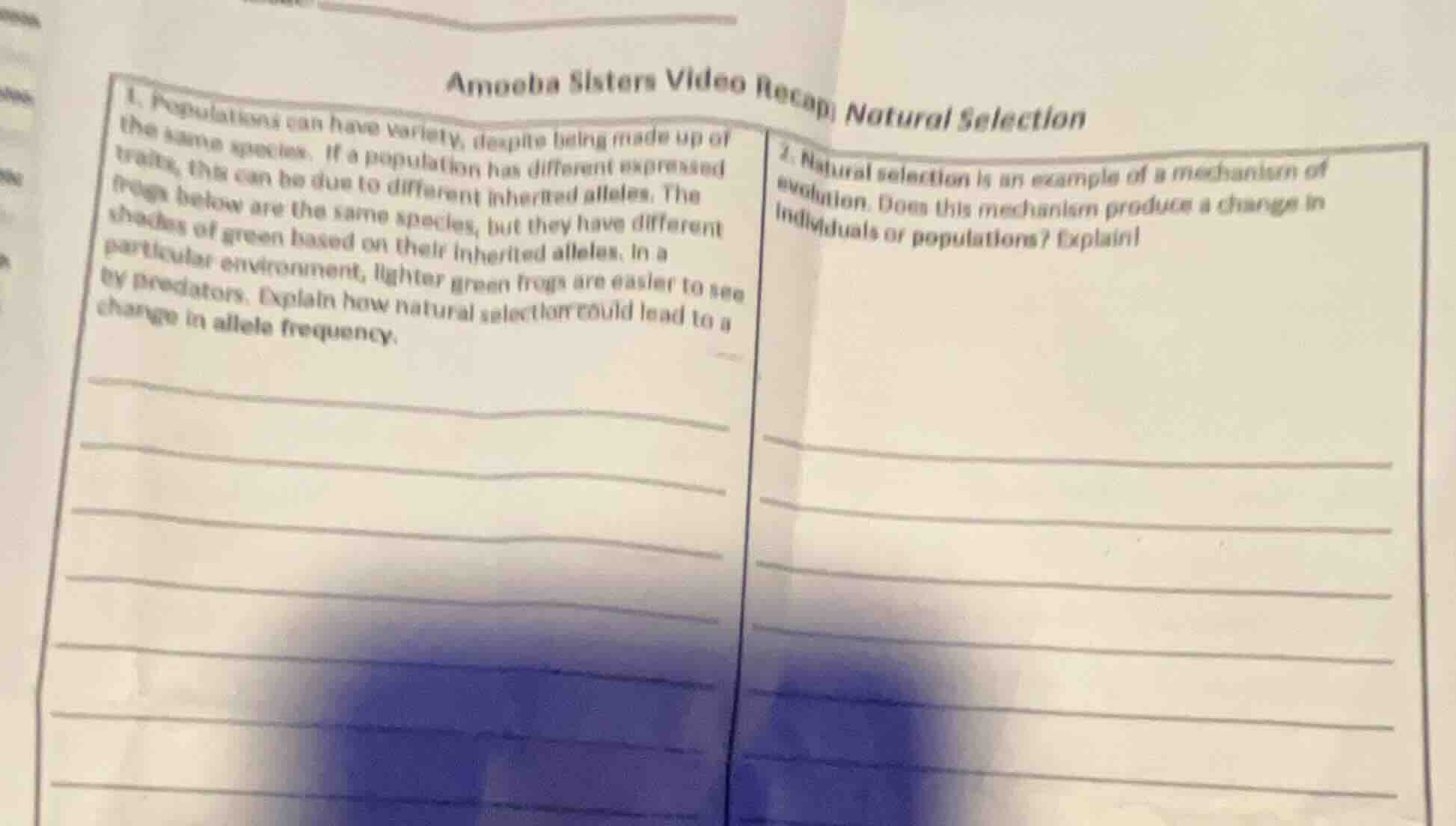
amoeba sisters video recap: natural selection
- populations can have variety, despite being made up of the same species. if a population has different expressed traits, this can be due to different inherited alleles. the frogs below are the same species, but they have different shades of green based on their inherited alleles. in a particular environment, lighter green frogs are easier to see by predators. explain how natural selection could lead to a change in allele frequency.
- natural selection is an example of a mechanism of evolution. does this mechanism produce a change in individuals or populations? explain!
Brief Explanations
- For the frog scenario: Lighter green frogs are more visible to predators, so they are less likely to survive and reproduce. Darker green frogs have higher survival and reproductive success, passing on their dark green alleles more often. Over time, the frequency of the dark green allele increases, and the light green allele decreases in the population.
- For the natural selection change question: Natural selection acts on individuals (their traits affect survival/reproduction), but the evolutionary change (shift in trait/allele frequencies) occurs across the entire population over generations, not in a single individual's lifetime.

Snap & solve any problem in the app
Get step-by-step solutions on Sovi AI
Photo-based solutions with guided steps
Explore more problems and detailed explanations
- Lighter green frogs face higher predation, so they survive and reproduce less frequently than darker green frogs. Darker green frogs pass their alleles to offspring more often, so over generations, the frequency of the dark green allele increases, and the light green allele frequency decreases in the population.
- Natural selection produces a change in populations, not individuals. Individuals cannot evolve during their lifetime; natural selection acts on the heritable traits of individuals, and over time, this leads to shifts in allele frequencies and traits across the entire population.