QUESTION IMAGE
Question
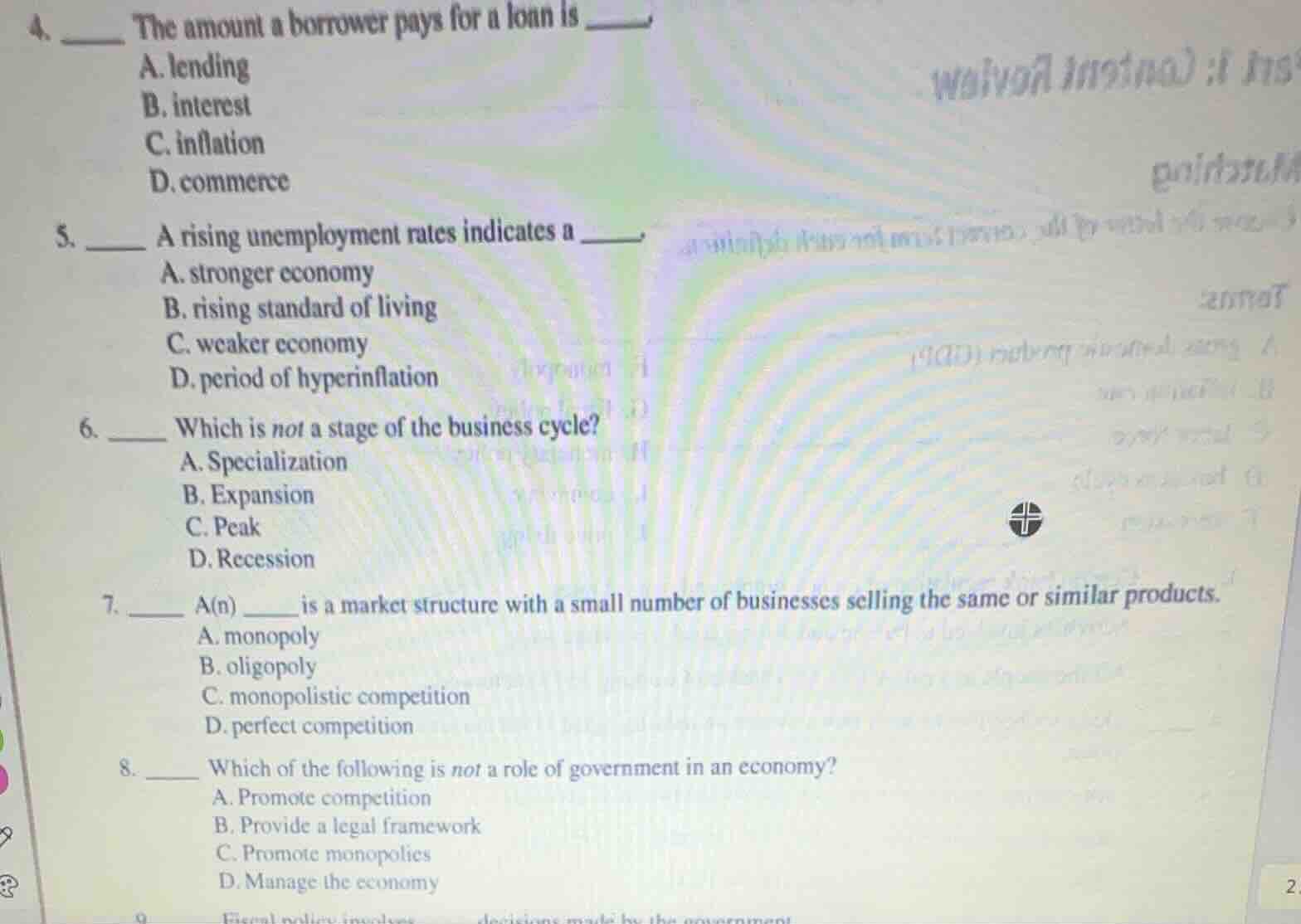
- __ the amount a borrower pays for a loan is __
a. lending
b. interest
c. inflation
d. commerce
- __ a rising unemployment rates indicates a __
a. stronger economy
b. rising standard of living
c. weaker economy
d. period of hyperinflation
- ____ which is not a stage of the business cycle?
a. specialization
b. expansion
c. peak
d. recession
- __ a(n) __ is a market structure with a small number of businesses selling the same or similar products.
a. monopoly
b. oligopoly
c. monopolistic competition
d. perfect competition
- ____ which of the following is not a role of government in an economy?
a. promote competition
b. provide a legal framework
c. promote monopolies
d. manage the economy
Response
Question 4
Brief Explanations
- Option A: Lending is the act of giving a loan, not what the borrower pays.
- Option B: Interest is the amount a borrower pays for using the lender's money (the loan), which matches the description.
- Option C: Inflation is a general rise in prices, not related to loan payment.
- Option D: Commerce is trade, not related to loan payment.
Brief Explanations
- Option A: A stronger economy usually has lower unemployment as businesses expand and hire.
- Option B: A rising standard of living is associated with a strong economy (more jobs, higher income), not rising unemployment.
- Option C: A weaker economy has less business activity, so companies lay off workers, leading to rising unemployment.
- Option D: Hyperinflation is extreme price rise, not directly linked to unemployment rate direction here.
Brief Explanations
- The business cycle stages are Expansion (growth), Peak (highest point), Recession (decline), Trough (lowest point), and Recovery.
- Option A: Specialization is about focusing production, not a business cycle stage.
- Options B, C, D are valid business cycle stages.

Snap & solve any problem in the app
Get step-by-step solutions on Sovi AI
Photo-based solutions with guided steps
Explore more problems and detailed explanations
B. interest