QUESTION IMAGE
Question
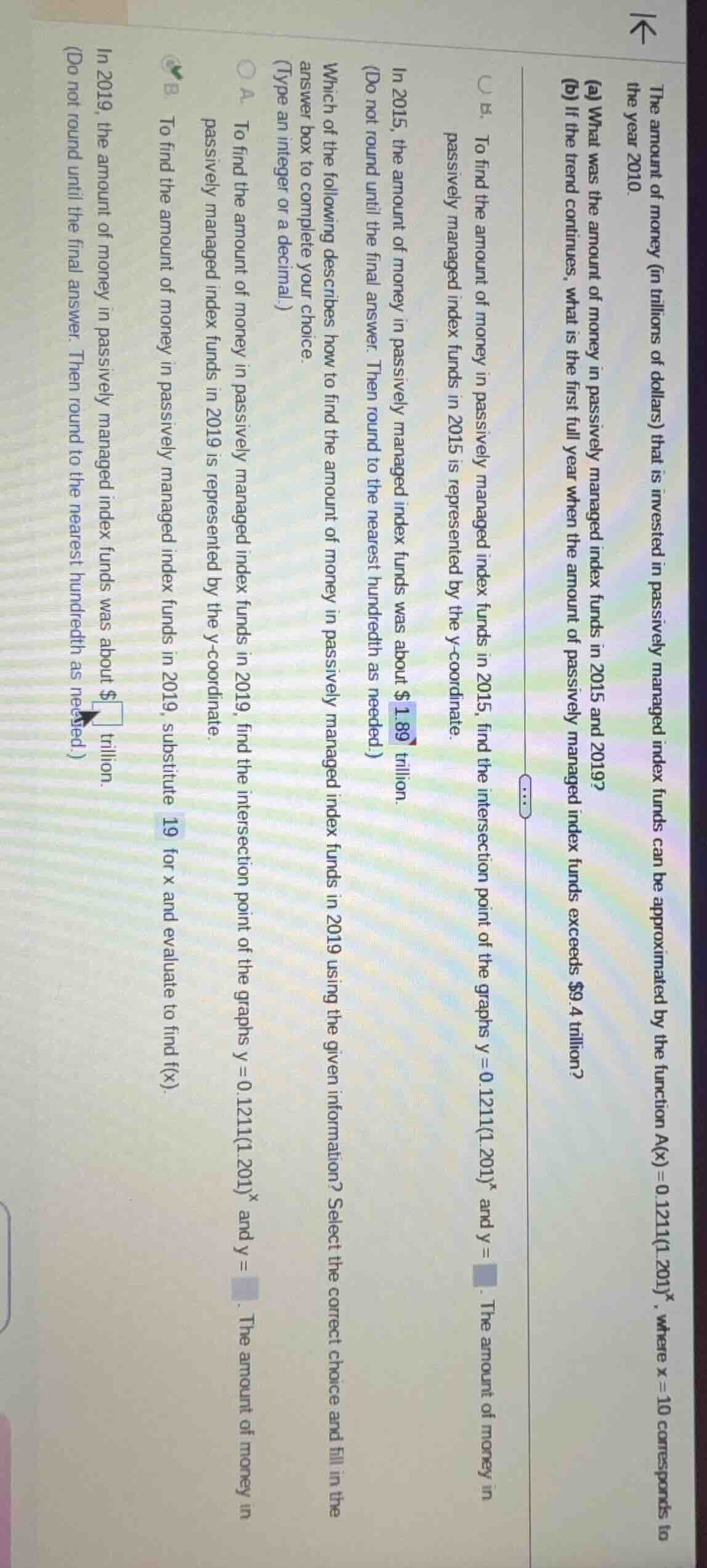
the amount of money (in trillions of dollars) that is invested in passively managed index funds can be approximated by the function ( a(x) = 0.1211(1.201)^x ), where ( x = 10 ) corresponds to the year 2010.
(a) what was the amount of money in passively managed index funds in 2015 and 2019?
(b) if the trend continues, what is the first full year when the amount of passively managed index funds exceeds $9.4 trillion?
...
to find the amount of money in passively managed index funds in 2015, find the intersection point of the graphs ( y = 0.1211(1.201)^x ) and ( y = square ). the amount of money in passively managed index funds in 2015 is represented by the y - coordinate.
in 2015, the amount of money in passively managed index funds was about $1.89 trillion. (do not round until the final answer. then round to the nearest hundredth as needed.)
which of the following describes how to find the amount of money in passively managed index funds in 2019 using the given information? select the correct choice and fill in the answer box to complete your choice.
(type an integer or a decimal.)
a. to find the amount of money in passively managed index funds in 2019, find the intersection point of the graphs ( y = 0.1211(1.201)^x ) and ( y = square ). the amount of money in passively managed index funds in 2019 is represented by the y - coordinate.
b. to find the amount of money in passively managed index funds in 2019, substitute 19 for ( x ) and evaluate to find ( f(x) ).
in 2019, the amount of money in passively managed index funds was about $ square trillion.
(do not round until the final answer. then round to the nearest hundredth as needed.)
Step1: Define x for 2015
Given $x=10$ for 2010, so for 2015:
$x = 10 + (2015-2010) = 15$
Step2: Calculate 2015 fund value
Substitute $x=15$ into $A(x)$:
$A(15)=0.1211(1.201)^{15}$
First compute $(1.201)^{15}\approx15.6197$, then:
$A(15)=0.1211\times15.6197\approx1.89$
Step3: Define x for 2019
For 2019:
$x = 10 + (2019-2010) = 19$
Step4: Calculate 2019 fund value
Substitute $x=19$ into $A(x)$:
$A(19)=0.1211(1.201)^{19}$
First compute $(1.201)^{19}\approx29.9023$, then:
$A(19)=0.1211\times29.9023\approx3.62$
Step5: Solve for x when A(x)=9.4
Set up the equation:
$9.4=0.1211(1.201)^x$
Isolate the exponential term:
$(1.201)^x=\frac{9.4}{0.1211}\approx77.6218$
Take natural log of both sides:
$x=\frac{\ln(77.6218)}{\ln(1.201)}$
Calculate logs: $\ln(77.6218)\approx4.352$, $\ln(1.201)\approx0.1826$
$x=\frac{4.352}{0.1826}\approx23.83$
Step6: Find the corresponding year
Since $x=10$ is 2010, the year is:
$2010 + (23.83-10)\approx2024$ (first full year)

Snap & solve any problem in the app
Get step-by-step solutions on Sovi AI
Photo-based solutions with guided steps
Explore more problems and detailed explanations
(a) 2015: $\boldsymbol{1.89}$ trillion; 2019: $\boldsymbol{3.62}$ trillion
(b) $\boldsymbol{2024}$