QUESTION IMAGE
Question
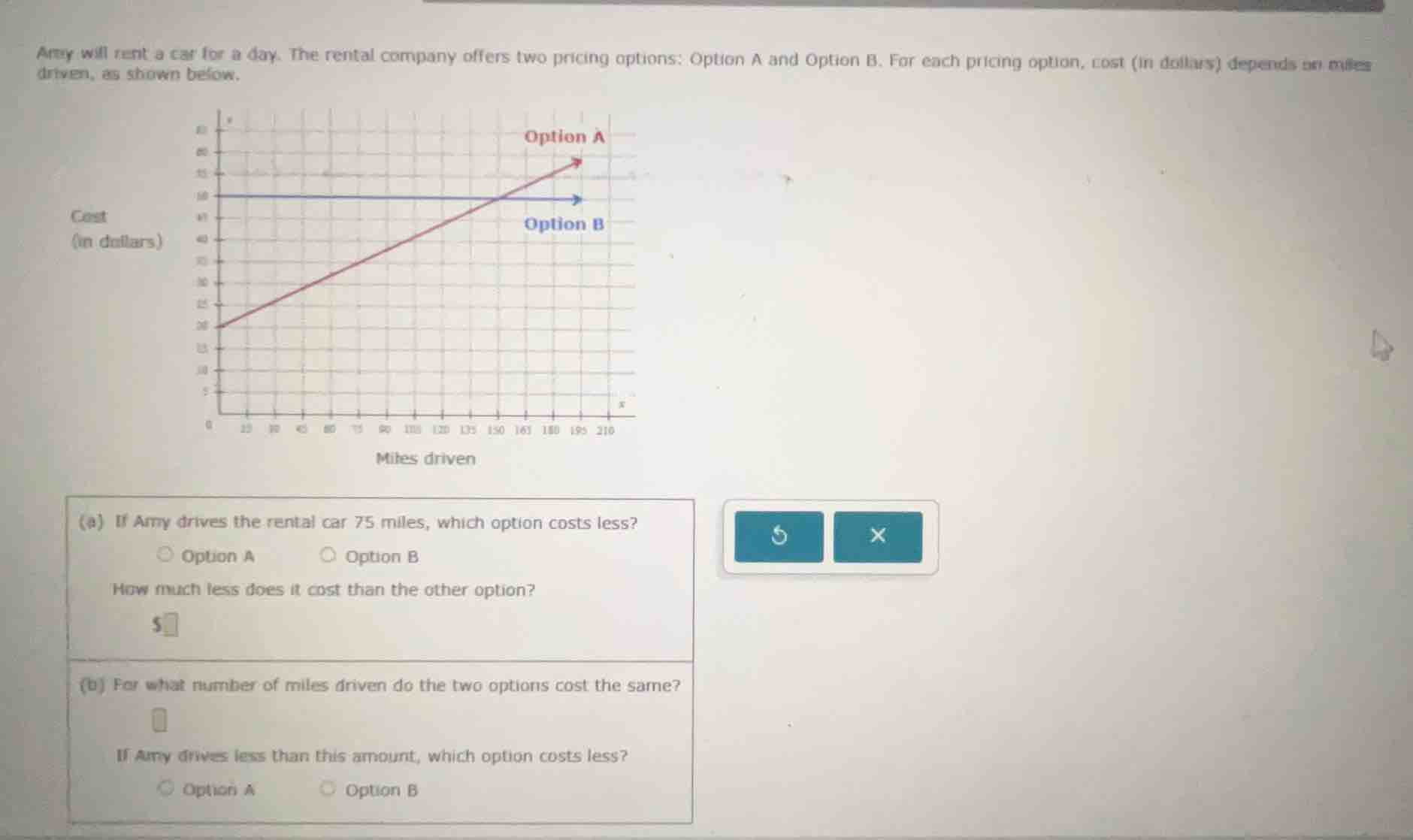
amy will rent a car for a day. the rental company offers two pricing options: option a and option b. for each pricing option, cost (in dollars) depends on miles driven, as shown below. (a) if amy drives the rental car 75 miles, which option costs less? option a option b how much less does it cost than the other option? $ (b) for what number of miles driven do the two options cost the same? if amy drives less than this amount, which option costs less? option a option b
Part (a)
Step1: Find cost of Option A at 75 miles
From the graph, Option A is a line starting at (0, 20) with a slope. Let's find the equation. The slope \( m = \frac{50 - 20}{150 - 0}=\frac{30}{150}=0.2 \). So equation is \( y = 0.2x + 20 \). At \( x = 75 \), \( y = 0.2(75)+20 = 15 + 20 = 35 \).
Step2: Find cost of Option B at 75 miles
Option B is a horizontal line at \( y = 50 \) (wait, no, looking at graph, Option B is horizontal at 50? Wait no, the blue line is Option B, which is horizontal at 50? Wait no, the graph: Option A is red, starts at (0,20), goes up. Option B is blue, horizontal at 50? Wait no, the x-axis is miles, y-axis is cost. Wait at x=0, Option A is 20, Option B is 50? Wait no, the graph: when x=150, Option A and B meet at (150,50). Wait my mistake earlier. Let's re-express.
Option A: passes through (0, 20) and (150, 50). Slope \( m=\frac{50 - 20}{150 - 0}=\frac{30}{150}=0.2 \), so \( y = 0.2x + 20 \).
Option B: horizontal line, from the graph, it's at y=50? Wait no, when x=0, Option B is at 50? Wait the blue line is horizontal, so for any x, y=50? Wait no, the graph shows Option B is horizontal, so cost is constant. Wait at x=75, Option B's cost is 50? Wait no, that can't be. Wait maybe I misread. Wait the y-axis: at x=0, Option A is 20, Option B is 50? Then at x=150, both meet at 50. So Option A: starts at 20, increases to 50 at 150. Option B: starts at 50, stays 50. Wait that makes more sense. So at x=75, Option A: \( y = 0.2(75)+20 = 15 + 20 = 35 \). Option B: 50. So Option A costs 35, Option B costs 50.
Step3: Compare costs and find difference
Difference: \( 50 - 35 = 15 \). So Option A costs less, and it's 15 dollars less.
Step1: Find miles where costs are equal
From the graph, the two lines intersect at (150, 50). So at 150 miles, both cost 50.
Step2: Determine which is cheaper for less than 150 miles
For x < 150, Option A's cost \( y = 0.2x + 20 \) is less than 50 (since at x=150, it's 50), and Option B is 50. So Option A is cheaper for x < 150.

Snap & solve any problem in the app
Get step-by-step solutions on Sovi AI
Photo-based solutions with guided steps
Explore more problems and detailed explanations
Option A; $15