QUESTION IMAGE
Question
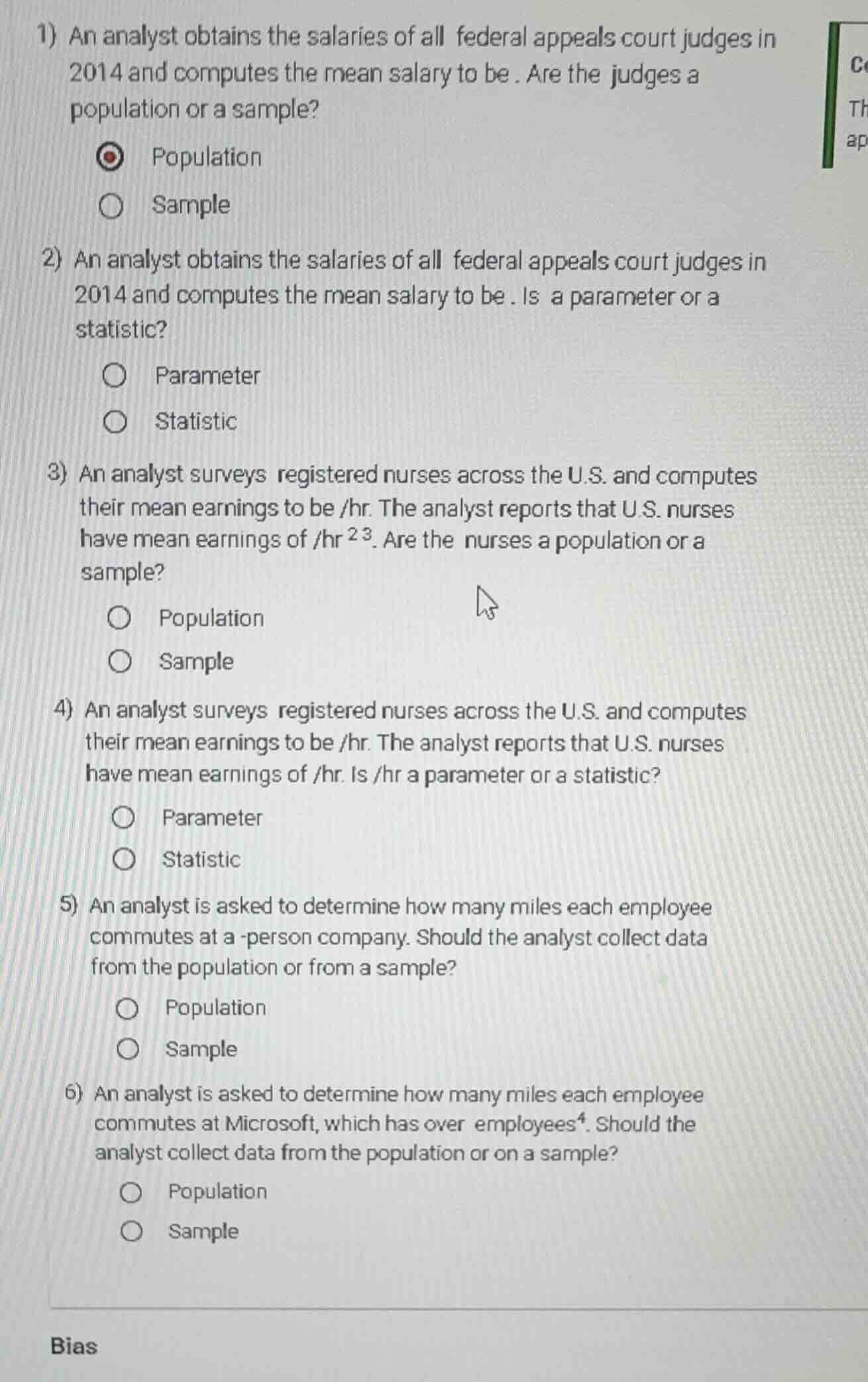
- an analyst obtains the salaries of all federal appeals court judges in 2014 and computes the mean salary to be. are the judges a population or a sample?
● population
○ sample
- an analyst obtains the salaries of all federal appeals court judges in 2014 and computes the mean salary to be. is a parameter or a statistic?
○ parameter
○ statistic
- an analyst surveys registered nurses across the u.s. and computes their mean earnings to be /hr. the analyst reports that u.s. nurses have mean earnings of /hr $^{2,3}$. are the nurses a population or a sample?
○ population
○ sample
- an analyst surveys registered nurses across the u.s. and computes their mean earnings to be /hr. the analyst reports that u.s. nurses have mean earnings of /hr. is /hr a parameter or a statistic?
○ parameter
○ statistic
- an analyst is asked to determine how many miles each employee commutes at a -person company. should the analyst collect data from the population or from a sample?
○ population
○ sample
- an analyst is asked to determine how many miles each employee commutes at microsoft, which has over employees$^4$. should the analyst collect data from the population or on a sample?
○ population
○ sample
bias
Brief Explanations
- A population includes all members of a group of interest; here all judges are included.
- A parameter describes a whole population; the mean uses all judges' salaries.
- A sample is a subset of the population; only some U.S. nurses are surveyed.
- A statistic describes a sample; the mean is from surveyed nurses, not all U.S. nurses.
- A small company's full employee group is easy to access, so use the population.
- A large company with many employees makes surveying all impractical, so use a sample.

Snap & solve any problem in the app
Get step-by-step solutions on Sovi AI
Photo-based solutions with guided steps
Explore more problems and detailed explanations
- Population
- Parameter
- Sample
- Statistic
- Population
- Sample