QUESTION IMAGE
Question
analyze
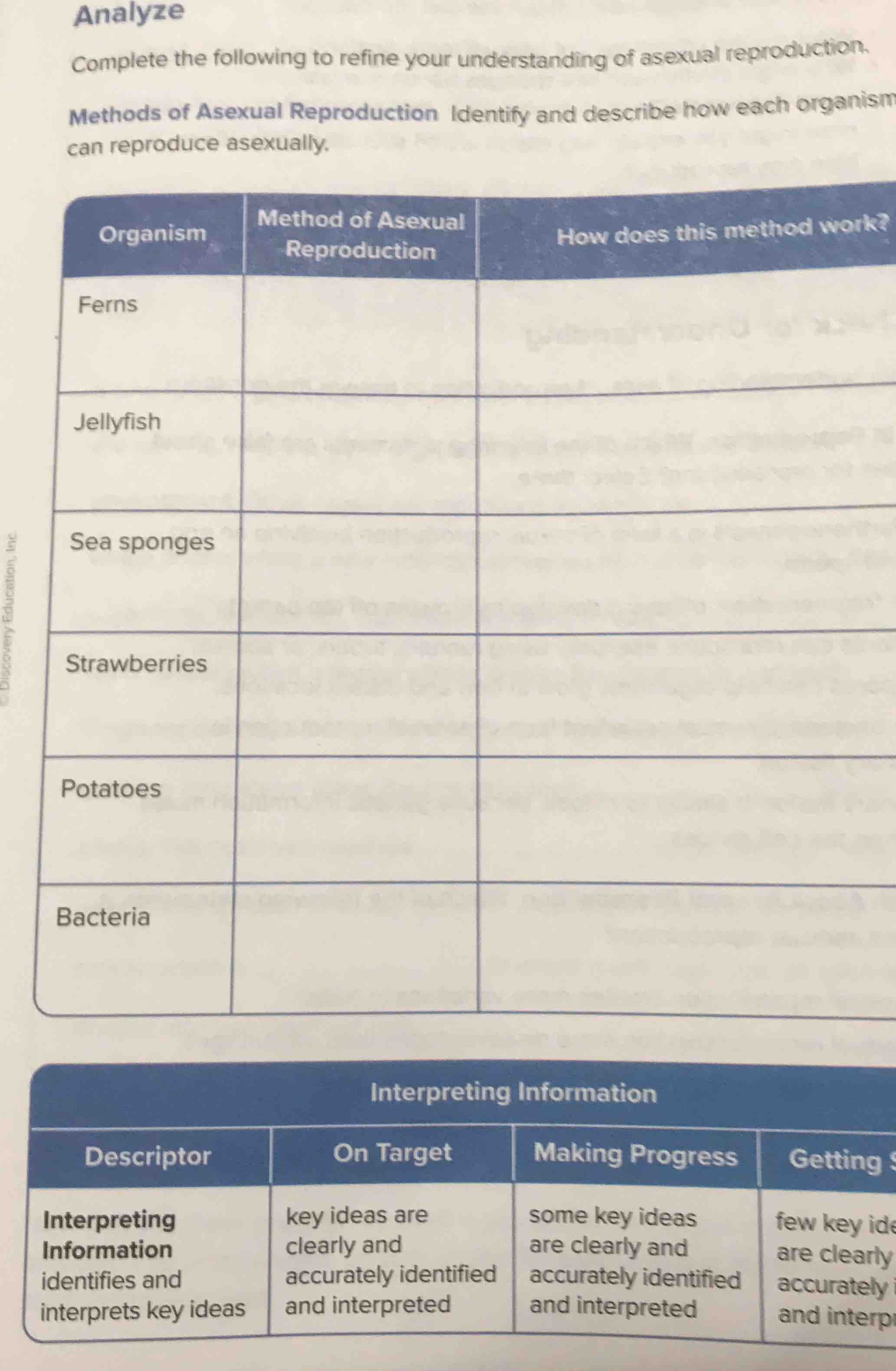
complete the following to refine your understanding of asexual reproduction.
methods of asexual reproduction identify and describe how each organism
can reproduce asexually.
interpreting information
Response
To solve this, we analyze each organism's asexual reproduction method:
Ferns
- Method: Spore formation
- How it works: Ferns produce spores (haploid cells) in structures called sporangia. When spores land in suitable conditions (moist, nutrient - rich), they germinate into a gametophyte, which then develops into a new fern plant.
Jellyfish
- Method: Budding
- How it works: A small outgrowth (bud) forms on the parent jellyfish. This bud grows, developing the same structures as the parent. Eventually, it detaches from the parent and becomes an independent jellyfish.
Sea sponges
- Method: Budding (or fragmentation)
- How it works (Budding): A small part of the sponge (a bud) grows on the parent. It gets its own set of cells and structures. When mature, it can detach. (For fragmentation: If a sponge breaks into pieces, each piece with viable cells can grow into a new sponge as the cells regenerate missing structures.)
Strawberries
- Method: Vegetative propagation (runners)
- How it works: Strawberry plants send out horizontal stems called runners (stolons). These runners touch the ground and develop roots and shoots at nodes. The new plantlet can then grow independently after detaching (or remaining connected) to the parent.
Potatoes
- Method: Vegetative propagation (tuber eyes)
- How it works: Potatoes are tubers (modified stems). The “eyes” of a potato are buds. When a potato (with eyes) is planted, these buds sprout into new potato plants, using the stored nutrients in the tuber.
Bacteria
- Method: Binary fission
- How it works: A bacterial cell replicates its DNA. Then, the cell membrane and cell wall grow inward, dividing the cell into two identical daughter cells, each with a copy of the DNA.
| Organism | Method of Asexual Reproduction | How does this method work? |
|---|---|---|
| Jellyfish | Budding | A bud forms on the parent, grows, and detaches to become independent. |
| Sea sponges | Budding (or Fragmentation) | Buds grow on the parent and detach (or fragments regenerate into new sponges). |
| Strawberries | Vegetative Propagation (Runners) | Runners (stolons) grow, form roots/shoots at nodes to create new plants. |
| Potatoes | Vegetative Propagation (Tuber Eyes) | Buds (eyes) on tubers sprout into new potato plants. |
| Bacteria | Binary Fission | DNA replicates, cell divides into two identical daughter cells. |

Snap & solve any problem in the app
Get step-by-step solutions on Sovi AI
Photo-based solutions with guided steps
Explore more problems and detailed explanations
To solve this, we analyze each organism's asexual reproduction method:
Ferns
- Method: Spore formation
- How it works: Ferns produce spores (haploid cells) in structures called sporangia. When spores land in suitable conditions (moist, nutrient - rich), they germinate into a gametophyte, which then develops into a new fern plant.
Jellyfish
- Method: Budding
- How it works: A small outgrowth (bud) forms on the parent jellyfish. This bud grows, developing the same structures as the parent. Eventually, it detaches from the parent and becomes an independent jellyfish.
Sea sponges
- Method: Budding (or fragmentation)
- How it works (Budding): A small part of the sponge (a bud) grows on the parent. It gets its own set of cells and structures. When mature, it can detach. (For fragmentation: If a sponge breaks into pieces, each piece with viable cells can grow into a new sponge as the cells regenerate missing structures.)
Strawberries
- Method: Vegetative propagation (runners)
- How it works: Strawberry plants send out horizontal stems called runners (stolons). These runners touch the ground and develop roots and shoots at nodes. The new plantlet can then grow independently after detaching (or remaining connected) to the parent.
Potatoes
- Method: Vegetative propagation (tuber eyes)
- How it works: Potatoes are tubers (modified stems). The “eyes” of a potato are buds. When a potato (with eyes) is planted, these buds sprout into new potato plants, using the stored nutrients in the tuber.
Bacteria
- Method: Binary fission
- How it works: A bacterial cell replicates its DNA. Then, the cell membrane and cell wall grow inward, dividing the cell into two identical daughter cells, each with a copy of the DNA.
| Organism | Method of Asexual Reproduction | How does this method work? |
|---|---|---|
| Jellyfish | Budding | A bud forms on the parent, grows, and detaches to become independent. |
| Sea sponges | Budding (or Fragmentation) | Buds grow on the parent and detach (or fragments regenerate into new sponges). |
| Strawberries | Vegetative Propagation (Runners) | Runners (stolons) grow, form roots/shoots at nodes to create new plants. |
| Potatoes | Vegetative Propagation (Tuber Eyes) | Buds (eyes) on tubers sprout into new potato plants. |
| Bacteria | Binary Fission | DNA replicates, cell divides into two identical daughter cells. |