QUESTION IMAGE
Question
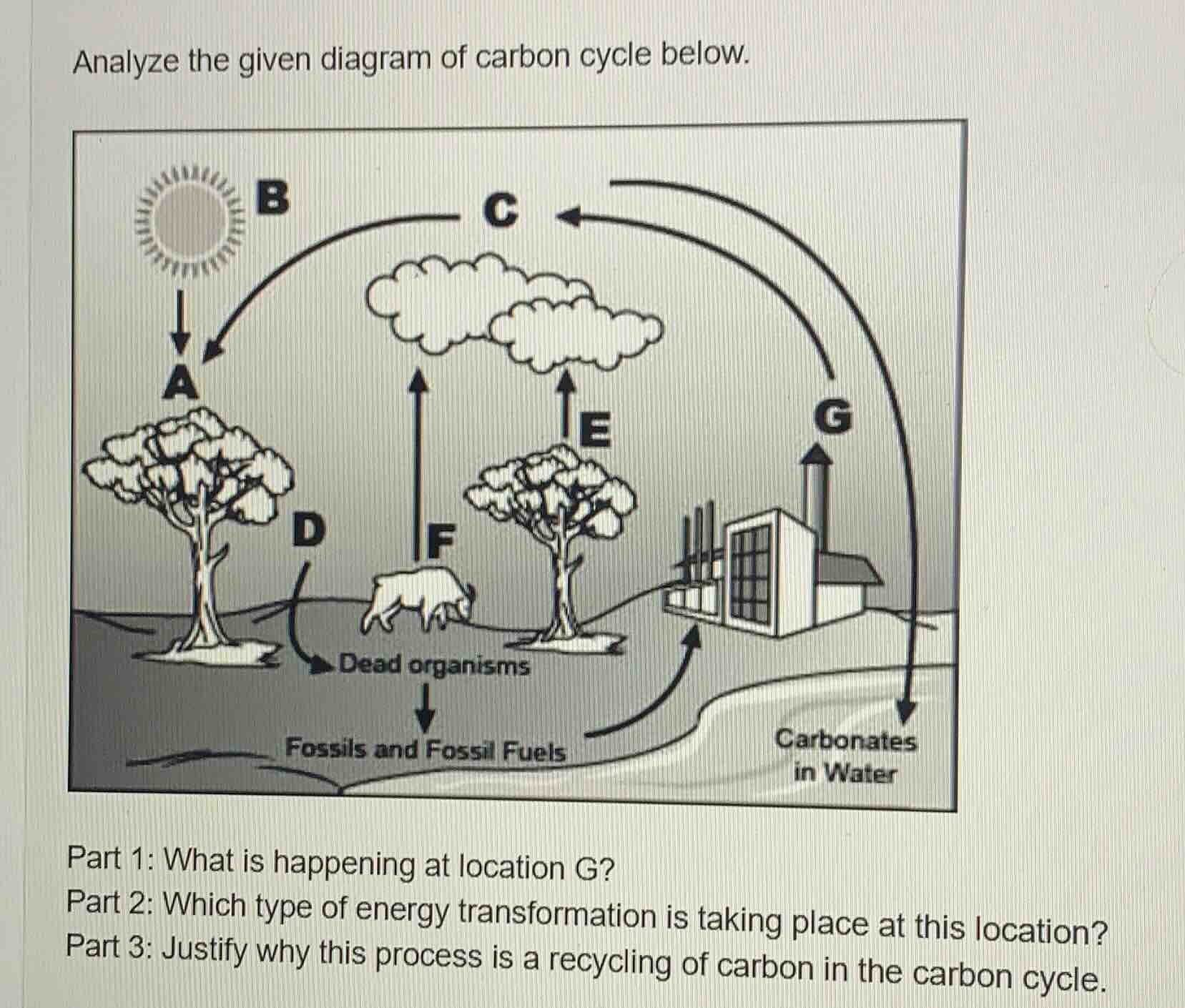
analyze the given diagram of carbon cycle below.
part 1: what is happening at location g?
part 2: which type of energy transformation is taking place at this location?
part 3: justify why this process is a recycling of carbon in the carbon cycle.
Part 1: Location G shows a factory releasing carbon-containing emissions (carbon dioxide) into the atmosphere, while the reverse arrow indicates carbon from the atmosphere dissolving into water to form carbonates. The primary process at G is the combustion of fossil fuels by the factory, releasing carbon dioxide into the atmosphere.
Part 2: Fossil fuels store chemical energy formed from ancient organic matter. When burned in the factory, this stored chemical energy is converted into thermal energy (heat) and mechanical/electrical energy (for the factory's operations), with the primary transformation being chemical to thermal/electrical energy.
Part 3: Carbon locked in fossil fuels is a long-term stored form of carbon from ancient dead organisms. When burned, it is released as carbon dioxide back into the atmosphere, where it can be used by plants for photosynthesis, dissolved into water as carbonates, or re-enter other parts of the carbon cycle. This moves carbon from a stored reservoir back into the active cycle, recycling the element through different components of the Earth's systems.

Snap & solve any problem in the app
Get step-by-step solutions on Sovi AI
Photo-based solutions with guided steps
Explore more problems and detailed explanations
- At location G, fossil fuels are being burned in a factory, releasing carbon dioxide ($\text{CO}_2$) into the atmosphere. Additionally, atmospheric carbon dioxide dissolves into water to form carbonates.
- Chemical energy (stored in fossil fuels) is transformed into thermal energy (heat) and electrical/mechanical energy.
- This process recycles carbon because it releases carbon that was locked in long-term fossil fuel reservoirs back into the atmosphere, where it can be reabsorbed by plants, dissolved into aquatic systems, or reused in other parts of the carbon cycle, continuing the flow of the element through Earth's biotic and abiotic components.