QUESTION IMAGE
Question
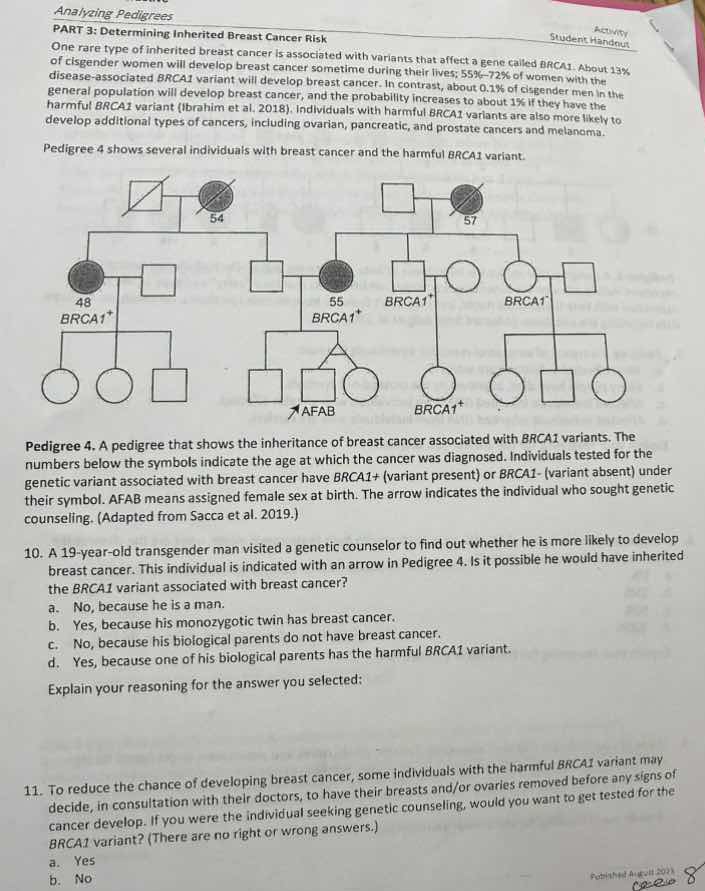
analyzing pedigreesactivitypart 3: determining inherited breast cancer riskstudent handoutone rare type of inherited breast cancer is associated with variants that affect a gene called brca1. about 13% of cisgender women will develop breast cancer sometime during their lives; 55%-72% of women with the disease-associated brca1 variant will develop breast cancer. in contrast, about 0.1% of cisgender men in the general population will develop breast cancer, and the probability increases to about 15% if they have the harmful brca1 variant (ibrahim et al. 2018). individuals with harmful brca1 variants are also more likely to develop additional types of cancers, including ovarian, pancreatic, and prostate cancers and melanoma.pedigree 4 shows several individuals with breast cancer and the harmful brca1 variant.pedigree 4. a pedigree that shows the inheritance of breast cancer associated with brca1 variants. the numbers below the symbols indicate the age at which the cancer was diagnosed. individuals tested for the genetic variant associated with breast cancer have brca1+ (variant present) or brca1- (variant absent) under their symbol. afab means assigned female sex at birth. the arrow indicates the individual who sought genetic counseling. (adapted from sacca et al. 2019.)10. a 19-year-old transgender man visited a genetic counselor to find out whether he is more likely to develop breast cancer. this individual is indicated with an arrow in pedigree 4. is it possible he would have inherited the brca1 variant associated with breast cancer?a. no, because he is a man.b. yes, because his monozygotic twin has breast cancer.c. no, because his biological parents do not have breast cancer.d. yes, because one of his biological parents has the harmful brca1 variant.explain your reasoning for the answer you selected:11. to reduce the chance of developing breast cancer, some individuals with the harmful brca1 variant may decide, in consultation with their doctors, to have their breasts and/or ovaries removed before any signs of cancer develop. if you were the individual seeking genetic counseling, would you want to get tested for the brca1 variant? (there are no right or wrong answers.)a. yesb. no
Question 10
The BRCA1 variant is inherited in an autosomal dominant pattern, meaning it can be passed from parent to child regardless of the child's sex. Looking at Pedigree 4, the individual (AFAB, transgender man) has a mother who is BRCA1+ (individual 55). Autosomal dominant alleles are passed from affected parents to offspring, so this individual could have inherited the variant, and sex does not prevent inheritance of this autosomal variant.
This is a personal decision with no universal correct answer. Choosing to get tested can provide information for proactive cancer prevention and treatment planning, while choosing not to may avoid potential psychological stress or unnecessary medical interventions.

Snap & solve any problem in the app
Get step-by-step solutions on Sovi AI
Photo-based solutions with guided steps
Explore more problems and detailed explanations
d. Yes, because one of his biological parents has the harmful BRCA1 variant.
---