QUESTION IMAGE
Question
analyzing a seminal us document
\brown v. board of education\
by chief justice warren
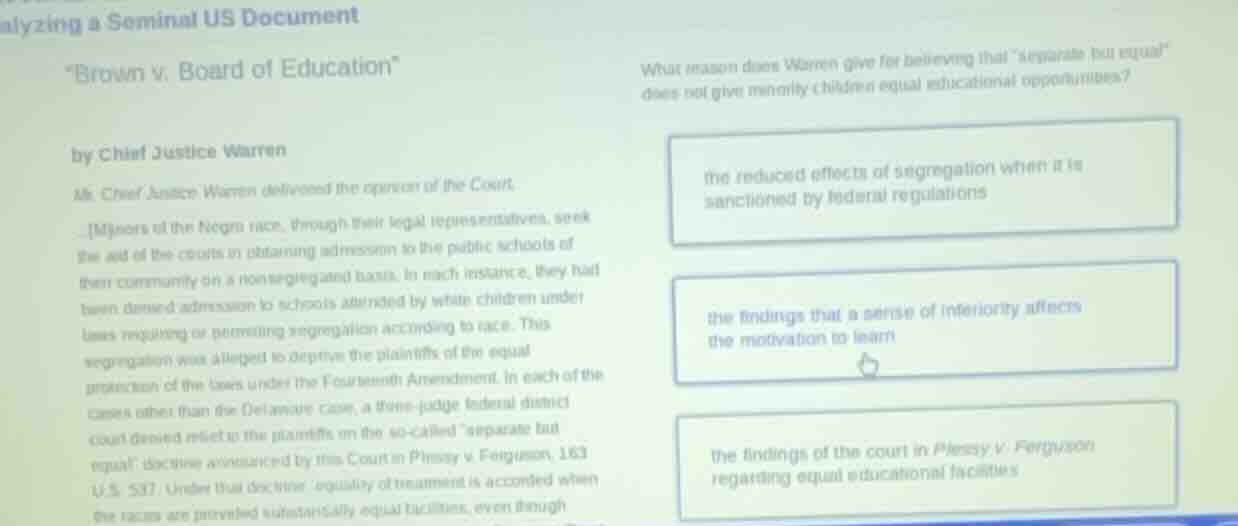
mr. chief justice warren delivered the opinion of the court.
minors of the negro race, through their legal representatives, seek the aid of the courts in obtaining admission to the public schools of their community on a nonsegregated basis. in each instance, they had been denied admission to schools attended by white children under laws requiring or permitting segregation according to race. this segregation was alleged to deprive the plaintiffs of the equal protection of the laws under the fourteenth amendment. in each of the cases other than the delaware case, a three - judge federal district court denied relief to the plaintiffs on the so - called \separate but equal\ doctrine advanced by this court in plessy v. ferguson, 163 u.s. 537. under that doctrine, equality of treatment is accorded when the races are provided substantially equal facilities, even though
what reason does warren give for believing that \separate but equal\ does not give minority children equal educational opportunities?
- the reduced effects of segregation when it is sanctioned by federal regulations
- the findings that a sense of inferiority affects the motivation to learn
- the findings of the court in plessy v. ferguson regarding equal educational facilities
Chief Justice Warren's reasoning in Brown v. Board of Education centered on social science evidence that enforced racial segregation created a sense of inferiority in minority children, which harmed their desire and ability to learn, making "separate but equal" inherently unequal in education.

Snap & solve any problem in the app
Get step-by-step solutions on Sovi AI
Photo-based solutions with guided steps
Explore more problems and detailed explanations
the findings that a sense of inferiority affects the motivation to learn