QUESTION IMAGE
Question
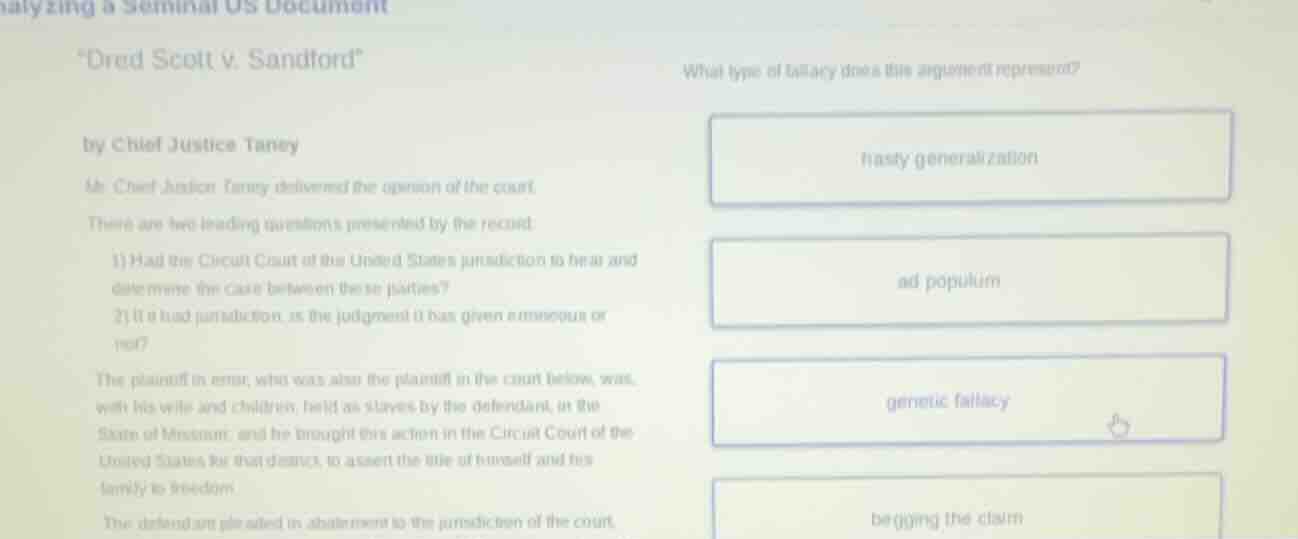
analyzing a seminal us document
\dred scott v. sandford\
by chief justice taney
mr. chief justice taney delivered the opinion of the court.
there are two leading questions presented by the record:
- had the circuit court of the united states jurisdiction to hear and determine the case between these parties?
- if it had jurisdiction, is the judgment it has given erroneous or not?
the plaintiff in error, who was also the plaintiff in the court below, was, with his wife and children, held as slaves by the defendant, in the state of missouri; and he brought this action in the circuit court of the united states for that district, to assert the title of himself and his family to freedom.
the defendant pleaded to the jurisdiction of the court.
what type of fallacy does this argument represent?
- hasty generalization
- ad populum
- genetic fallacy
- begging the claim
To identify the fallacy, we analyze the context of Dred Scott v. Sandford: Chief Justice Taney's argument centered on claiming Black people could not be US citizens by relying on the racist societal views and legal norms of the founding era, rather than evaluating the merits of citizenship based on current legal principles or individual rights. This is a genetic fallacy, as it judges the validity of a claim (Black citizenship) based on its origin (historical attitudes) instead of the claim itself.

Snap & solve any problem in the app
Get step-by-step solutions on Sovi AI
Photo-based solutions with guided steps
Explore more problems and detailed explanations
genetic fallacy