QUESTION IMAGE
Question
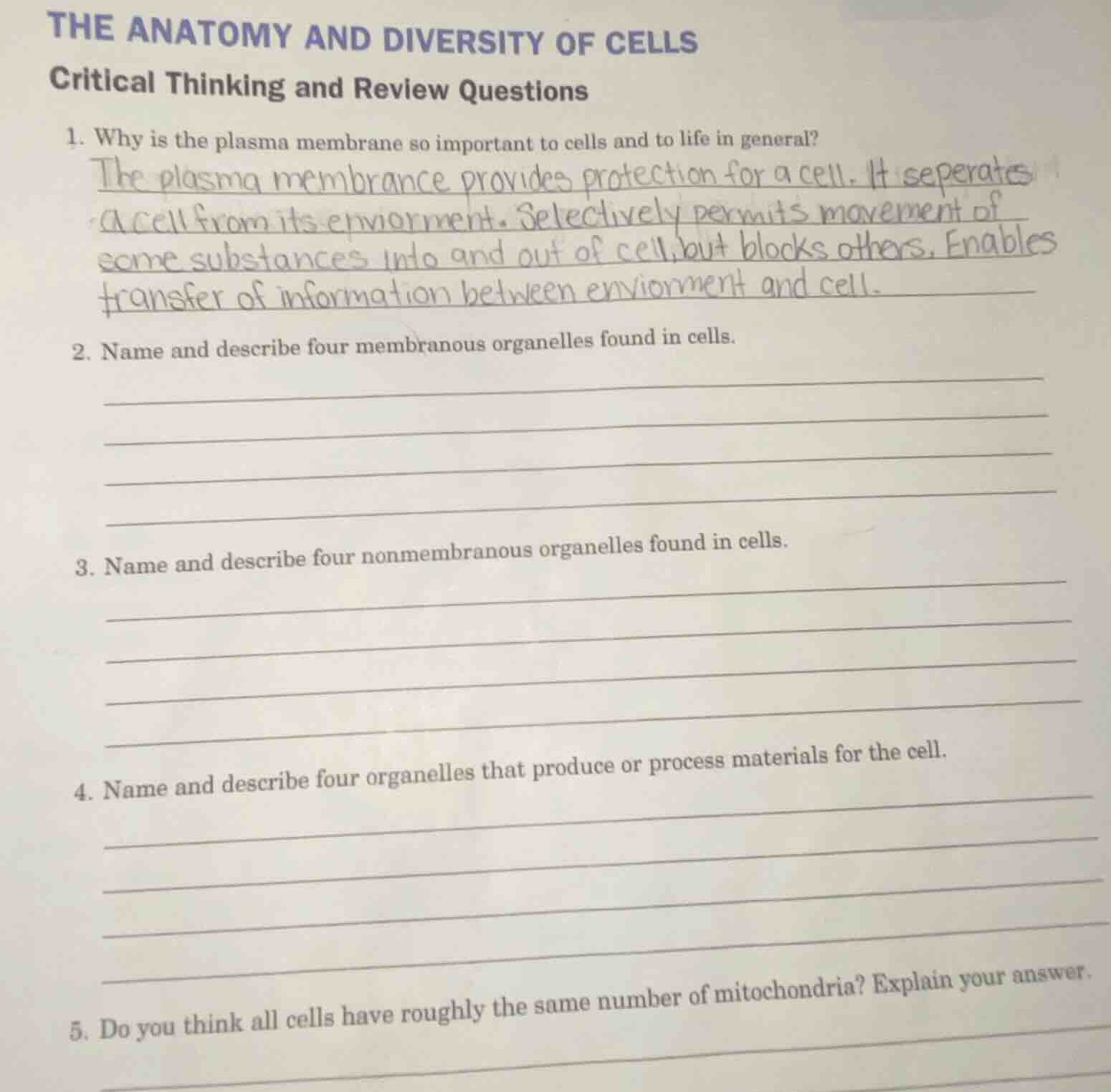
the anatomy and diversity of cells
critical thinking and review questions
- why is the plasma membrane so important to cells and to life in general?
the plasma membrance provides protection for a cell. it seperates a cell from its enviorment. selectively permits movement of some substances into and out of cell,but blocks others. enables transfer of information between enviorment and cell.
- name and describe four membranous organelles found in cells.
- name and describe four nonmembranous organelles found in cells.
- name and describe four organelles that produce or process materials for the cell.
- do you think all cells have roughly the same number of mitochondria? explain your answer.
Brief Explanations
- Identifies four membrane-bound organelles and their core functions.
- Identifies four non-membrane-bound organelles and their core functions.
- Identifies four organelles involved in producing/processing cellular materials and their roles.
- Explains mitochondrial count variation based on cellular energy needs.

Snap & solve any problem in the app
Get step-by-step solutions on Sovi AI
Photo-based solutions with guided steps
Explore more problems and detailed explanations
2.
- Mitochondria: Double-membraned organelle that generates ATP (cellular energy) via cellular respiration; the inner membrane is folded into cristae to increase surface area for energy production.
- Endoplasmic Reticulum (ER):
- Rough ER: Studded with ribosomes, it synthesizes and modifies proteins for secretion or membrane integration.
- Smooth ER: Lacks ribosomes, it synthesizes lipids, detoxifies harmful substances, and stores calcium ions.
- Golgi Apparatus: Stack of flattened membrane sacs that modifies, sorts, packages, and transports proteins and lipids from the ER to their final destinations (e.g., cell membrane, lysosomes, extracellular space).
- Lysosomes: Membrane-bound vesicles containing digestive enzymes that break down worn-out cell components, foreign particles, and waste materials for recycling or removal.
3.
- Ribosomes: Composed of RNA and proteins, they are the site of protein synthesis; they can be free-floating in the cytoplasm or attached to the rough ER.
- Cytoskeleton: A network of protein filaments (microtubules, microfilaments, intermediate filaments) that provides cell shape, enables cell movement, and facilitates intracellular transport of organelles and materials.
- Centrioles: Paired cylindrical structures made of microtubules that organize the spindle apparatus during cell division (in animal cells) and help form cilia/flagella.
- Nucleolus: A dense, non-membrane-bound structure within the nucleus that synthesizes ribosomal RNA (rRNA) and assembles ribosomal subunits.
4.
- Ribosomes: Synthesize proteins from mRNA templates, which are critical for cellular structure, function, and signaling.
- Rough Endoplasmic Reticulum: Synthesizes and modifies proteins, then packages them into vesicles for transport to the Golgi apparatus.
- Golgi Apparatus: Processes, sorts, and packages proteins and lipids into vesicles for delivery to specific cellular locations or secretion outside the cell.
- Mitochondria: Produces ATP, the primary energy currency that powers all cellular processes including the production and processing of materials.
- No, all cells do not have roughly the same number of mitochondria. The number of mitochondria in a cell is directly tied to the cell's energy demand. For example, muscle cells (especially cardiac muscle) and sperm cells require large amounts of energy for contraction and movement, so they contain hundreds to thousands of mitochondria. In contrast, cells with low energy needs, such as red blood cells (which lack mitochondria entirely) or skin cells, have far fewer mitochondria. Mitochondrial count can also change in response to a cell's changing energy requirements (e.g., muscle cells may produce more mitochondria with regular exercise).