QUESTION IMAGE
Question
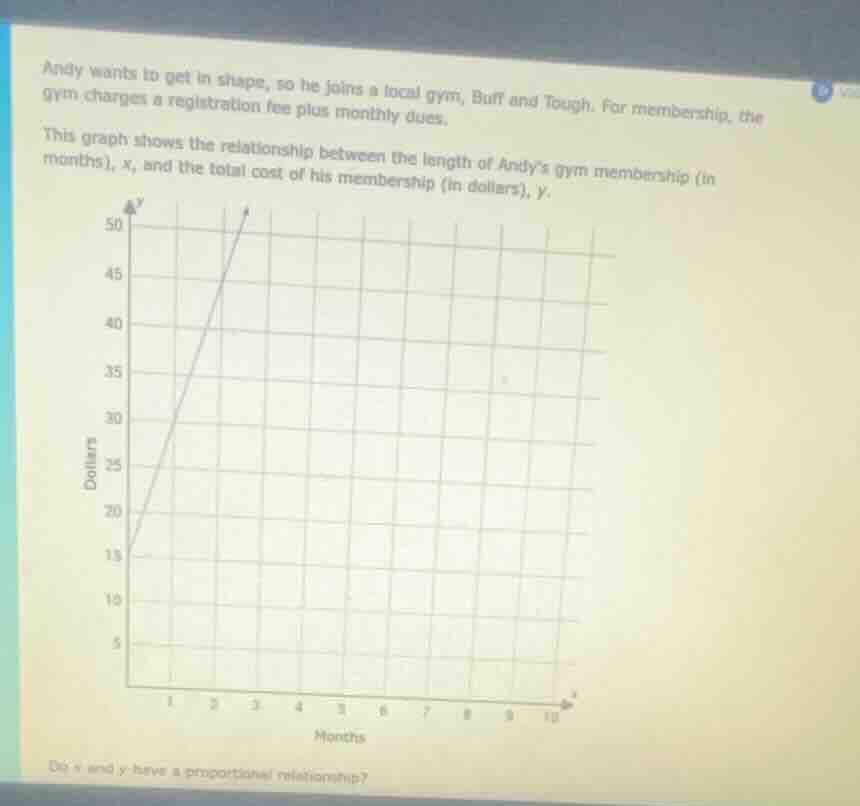
andy wants to get in shape, so he joins a local gym, buff and tough. for membership, the gym charges a registration fee plus monthly dues. this graph shows the relationship between the length of andys gym membership (in months), x, and the total cost of his membership (in dollars), y. do x and y have a proportional relationship?
Step1: Recall proportional relationship
A proportional relationship between two variables \( x \) and \( y \) is of the form \( y = kx \), where \( k \) is a constant (the constant of proportionality), and the graph of such a relationship passes through the origin \((0,0)\).
Step2: Analyze the given graph
Looking at the graph, when \( x = 0 \) (0 months of membership), the total cost \( y \) is 15 dollars (the registration fee). In a proportional relationship, when \( x = 0 \), \( y \) should be 0 (since \( y=kx \) implies \( y = 0 \) when \( x = 0 \)). Since the graph does not pass through the origin (it starts at \((0,15)\) instead of \((0,0)\)), \( x \) and \( y \) do not have a proportional relationship.

Snap & solve any problem in the app
Get step-by-step solutions on Sovi AI
Photo-based solutions with guided steps
Explore more problems and detailed explanations
No, \( x \) and \( y \) do not have a proportional relationship because the graph of their relationship does not pass through the origin \((0,0)\) (it has a \( y \)-intercept of 15, indicating a non - proportional linear relationship \( y=mx + b\) with \( b
eq0\)).