QUESTION IMAGE
Question
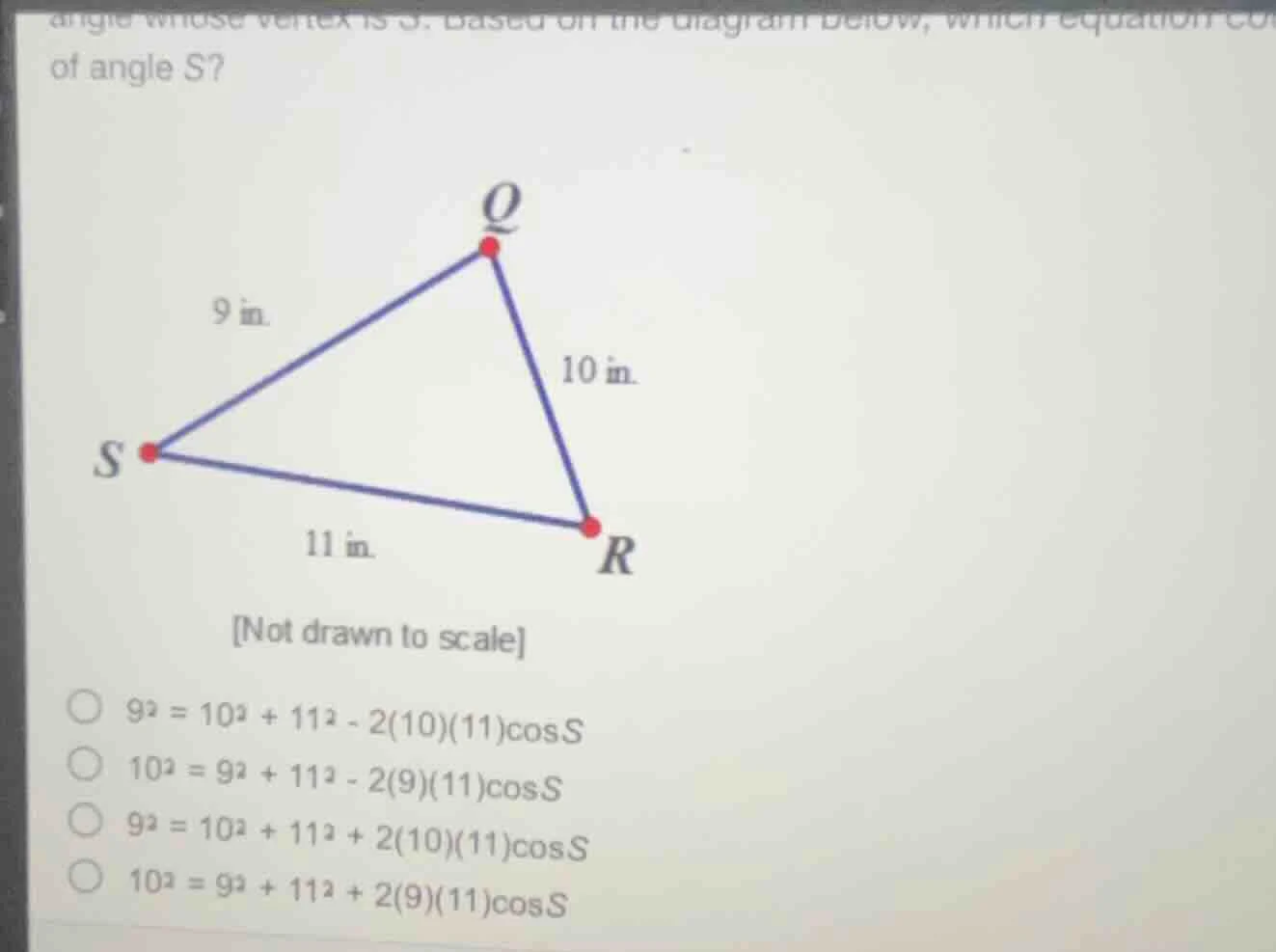
angle whose vertex is s. based on the diagram below, which equation of angle s?
diagram of triangle sqr with sq = 9 in, qr = 10 in, sr = 11 in, labeled with points s, q, r; not drawn to scale
options:
- $9^2 = 10^2 + 11^2 - 2(10)(11)\cos s$
- $10^2 = 9^2 + 11^2 - 2(9)(11)\cos s$
- $9^2 = 10^2 + 11^2 + 2(10)(11)\cos s$
- $10^2 = 9^2 + 11^2 + 2(9)(11)\cos s$
Step1: Recall the Law of Cosines
The Law of Cosines states that for a triangle with sides \(a\), \(b\), \(c\) and the angle \(C\) opposite side \(c\), the formula is \(c^{2}=a^{2}+b^{2}-2ab\cos C\).
Step2: Identify the sides and angle in triangle \(SQR\) (or \(S R Q\))
In triangle \(SQR\) (with vertices \(S\), \(Q\), \(R\)), we want to find the equation related to angle \(S\). The side opposite angle \(S\) is \(QR\), which has length \(10\) in? Wait, no, wait. Wait, the sides: \(SQ = 9\) in, \(SR=11\) in, and \(QR = 10\) in. Wait, angle \(S\) is at vertex \(S\), so the sides adjacent to angle \(S\) are \(SQ = 9\) and \(SR = 11\), and the side opposite angle \(S\) is \(QR=10\)? Wait, no, wait the labels: \(S\), \(Q\), \(R\). So \(SQ = 9\), \(SR = 11\), \(QR = 10\). So angle at \(S\): the two sides forming angle \(S\) are \(SQ\) (length \(9\)) and \(SR\) (length \(11\)), and the side opposite angle \(S\) is \(QR\) (length \(10\)). Wait, no, wait the Law of Cosines: if we have angle \(S\), then the side opposite angle \(S\) is \(QR\), so let's denote:
- Let \(a = SQ = 9\), \(b = SR = 11\), \(c = QR = 10\)
- Then by Law of Cosines, \(c^{2}=a^{2}+b^{2}-2ab\cos S\)
- Substituting the values: \(10^{2}=9^{2}+11^{2}-2(9)(11)\cos S\)
Wait, wait, maybe I mixed up. Wait, the options: let's check the options. The first option: \(9^{2}=10^{2}+11^{2}-2(10)(11)\cos S\) – no. Wait, maybe I got the sides wrong. Wait, the triangle: \(S\) to \(Q\) is \(9\) in, \(Q\) to \(R\) is \(10\) in, \(S\) to \(R\) is \(11\) in. So angle at \(S\): the sides around angle \(S\) are \(SQ = 9\) and \(SR = 11\), and the side opposite angle \(S\) is \(QR = 10\). Wait, no, the Law of Cosines formula is \(c^{2}=a^{2}+b^{2}-2ab\cos C\), where \(C\) is the angle between sides \(a\) and \(b\), and \(c\) is the side opposite angle \(C\). So if angle \(S\) is between \(SQ\) (length \(9\)) and \(SR\) (length \(11\)), then the side opposite angle \(S\) is \(QR\) (length \(10\)). So the formula should be \(QR^{2}=SQ^{2}+SR^{2}-2(SQ)(SR)\cos S\). So \(10^{2}=9^{2}+11^{2}-2(9)(11)\cos S\), which is the second option: \(10^{2}=9^{2}+11^{2}-2(9)(11)\cos S\). Wait, let's check the options:
Option 1: \(9^{2}=10^{2}+11^{2}-2(10)(11)\cos S\)
Option 2: \(10^{2}=9^{2}+11^{2}-2(9)(11)\cos S\)
Yes, so the correct formula is \(10^{2}=9^{2}+11^{2}-2(9)(11)\cos S\), which is the second option.

Snap & solve any problem in the app
Get step-by-step solutions on Sovi AI
Photo-based solutions with guided steps
Explore more problems and detailed explanations
\(10^{2}=9^{2}+11^{2}-2(9)(11)\cos S\) (corresponding to the option: \(10^2 = 9^2 + 11^2 - 2(9)(11)\cos S\))