QUESTION IMAGE
Question
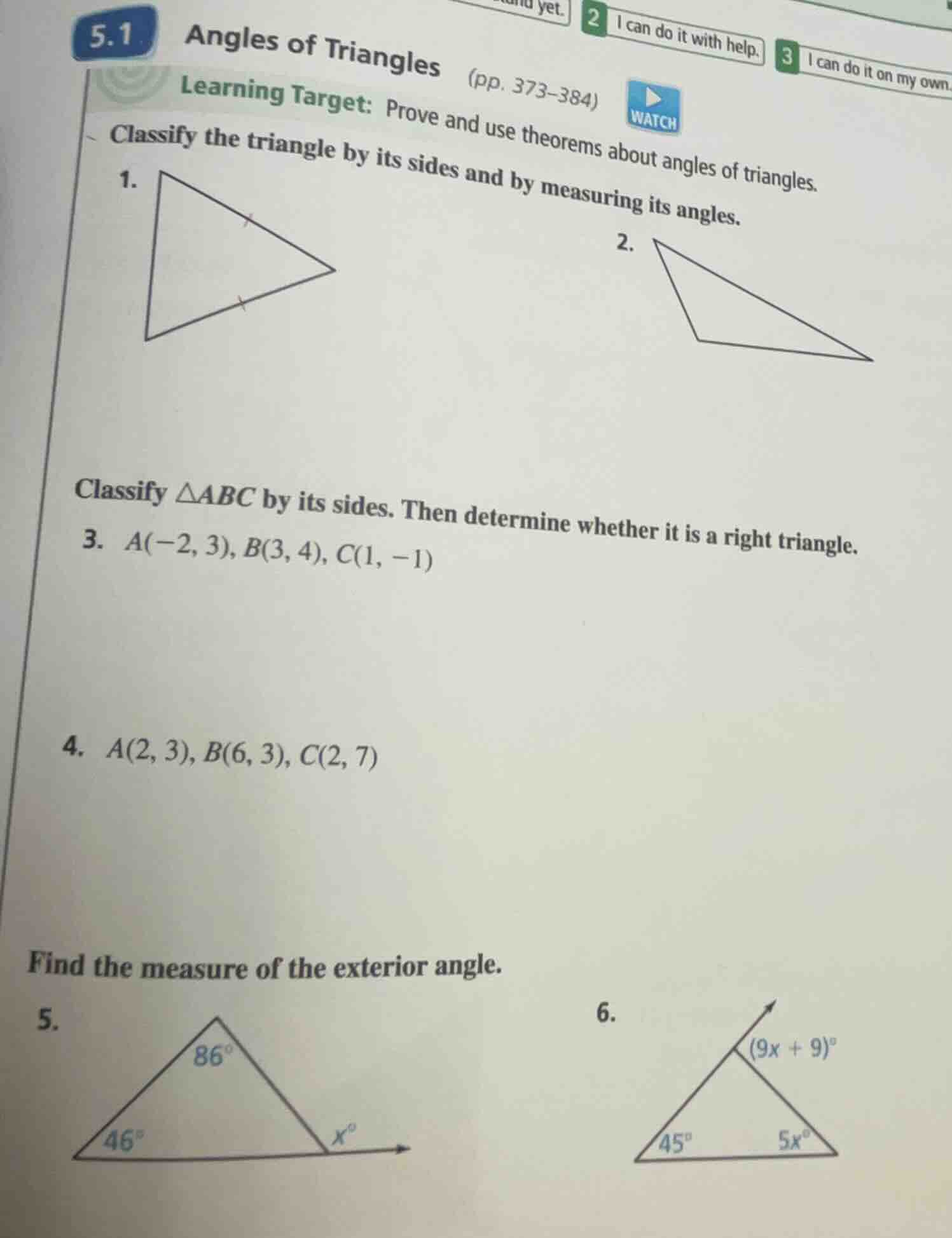
5.1 angles of triangles (pp. 373-384) learning target: prove and use theorems about angles of triangles. classify the triangle by its sides and by measuring its angles. 1. triangle with two marked sides 2. triangle classify △abc by its sides. then determine whether it is a right triangle. 3. a(-2, 3), b(3, 4), c(1, -1) 4. a(2, 3), b(6, 3), c(2, 7) find the measure of the exterior angle. 5. triangle with angles 86° and 46°, exterior angle x° 6. triangle with angles 45° and 5x°, exterior angle (9x + 9)°
Let's solve each problem one by one.
Problem 1: Classify the triangle by its sides and angles (first triangle with two marked sides)
Step 1: Classify by sides
The triangle has two sides marked as equal (the tick marks), so by sides, it is an isosceles triangle.
Step 2: Classify by angles
Since it's isosceles, the base angles are equal. Assuming the unmarked side is the base, the angles opposite the equal sides are equal. If we measure (visually, it looks acute), so it's an acute isosceles triangle.
Step 1: By angles
The triangle has one angle greater than 90° (the obtuse angle), so it's an obtuse triangle.
Step 2: By sides
Visually, all sides seem different, so it's a scalene triangle (since no sides are marked equal). So it's an obtuse scalene triangle.
Step 1: Find side lengths using distance formula \( d = \sqrt{(x_2 - x_1)^2 + (y_2 - y_1)^2} \)
- \( AB \): \( \sqrt{(3 - (-2))^2 + (4 - 3)^2} = \sqrt{5^2 + 1^2} = \sqrt{25 + 1} = \sqrt{26} \)
- \( BC \): \( \sqrt{(1 - 3)^2 + (-1 - 4)^2} = \sqrt{(-2)^2 + (-5)^2} = \sqrt{4 + 25} = \sqrt{29} \)
- \( AC \): \( \sqrt{(1 - (-2))^2 + (-1 - 3)^2} = \sqrt{3^2 + (-4)^2} = \sqrt{9 + 16} = \sqrt{25} = 5 \)
Since all sides \( \sqrt{26} \), \( \sqrt{29} \), \( 5 \) are different, it's scalene by sides.
Step 2: Check if right triangle (use Pythagorean theorem: \( a^2 + b^2 = c^2 \) for right angle)
Check \( AB^2 + AC^2 \): \( 26 + 25 = 51
eq 29 = BC^2 \)
Check \( AB^2 + BC^2 \): \( 26 + 29 = 55
eq 25 = AC^2 \)
Check \( AC^2 + BC^2 \): \( 25 + 29 = 54
eq 26 = AB^2 \)
So not a right triangle.

Snap & solve any problem in the app
Get step-by-step solutions on Sovi AI
Photo-based solutions with guided steps
Explore more problems and detailed explanations
By sides: Isosceles triangle; By angles: Acute isosceles triangle