QUESTION IMAGE
Question
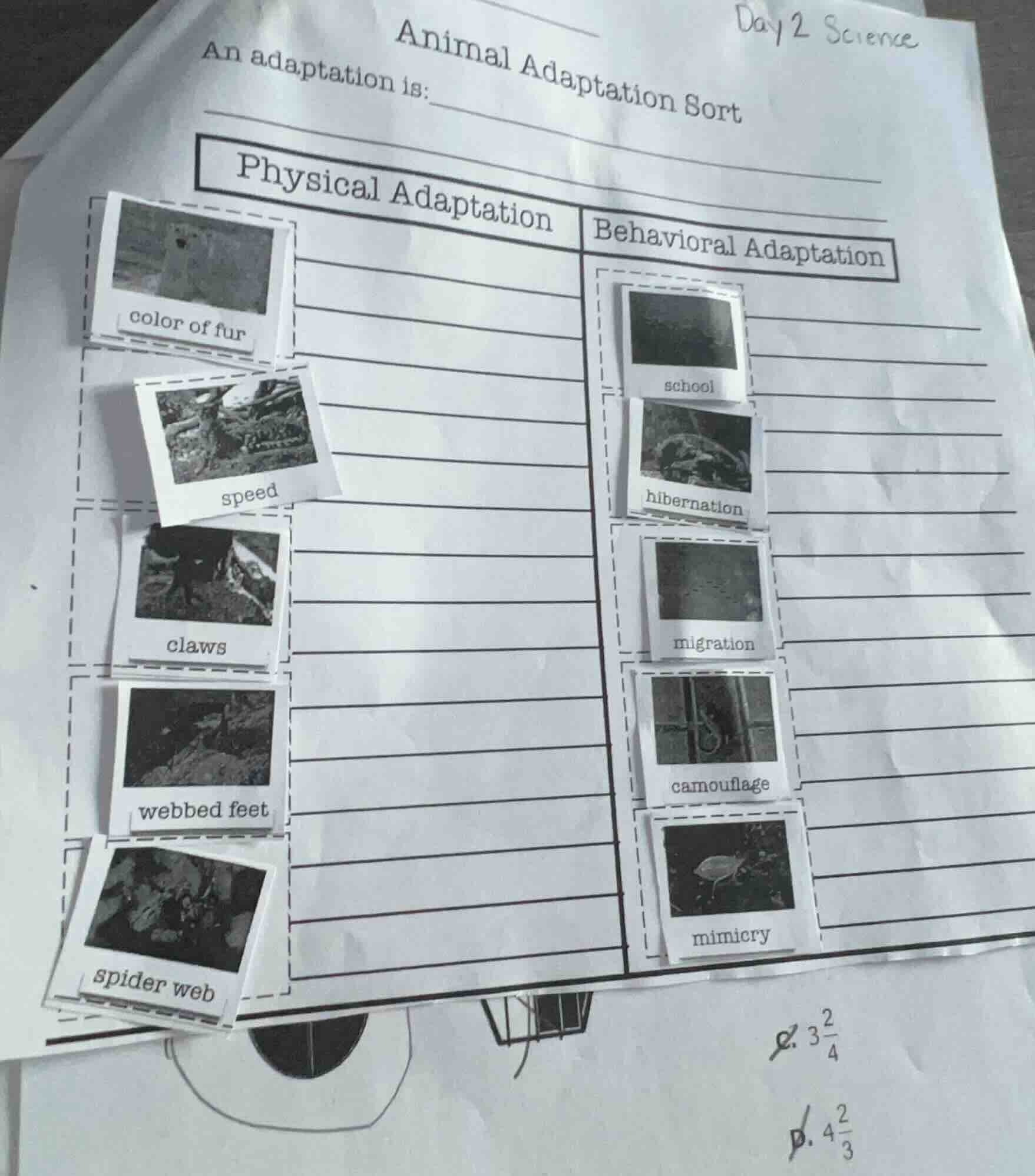
animal adaptation sort
an adaptation is:
physical adaptation \t behavioral adaptation
color of fur \t school
speed \t hibernation
claws \t migration
webbed feet \t camouflage
spider web \t mimicry
To solve the task of sorting animal adaptations into physical and behavioral, we first recall the definitions:
- Physical Adaptation: Structural or physical traits of an organism (body parts, color, shape, etc.).
- Behavioral Adaptation: Actions or behaviors an organism does (instincts, social behaviors, survival actions).
Step 1: Identify Physical Adaptations
These are traits related to the organism’s body:
- Color of fur (body color)
- Speed (relates to body structure/physiology for movement)
- Claws (body part)
- Webbed feet (body part)
- Spider web (product of a physical body structure, made by the spider)
- Camouflage (body color/pattern)
- Mimicry (body color/pattern to resemble others)
Step 2: Identify Behavioral Adaptations
These are actions the organism performs:
- School (social behavior, moving in groups)
- Hibernation (behavior to survive cold/seasons)
- Migration (behavior to move for survival)
Correct Sorting:
| Physical Adaptation | Behavioral Adaptation |
|---|---|
| speed | hibernation |
| claws | migration |
| webbed feet | (no others here) |
| spider web | |
| camouflage | |
| mimicry |
(Note: Some items like “camouflage” and “mimicry” can be confusing, but they are physical (body color/pattern) unless referring to a behavioral mimicry (rare). Here, they are physical. “Spider web” is a physical structure made by the spider’s body.)

Snap & solve any problem in the app
Get step-by-step solutions on Sovi AI
Photo-based solutions with guided steps
Explore more problems and detailed explanations
To solve the task of sorting animal adaptations into physical and behavioral, we first recall the definitions:
- Physical Adaptation: Structural or physical traits of an organism (body parts, color, shape, etc.).
- Behavioral Adaptation: Actions or behaviors an organism does (instincts, social behaviors, survival actions).
Step 1: Identify Physical Adaptations
These are traits related to the organism’s body:
- Color of fur (body color)
- Speed (relates to body structure/physiology for movement)
- Claws (body part)
- Webbed feet (body part)
- Spider web (product of a physical body structure, made by the spider)
- Camouflage (body color/pattern)
- Mimicry (body color/pattern to resemble others)
Step 2: Identify Behavioral Adaptations
These are actions the organism performs:
- School (social behavior, moving in groups)
- Hibernation (behavior to survive cold/seasons)
- Migration (behavior to move for survival)
Correct Sorting:
| Physical Adaptation | Behavioral Adaptation |
|---|---|
| speed | hibernation |
| claws | migration |
| webbed feet | (no others here) |
| spider web | |
| camouflage | |
| mimicry |
(Note: Some items like “camouflage” and “mimicry” can be confusing, but they are physical (body color/pattern) unless referring to a behavioral mimicry (rare). Here, they are physical. “Spider web” is a physical structure made by the spider’s body.)