QUESTION IMAGE
Question
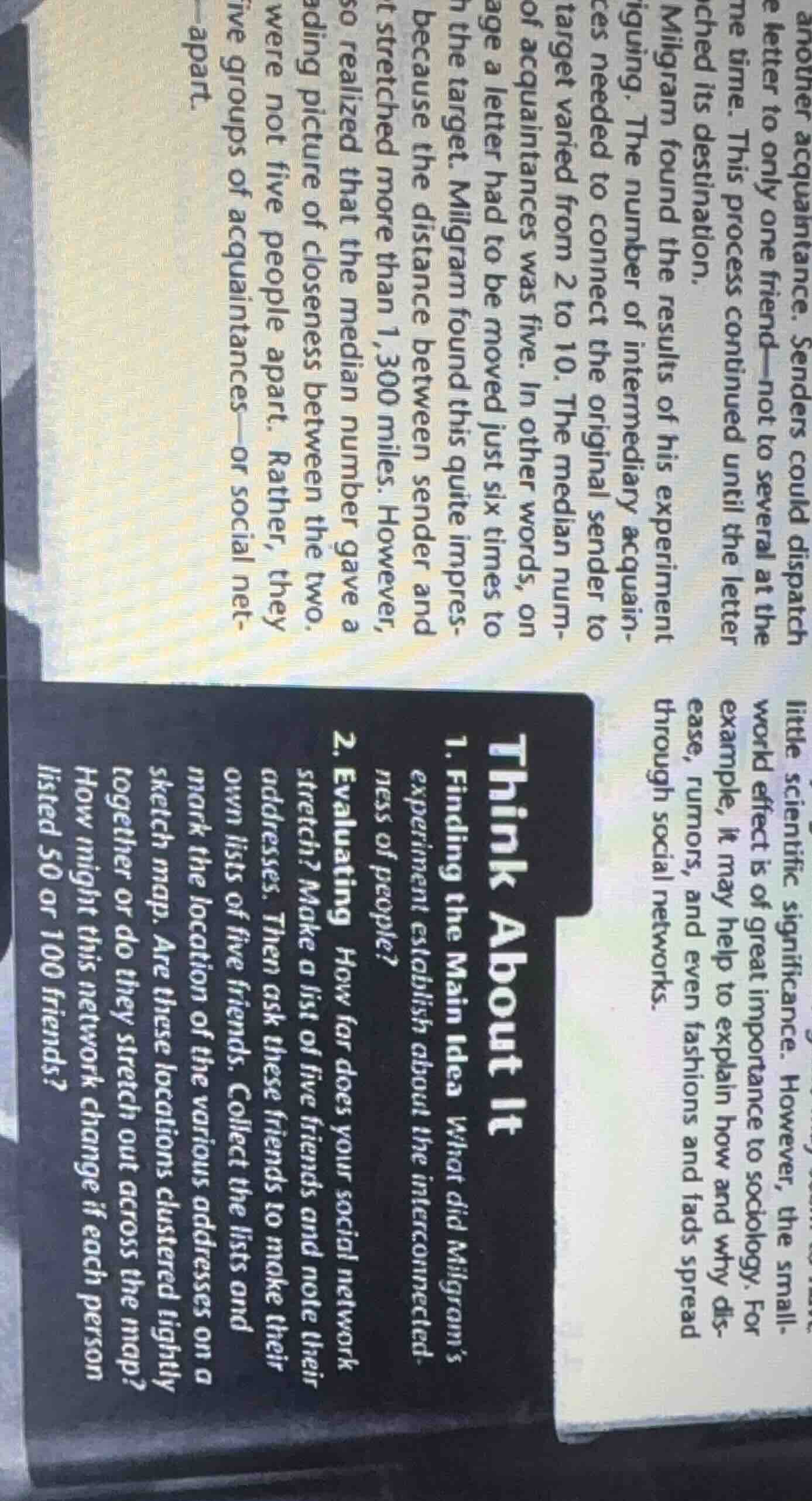
another acquaintance. senders could dispatch e letter to only one friend—not to several at the me time. this process continued until the letter tched its destination. milgram found the results of his experiment iguing. the number of intermediary acquain- ces needed to connect the original sender to target varied from 2 to 10. the median num- of acquaintances was five. in other words, on age a letter had to be moved just six times to n the target. milgram found this quite impres- because the distance between sender and t stretched more than 1,300 miles. however, so realized that the median number gave a ading picture of closeness between the two. were not five people apart. rather, they five groups of acquaintances—or social net- —apart. little scientific significance. however, the small- world effect is of great importance to sociology. for example, it may help to explain how and why dis- ease, rumors, and even fashions and fads spread through social networks. think about it 1. finding the main idea what did milgram’s experiment establish about the interconnected- ness of people? 2. evaluating how far does your social network stretch? make a list of five friends and note their addresses. then ask these friends to make their own lists of five friends. collect the lists and mark the location of the various addresses on a sketch map. are these locations clustered tightly together or do they stretch out across the map? how might this network change if each person listed 50 or 100 friends?
1. Finding the Main Idea
Milgram's experiment studied how letters were passed through acquaintances (social networks) to a target. It found the median number of intermediaries (acquaintances) to connect sender and target was around 5, and the distance between them was over 1,300 miles, showing social network connectivity.
- List Friends & Addresses: First, list 5 friends and their addresses. Then, for each friend, get their 5 - friend lists.
- Collect & Mark Locations: Gather all these addresses and mark them on a sketch map. Observe if locations cluster (e.g., same city/region) or are spread out (different cities/countries).
- Analyze Stretch: If each person has 50 - 100 friends, the network grows exponentially (each friend has 50 - 100, so 550 = 250, 5100 = 500 at next level, etc.). This would likely increase the geographic stretch, as more friends mean more diverse locations, spreading the network further (e.g., friends of friends may live in different states/countries). Clustering might occur in areas with shared social circles (e.g., same school/workplace), but with more friends, the spread (stretch) should increase due to broader connections.

Snap & solve any problem in the app
Get step-by-step solutions on Sovi AI
Photo-based solutions with guided steps
Explore more problems and detailed explanations
Milgram’s experiment explored how a letter traveled through social networks (acquaintances) to a target, finding a median of ~5 intermediaries and large geographic spread, highlighting social network interconnection.