QUESTION IMAGE
Question
another feature of sexual reproduction that increases genetic variation is that one individual produces a variety of gametes with different combinations of alleles. gametes are produced when specialized diploid cells, called germ cells, divide during a process called meiosis.
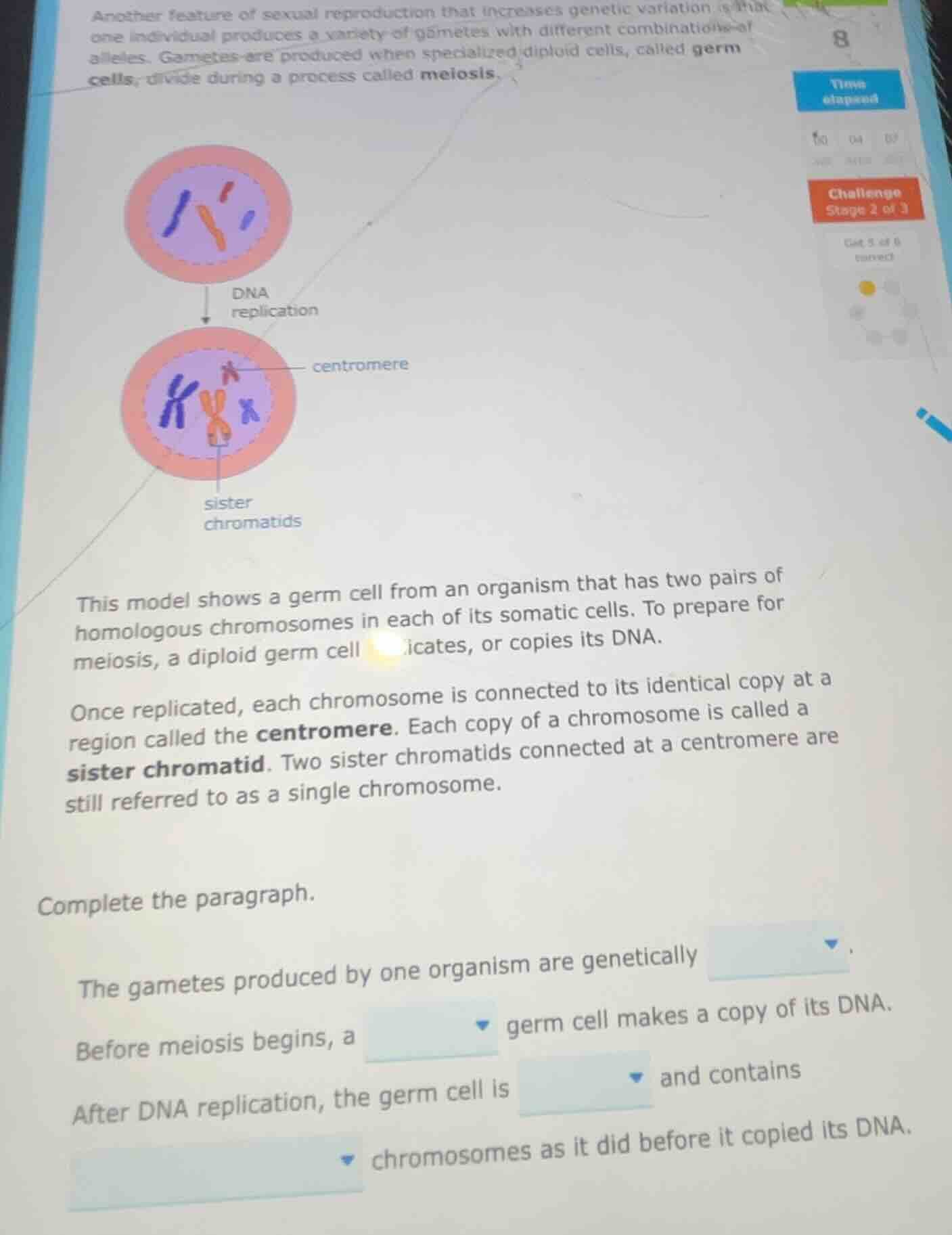
this model shows a germ cell from an organism that has two pairs of homologous chromosomes in each of its somatic cells. to prepare for meiosis, a diploid germ cell replicates, or copies its dna.
once replicated, each chromosome is connected to its identical copy at a region called the centromere. each copy of a chromosome is called a sister chromatid. two sister chromatids connected at a centromere are still referred to as a single chromosome.
complete the paragraph.
the gametes produced by one organism are genetically dropdown.
before meiosis begins, a dropdown germ cell makes a copy of its dna.
after dna replication, the germ cell is dropdown and contains dropdown chromosomes as it did before it copied its dna.
- Sexual reproduction (via meiosis) creates gametes with unique allele combinations, so they are genetically different.
- Germ cells start as diploid (matching somatic cell chromosome number) before meiosis.
- DNA replication duplicates chromatids but not chromosome count, so the cell remains diploid.
- Replication creates sister chromatids attached at centromeres; the total number of distinct chromosomes (counted by centromeres) stays the same as the pre-replication cell.

Snap & solve any problem in the app
Get step-by-step solutions on Sovi AI
Photo-based solutions with guided steps
Explore more problems and detailed explanations
- The gametes produced by one organism are genetically different
- Before meiosis begins, a diploid germ cell makes a copy of its DNA.
- After DNA replication, the germ cell is still diploid and contains
- the same number of chromosomes as it did before it copied its DNA.