QUESTION IMAGE
Question
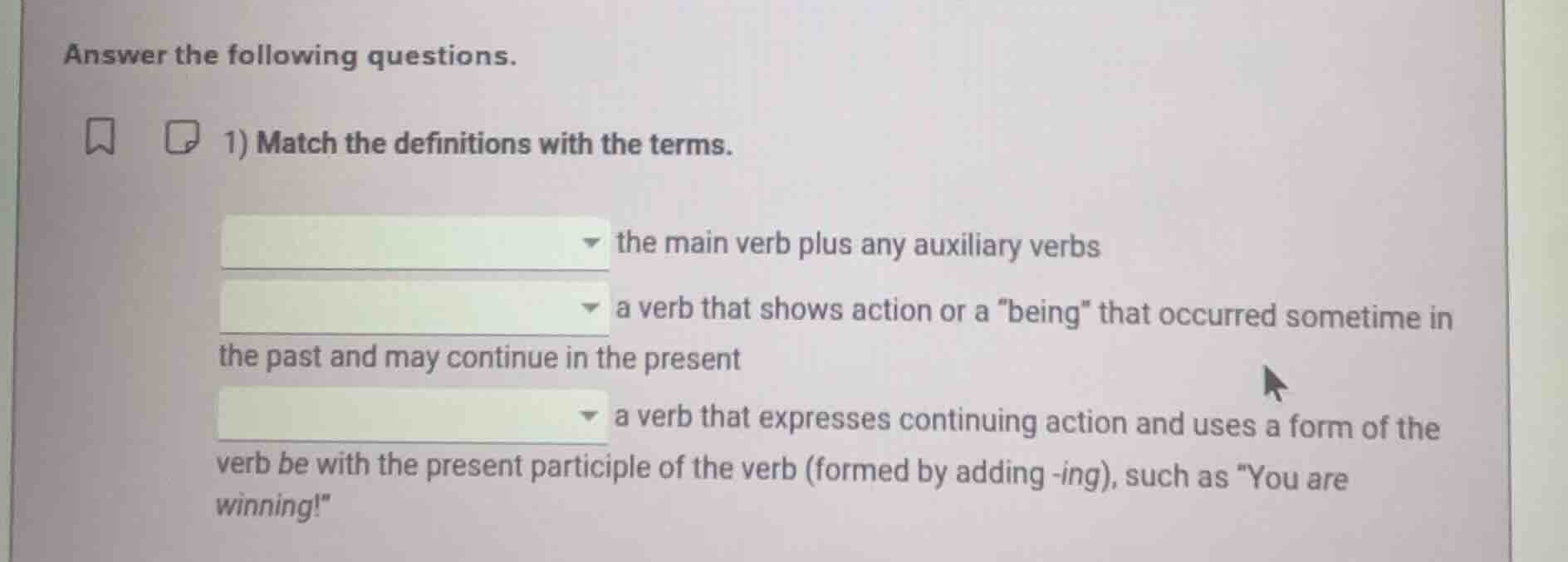
answer the following questions. 1) match the definitions with the terms. the main verb plus any auxiliary verbs a verb that shows action or a \being\ that occurred sometime in the past and may continue in the present a verb that expresses continuing action and uses a form of the verb be with the present participle of the verb (formed by adding -ing), such as \you are winning!\
To solve this, we match each definition to the correct grammatical term:
- "the main verb plus any auxiliary verbs" → This is the verb phrase. A verb phrase consists of the main verb and any helping (auxiliary) verbs, e.g., "have been working" (auxiliaries: have, been; main verb: working).
- "a verb that shows action or a 'being' that occurred sometime in the past and may continue in the present" → This is the present perfect tense (or more generally, a past - related verb form with present relevance, but the term here is likely "present perfect" or "past - present - relevant verb"; however, the standard term for a verb showing past action that may continue to present is the present perfect, e.g., "I have lived here for 5 years").
- "a verb that expresses continuing action and uses a form of the verb be with the present participle of the verb (formed by adding -ing), such as 'You are winning!'" → This is the present continuous tense (or "present progressive"). The structure is be (am/is/are) + present participle (-ing form), which shows an action in progress now.
If we assume the terms to match are (common verb - related terms for these definitions):
- First dropdown: Verb Phrase
- Second dropdown: Present Perfect (or a similar term for past - present action)
- Third dropdown: Present Continuous (or Present Progressive)
(Note: If the dropdown options included these terms, the matches would be:
- "the main verb plus any auxiliary verbs" → Verb Phrase
- "a verb that shows action or a 'being' that occurred sometime in the past and may continue in the present" → Present Perfect (or a term like "past - present verb")
- "a verb that expresses continuing action... 'You are winning!'" → Present Continuous (Present Progressive))

Snap & solve any problem in the app
Get step-by-step solutions on Sovi AI
Photo-based solutions with guided steps
Explore more problems and detailed explanations
To solve this, we match each definition to the correct grammatical term:
- "the main verb plus any auxiliary verbs" → This is the verb phrase. A verb phrase consists of the main verb and any helping (auxiliary) verbs, e.g., "have been working" (auxiliaries: have, been; main verb: working).
- "a verb that shows action or a 'being' that occurred sometime in the past and may continue in the present" → This is the present perfect tense (or more generally, a past - related verb form with present relevance, but the term here is likely "present perfect" or "past - present - relevant verb"; however, the standard term for a verb showing past action that may continue to present is the present perfect, e.g., "I have lived here for 5 years").
- "a verb that expresses continuing action and uses a form of the verb be with the present participle of the verb (formed by adding -ing), such as 'You are winning!'" → This is the present continuous tense (or "present progressive"). The structure is be (am/is/are) + present participle (-ing form), which shows an action in progress now.
If we assume the terms to match are (common verb - related terms for these definitions):
- First dropdown: Verb Phrase
- Second dropdown: Present Perfect (or a similar term for past - present action)
- Third dropdown: Present Continuous (or Present Progressive)
(Note: If the dropdown options included these terms, the matches would be:
- "the main verb plus any auxiliary verbs" → Verb Phrase
- "a verb that shows action or a 'being' that occurred sometime in the past and may continue in the present" → Present Perfect (or a term like "past - present verb")
- "a verb that expresses continuing action... 'You are winning!'" → Present Continuous (Present Progressive))