QUESTION IMAGE
Question
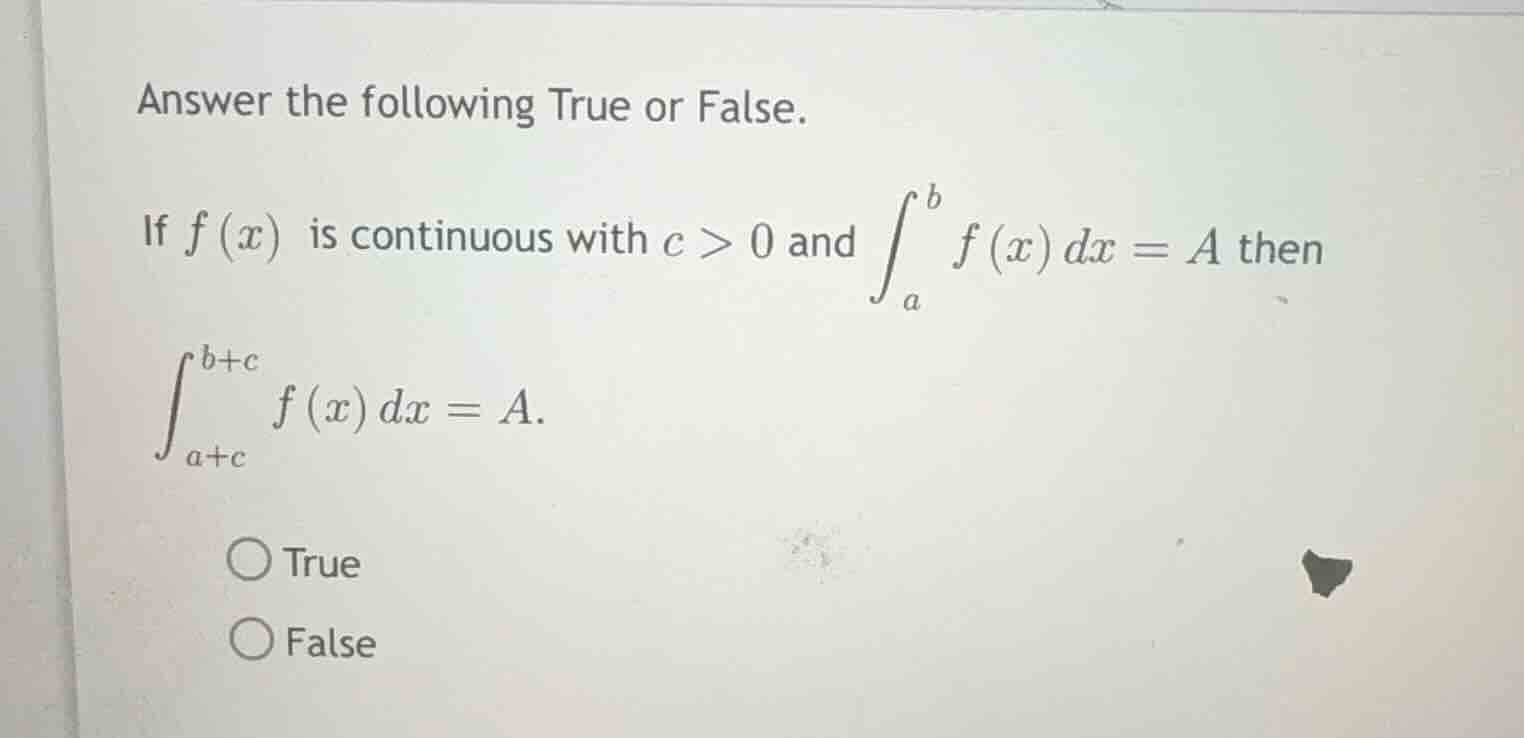
answer the following true or false. if $f(x)$ is continuous with $c > 0$ and $int_{a}^{b} f(x) dx = a$ then $int_{a + c}^{b + c} f(x) dx = a$. \bigcirc true \bigcirc false
Step1: Use substitution for the integral
Let $u = x - c$, so $x = u + c$ and $du = dx$. When $x = a+c$, $u = a$; when $x = b+c$, $u = b$.
Step2: Rewrite the integral with substitution
$$\int_{a+c}^{b+c} f(x) dx = \int_{a}^{b} f(u + c) du$$
Step3: Compare to original integral
The original integral is $\int_{a}^{b} f(x) dx = A$. For $\int_{a}^{b} f(u + c) du$ to equal $A$, $f(u + c) = f(u)$ (i.e., $f$ is periodic with period $c$), which is not stated. A counterexample: let $f(x)=x$, $a=0$, $b=1$, $c=1$. $\int_{0}^{1}x dx=\frac{1}{2}$, but $\int_{1}^{2}x dx=\frac{3}{2}
eq\frac{1}{2}$.

Snap & solve any problem in the app
Get step-by-step solutions on Sovi AI
Photo-based solutions with guided steps
Explore more problems and detailed explanations
False