QUESTION IMAGE
Question
- answer the questions below to help you write your case summary.
- use the scroll bar on the right to move down the page.
background
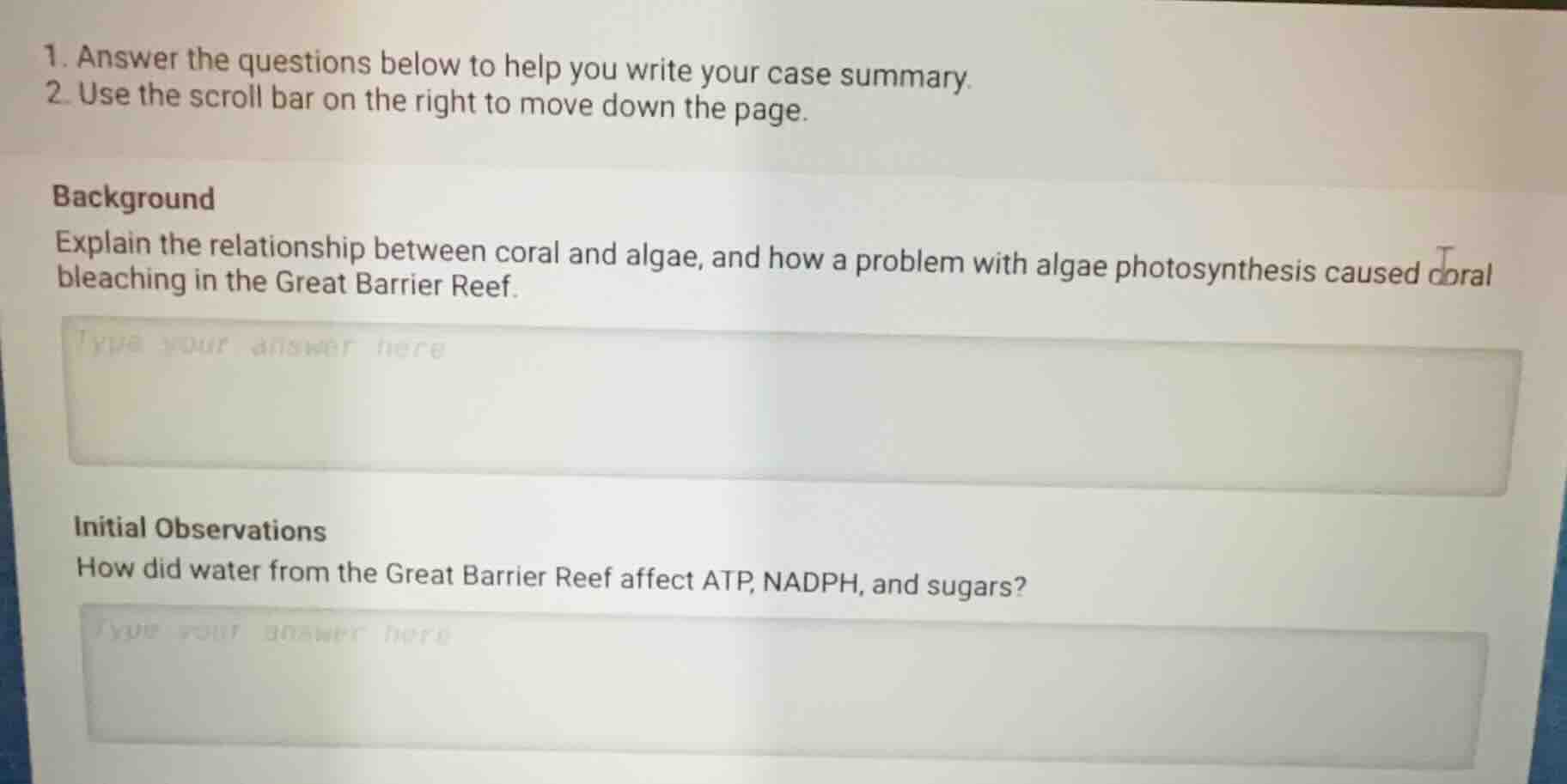
explain the relationship between coral and algae, and how a problem with algae photosynthesis caused coral bleaching in the great barrier reef.
initial observations
how did water from the great barrier reef affect atp, nadph, and sugars?
For Background:
Corals and algae have a mutualistic symbiosis: the coral provides a protected habitat and nutrients (like carbon dioxide) for the zooxanthellae (algae) living in its tissues. The algae use photosynthesis to produce sugars, oxygen, and other organic compounds that the coral uses for energy, growth, and calcification. When ocean temperatures rise (a key stressor for the Great Barrier Reef), the algae's photosynthetic machinery is damaged. This causes the algae to produce toxic reactive oxygen species. To protect itself, the coral expels the algae, losing the main source of its color and food, which results in coral bleaching.
For Initial Observations:
When Great Barrier Reef waters warm (the main stressor), the algae's photosystem II is impaired. This reduces the light-dependent reactions of photosynthesis, so less ATP and NADPH are produced. Since ATP and NADPH are required for the light-independent (Calvin) cycle to synthesize sugars, the production of glucose and other organic sugars drops sharply. Without these sugars, the coral loses its primary energy source, worsening the bleaching crisis.

Snap & solve any problem in the app
Get step-by-step solutions on Sovi AI
Photo-based solutions with guided steps
Explore more problems and detailed explanations
- Background: Corals and zooxanthellae (algae) have a mutualistic relationship: corals provide shelter and nutrients for algae, while algae produce food (via photosynthesis) and give corals their color. In the Great Barrier Reef, elevated ocean temperatures damage the algae's photosynthetic machinery, leading to toxic byproducts. Corals expel the algae, causing bleaching (loss of color and food source).
- Initial Observations: Warmed reef water impairs algae photosynthesis:
- ATP: Production decreases due to damaged light-dependent reactions.
- NADPH: Production drops alongside ATP, as it is also a product of light-dependent photosynthetic reactions.
- Sugars: Synthesis is drastically reduced because ATP and NADPH (required for the Calvin cycle to make sugars) are no longer available in sufficient quantities.