QUESTION IMAGE
Question
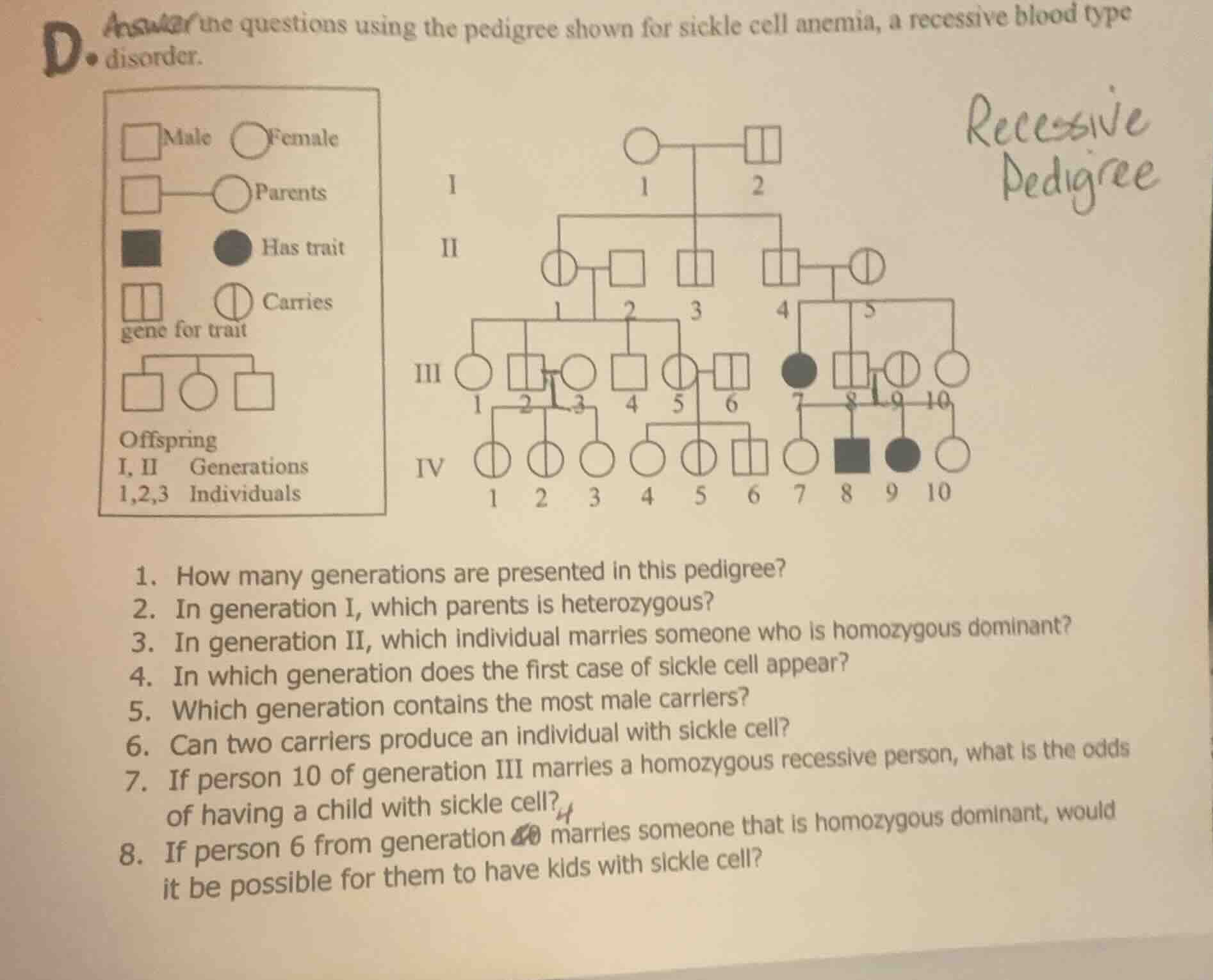
d. answer the questions using the pedigree shown for sickle cell anemia, a recessive blood type disorder.1. how many generations are presented in this pedigree?2. in generation i, which parents is heterozygous?3. in generation ii, which individual marries someone who is homozygous dominant?4. in which generation does the first case of sickle cell appear?5. which generation contains the most male carriers?6. can two carriers produce an individual with sickle cell?7. if person 10 of generation iii marries a homozygous recessive person, what is the odds of having a child with sickle cell?8. if person 6 from generation iii marries someone that is homozygous dominant, would it be possible for them to have kids with sickle cell?
Step1: Count labeled generations
Identify generations marked I, II, III, IV.
Step2: Identify heterozygous in Gen I
Heterozygous = carrier; check Gen I symbols.
Step3: Find Gen II spouse of homozygous dom
Homozygous dominant = unshaded, non-carrier; match to Gen II partner.
Step4: Locate first sickle cell case
Look for filled symbols (has trait) in earliest gen.
Step5: Count male carriers per generation
Male carriers = square with inner lines; tally each gen.
Step6: Apply recessive inheritance rules
Two carriers (Aa) can pass a (recessive) allele each.
Step7: Genotype of III-10, cross with aa
III-10 is unshaded, non-carrier: AA. Cross with aa.
Step8: Genotype of III-6, cross with AA
III-6 is male carrier (Aa). Cross with AA.

Snap & solve any problem in the app
Get step-by-step solutions on Sovi AI
Photo-based solutions with guided steps
Explore more problems and detailed explanations
- 4
- Both Parent 1 (female) and Parent 2 (male)
- Individual 1 (female)
- Generation III
- Generation III
- Yes
- 0 (0% chance)
- No