QUESTION IMAGE
Question
answer the questions.
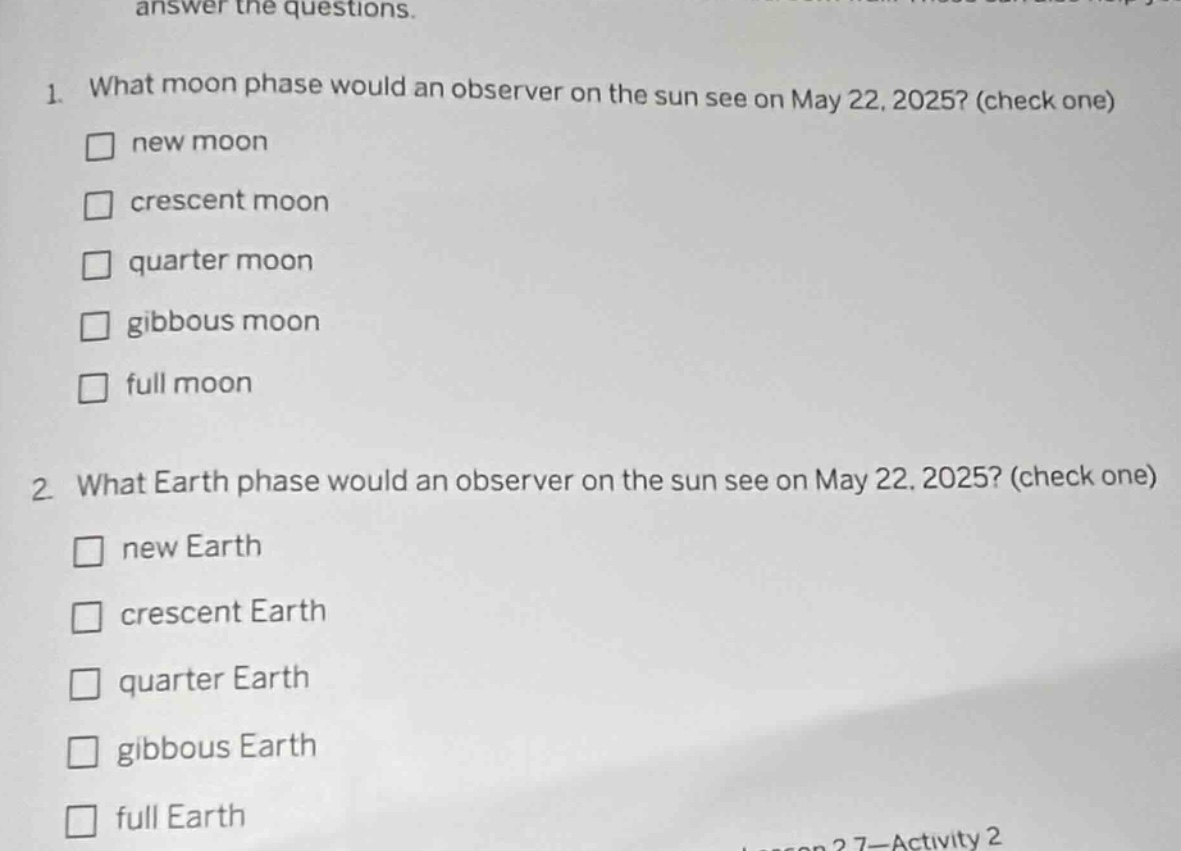
- what moon phase would an observer on the sun see on may 22, 2025? (check one)
□ new moon
□ crescent moon
□ quarter moon
□ gibbous moon
□ full moon
- what earth phase would an observer on the sun see on may 22, 2025? (check one)
□ new earth
□ crescent earth
□ quarter earth
□ gibbous earth
□ full earth
activity 2
Question 1
To determine the moon phase seen from the Sun, we use the relationship between Earth - Moon - Sun positions. When an observer on Earth sees a new moon, the Moon is between Earth and the Sun. From the Sun's perspective, the side of the Moon facing the Sun (the illuminated side) is mostly visible, but the Moon is close to the Sun's glare. However, the key is the phase relationship: the phase of the Moon as seen from the Sun is complementary to the phase seen from Earth in a sense, but more directly, when Earth sees a new moon (Moon between Earth and Sun), from the Sun, the Moon's illuminated side (the side we don't see during new moon on Earth) is facing the Sun, but the Moon is near the Sun. Wait, actually, the phase of the Moon as seen from the Sun: the full moon as seen from Earth means the Moon is opposite the Sun, so from the Sun, the Moon would be a new moon? No, wait, let's think again. The phase of the Moon is determined by the fraction of the Moon's illuminated side (by the Sun) that is visible from a vantage point. From the Sun, the Moon is always half - illuminated (the side facing the Sun). But the "phase" here is about how much of the Moon's disk is visible from the Sun, considering the Moon's position relative to Earth. Wait, no, the question is about the "moon phase" as seen from the Sun. Let's recall: the new moon on Earth is when the Moon is between Earth and Sun. So from the Sun, the Moon is behind Earth? No, new moon: Moon is between Earth and Sun. So from the Sun, the Moon is in front of Earth (from the Sun's perspective, Earth is behind the Moon? No, Sun --- Moon --- Earth for new moon on Earth. So from the Sun, the Moon is between the Sun and Earth, so the side of the Moon facing the Sun is fully illuminated (the side we can't see from Earth during new moon), but the Moon is near the Sun. But the options are about the phase. Wait, the correct approach: the phase of the Moon as seen from the Sun is such that when Earth sees a new moon, from the Sun, the Moon is a "full moon" in terms of the illuminated side visible? No, I think I got it wrong. Let's use the concept of mutual phases. The phase of the Moon as seen from the Sun is the complement of the phase seen from Earth in the sense that the phase angle (the angle between the Sun - Moon and Earth - Moon lines) determines the phase. For a new moon on Earth (Moon between Earth and Sun), the phase angle is 0 degrees. From the Sun, the Moon is at a phase angle of 180 degrees relative to Earth? No, maybe a better way: the full moon as seen from Earth occurs when the Moon is opposite the Sun (Earth between Sun and Moon). So from the Sun, the Moon is at a position where the Earth is between the Sun and the Moon. So from the Sun, the Moon's illuminated side (the side facing the Sun) is visible, but the Earth is in front of the Moon (from the Sun's view). Wait, I'm overcomplicating. Let's look at the options. The correct answer for the moon phase on May 22, 2025 (we can check the lunar calendar, but generally, the key is that the phase of the Moon as seen from the Sun: when Earth has a new moon, from the Sun, the Moon is a full moon? No, no. Wait, the phase of the Moon is the fraction of the Moon's disk that is illuminated as seen from a point. From the Sun, the Moon is always half - illuminated (the side facing the Sun). But the "phase" here is about the apparent shape. Wait, the question is likely based on the fact that the phase of the Moon as seen from the Sun is the opposite of the phase seen from Earth in terms of the "full" and "new" labels. Wait, no. Let's take an…
The moon phase as seen from the Sun: When the Moon is in a new moon phase as seen from Earth (between Earth and Sun), from the Sun, the Moon's illuminated side (facing the Sun) is mostly hidden behind the Sun's glare, but the phase is new moon (since the Moon is close to the Sun and the side facing Earth is dark, but from the Sun, the side facing the Sun is bright, but the Moon is near the Sun, so the apparent phase is new moon).
The Earth phase as seen from the Sun: When the Moon is in a new moon phase (between Earth and Sun), the Earth's illuminated side (facing the Sun) is fully visible from the Sun (since the Moon is between Earth and Sun, but the Earth's day side is facing the Sun), so the Earth appears as a full Earth from the Sun.

Snap & solve any problem in the app
Get step-by-step solutions on Sovi AI
Photo-based solutions with guided steps
Explore more problems and detailed explanations
\(\square\) new moon (checked)
\(\square\) crescent moon
\(\square\) quarter moon
\(\square\) gibbous moon
\(\square\) full moon