QUESTION IMAGE
Question
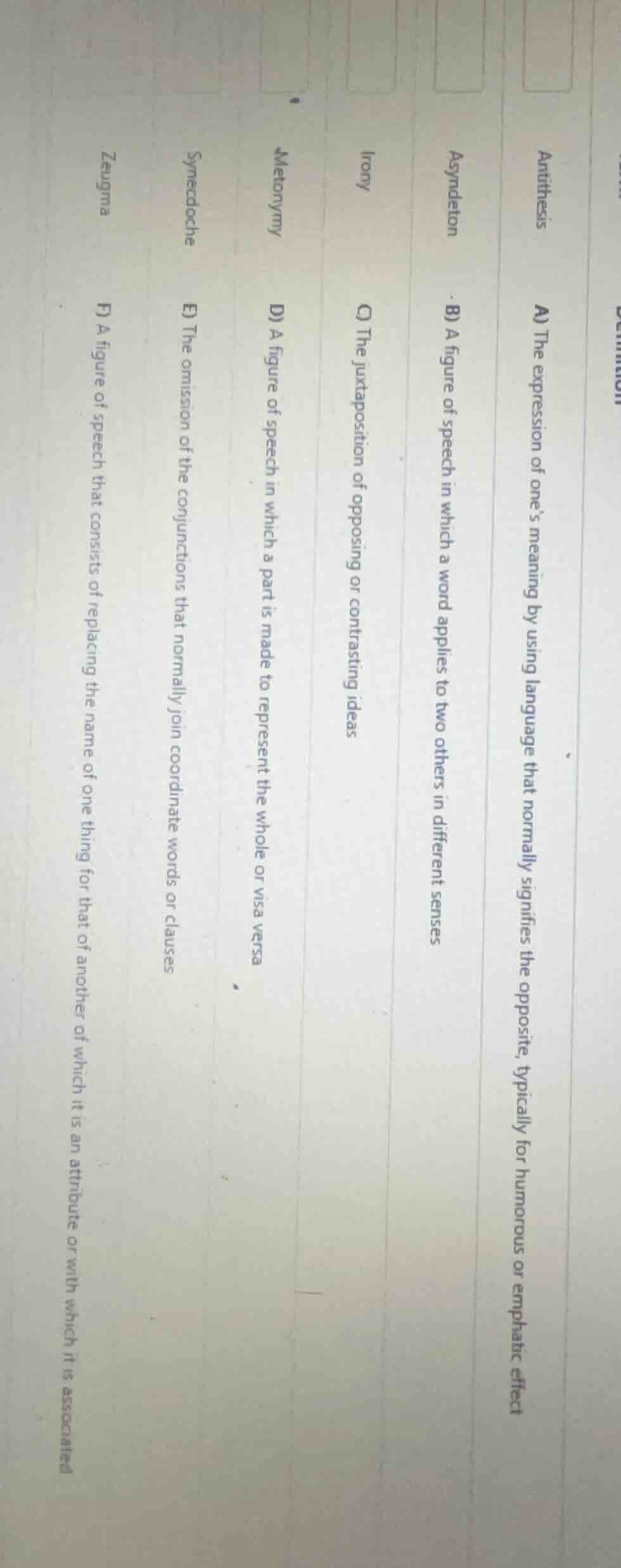
antithesis
a) the expression of one’s meaning by using language that normally signifies the opposite, typically for humorous or emphatic effect
asyndeton
b) a figure of speech in which a word applies to two others in different senses
irony
c) the juxtaposition of opposing or contrasting ideas
metonymy
d) a figure of speech in which a part is made to represent the whole or visa versa
synecdoche
e) the omission of the conjunctions that normally join coordinate words or clauses
zeugma
f) a figure of speech that consists of replacing the name of one thing for that of another of which it is an attribute or with which it is associated
- Antithesis: The option A describes using language that signifies the opposite, typically for humorous or emphatic effect. But wait, actually, Antithesis is the juxtaposition of opposing or contrasting ideas. Wait, no, let's re - check:
- Antithesis: The correct definition for Antithesis is the juxtaposition of opposing or contrasting ideas? No, wait, no. Wait, the options:
- Option A: "The expression of one’s meaning by using language that normally signifies the opposite, typically for humorous or emphatic effect" is the definition of Irony.
- Option B: "A figure of speech in which a word applies to two others in different senses" is Zeugma.
- Option C: "The juxtaposition of opposing or contrasting ideas" is Antithesis.
- Option D: "A figure of speech in which a part is made to represent the whole or visa versa" is Synecdoche.
- Option E: "The omission of the conjunctions that normally join coordinate words or clauses" is Asyndeton.
- Option F: "A figure of speech that consists of replacing the name of one thing for that of another of which it is an attribute or with which it is associated" is Metonymy.
- So for Antithesis, the correct option is C.
- Asyndeton: The omission of conjunctions that normally join coordinate words or clauses (Option E).
- Irony: Using language that signifies the opposite for humorous/emphatic effect (Option A).
- Metonymy: Replacing a thing's name with an associated attribute's name (Option F).
- Synecdoche: Using a part to represent the whole or vice - versa (Option D).
- Zeugma: A word applying to two others in different senses (Option B).

Snap & solve any problem in the app
Get step-by-step solutions on Sovi AI
Photo-based solutions with guided steps
Explore more problems and detailed explanations
- Antithesis: C) The juxtaposition of opposing or contrasting ideas
- Asyndeton: E) The omission of the conjunctions that normally join coordinate words or clauses
- Irony: A) The expression of one’s meaning by using language that normally signifies the opposite, typically for humorous or emphatic effect
- Metonymy: F) A figure of speech that consists of replacing the name of one thing for that of another of which it is an attribute or with which it is associated
- Synecdoche: D) A figure of speech in which a part is made to represent the whole or visa versa
- Zeugma: B) A figure of speech in which a word applies to two others in different senses