QUESTION IMAGE
Question
applications
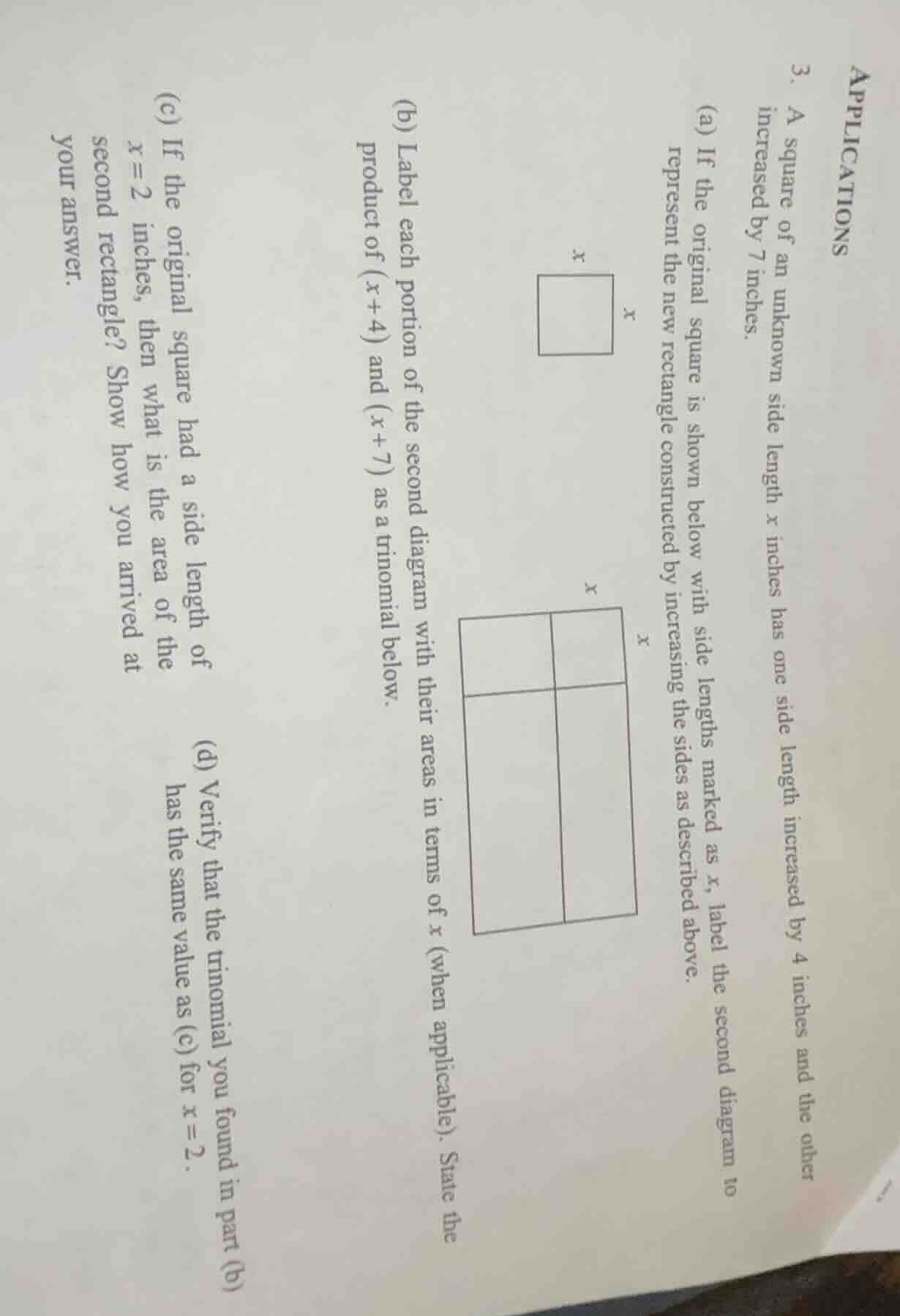
- a square of an unknown side length ( x ) inches has one side length increased by 4 inches and the other increased by 7 inches.
(a) if the original square is shown below with side lengths marked as ( x ), label the second diagram to represent the new rectangle constructed by increasing the sides as described above.
(image of a square with side ( x ), and a larger rectangle divided into four parts)
(b) label each portion of the second diagram with their areas in terms of ( x ) (when applicable). state the product of ( (x + 4) ) and ( (x + 7) ) as a trinomial below.
(c) if the original square had a side length of ( x = 2 ) inches, then what is the area of the second rectangle? show how you arrived at your answer.
(d) verify that the trinomial you found in part (b) has the same value as (c) for ( x = 2 ).
Part (a)
Step1: Identify the new dimensions
The original square has side length \( x \). One side is increased by 4, so the new length is \( x + 4 \), and the other side is increased by 7, so the new width is \( x + 7 \). The diagram should be a rectangle divided into four parts: a square of side \( x \) (area \( x^2 \)), a rectangle of length \( x \) and width 4 (area \( 4x \)), a rectangle of length \( x \) and width 7 (area \( 7x \)), and a rectangle of length 4 and width 7 (area \( 4\times7 = 28 \)).
Step2: Label the diagram
- Top - left: Square with side \( x \), label area \( x^2 \).
- Top - right: Rectangle with length \( x \), width 4, label area \( 4x \).
- Bottom - left: Rectangle with length \( x \), width 7, label area \( 7x \).
- Bottom - right: Rectangle with length 4, width 7, label area \( 28 \).
Part (b)
Step1: Expand the product \((x + 4)(x + 7)\)
Using the distributive property (FOIL method): \((x+4)(x + 7)=x\times x+x\times7 + 4\times x+4\times7\)
Step2: Simplify the terms
\(x\times x=x^{2}\), \(x\times7 = 7x\), \(4\times x=4x\), \(4\times7 = 28\). Then combine like terms: \(x^{2}+7x + 4x+28=x^{2}+11x + 28\)
Part (c)
Step1: Determine the new dimensions
If the original side \( x = 2\) inches, the new length is \(x + 4=2 + 4=6\) inches and the new width is \(x + 7=2+7 = 9\) inches.
Step2: Calculate the area of the rectangle
The area of a rectangle is \(A=\text{length}\times\text{width}\), so \(A = 6\times9 = 54\) square inches.
Part (d)

Snap & solve any problem in the app
Get step-by-step solutions on Sovi AI
Photo-based solutions with guided steps
Explore more problems and detailed explanations
Step1: Substitute \( x = 2\) into the trinomial from part (b)
The trinomial is \(x^{2}+11x + 28\). Substitute \( x = 2 \): \( (2)^{2}+11\times(2)+28\)
Step2: Calculate the value
\(2^{2}=4\), \(11\times2 = 22\), so \(4 + 22+28=54\), which is the same as the area calculated in part (c).
Final Answers:
(a) Diagram labeled with areas \( x^2 \), \( 4x \), \( 7x \), \( 28 \) as described.
(b) The trinomial is \( \boldsymbol{x^{2}+11x + 28} \)
(c) The area is \( \boldsymbol{54} \) square inches.
(d) Verified, as both methods give 54.