QUESTION IMAGE
Question
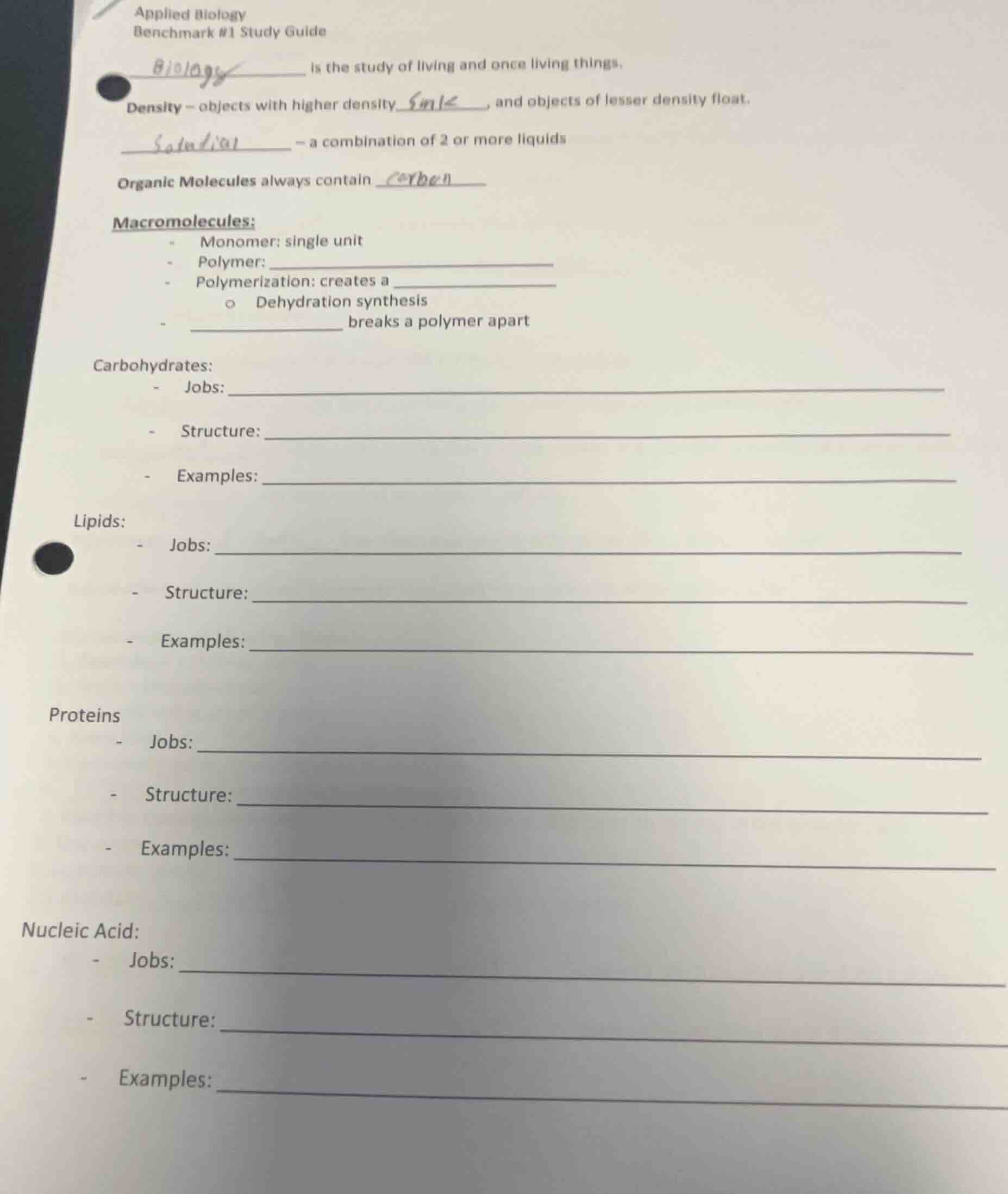
applied biology
benchmark #1 study guide
______ is the study of living and once living things.
density – objects with higher density ______, and objects of lesser density float.
______ – a combination of 2 or more liquids
organic molecules always contain ______
macromolecules:
- monomer: single unit
- polymer: ______
- polymerization: creates a ______
- dehydration synthesis
- ______ breaks a polymer apart
carbohydrates:
- jobs: ______
- structure: ______
- examples: ______
lipids:
- jobs: ______
- structure: ______
- examples: ______
proteins
- jobs: ______
- structure: ______
- examples: ______
nucleic acid:
- jobs: ______
- structure: ______
- examples: ______
To answer the fill - in - the - blanks in this Applied Biology study guide, we analyze each part based on biological concepts:
1. First blank:
The study of living and once - living things is the definition of Biology.
2. Density - related blank:
According to the principle of density, objects with higher density will sink (since denser objects are heavier relative to the fluid they are in, so they go down), while objects with lower density float.
3. Combination of 2 or more liquids:
A solution (or more specifically, a liquid - liquid solution, though the term "solution" generally can refer to a homogeneous mixture of two or more substances, and when it's two or more liquids, it's a type of solution) is a combination of 2 or more liquids (or a liquid and other solutes, but in the context of two or more liquids, it's a liquid - liquid solution).
4. Organic Molecules:
Organic molecules always contain carbon (along with hydrogen, and often oxygen, nitrogen, etc., but carbon is the key element that defines organic compounds in the traditional sense).
5. Macromolecules:
- Polymer: A polymer is a large molecule made up of many repeating monomer units (so the answer is "many monomer units linked together").
- Polymerization: Polymerization creates a polymer (by linking monomers together).
- The process that breaks a polymer apart is Hydrolysis (it uses water to break the bonds between monomers in a polymer).
6. Carbohydrates:
- Jobs: Carbohydrates are mainly used for energy storage and quick energy release (like glucose is used for immediate energy, and starch or glycogen are for storage) and also have structural roles (like cellulose in plant cell walls).
- Structure: Carbohydrates are made up of carbon, hydrogen, and oxygen in a ratio of approximately $C_n(H_2O)_n$ (they are polyhydroxy aldehydes or ketones, and their polymers are made by linking monosaccharides like glucose).
- Examples: Glucose, fructose, sucrose, starch, glycogen, cellulose.
7. Lipids:
- Jobs: Lipids are used for long - term energy storage (fats store a large amount of energy), insulation (to keep organisms warm), and structural components of cell membranes (phospholipids are a major part of cell membranes).
- Structure: Lipids are generally non - polar molecules, made up of fatty acids (and glycerol in the case of triglycerides), with a hydrophobic (water - fearing) region.
- Examples: Fats (like butter, lard), oils (like olive oil, canola oil), phospholipids, cholesterol.
8. Proteins:
- Jobs: Proteins have a wide range of jobs including enzymatic activity (enzymes are proteins that catalyze reactions), structural support (like collagen in skin and bones), transport (like hemoglobin transporting oxygen), defense (like antibodies), and regulation of cell processes (like hormones such as insulin).
- Structure: Proteins are made up of amino acids linked together by peptide bonds. The structure has four levels: primary (the sequence of amino acids), secondary (alpha - helices and beta - pleated sheets), tertiary (the 3 - D folding of the polypeptide chain), and quaternary (the association of multiple polypeptide chains).
- Examples: Hemoglobin, insulin, collagen, enzymes like amylase.
9. Nucleic Acid:
- Jobs: Nucleic acids (DNA and RNA) are responsible for storing and transmitting genetic information (DNA stores the genetic code, and RNA is involved in protein synthesis and other genetic processes).
- Structure:…

Snap & solve any problem in the app
Get step-by-step solutions on Sovi AI
Photo-based solutions with guided steps
Explore more problems and detailed explanations
To answer the fill - in - the - blanks in this Applied Biology study guide, we analyze each part based on biological concepts:
1. First blank:
The study of living and once - living things is the definition of Biology.
2. Density - related blank:
According to the principle of density, objects with higher density will sink (since denser objects are heavier relative to the fluid they are in, so they go down), while objects with lower density float.
3. Combination of 2 or more liquids:
A solution (or more specifically, a liquid - liquid solution, though the term "solution" generally can refer to a homogeneous mixture of two or more substances, and when it's two or more liquids, it's a type of solution) is a combination of 2 or more liquids (or a liquid and other solutes, but in the context of two or more liquids, it's a liquid - liquid solution).
4. Organic Molecules:
Organic molecules always contain carbon (along with hydrogen, and often oxygen, nitrogen, etc., but carbon is the key element that defines organic compounds in the traditional sense).
5. Macromolecules:
- Polymer: A polymer is a large molecule made up of many repeating monomer units (so the answer is "many monomer units linked together").
- Polymerization: Polymerization creates a polymer (by linking monomers together).
- The process that breaks a polymer apart is Hydrolysis (it uses water to break the bonds between monomers in a polymer).
6. Carbohydrates:
- Jobs: Carbohydrates are mainly used for energy storage and quick energy release (like glucose is used for immediate energy, and starch or glycogen are for storage) and also have structural roles (like cellulose in plant cell walls).
- Structure: Carbohydrates are made up of carbon, hydrogen, and oxygen in a ratio of approximately $C_n(H_2O)_n$ (they are polyhydroxy aldehydes or ketones, and their polymers are made by linking monosaccharides like glucose).
- Examples: Glucose, fructose, sucrose, starch, glycogen, cellulose.
7. Lipids:
- Jobs: Lipids are used for long - term energy storage (fats store a large amount of energy), insulation (to keep organisms warm), and structural components of cell membranes (phospholipids are a major part of cell membranes).
- Structure: Lipids are generally non - polar molecules, made up of fatty acids (and glycerol in the case of triglycerides), with a hydrophobic (water - fearing) region.
- Examples: Fats (like butter, lard), oils (like olive oil, canola oil), phospholipids, cholesterol.
8. Proteins:
- Jobs: Proteins have a wide range of jobs including enzymatic activity (enzymes are proteins that catalyze reactions), structural support (like collagen in skin and bones), transport (like hemoglobin transporting oxygen), defense (like antibodies), and regulation of cell processes (like hormones such as insulin).
- Structure: Proteins are made up of amino acids linked together by peptide bonds. The structure has four levels: primary (the sequence of amino acids), secondary (alpha - helices and beta - pleated sheets), tertiary (the 3 - D folding of the polypeptide chain), and quaternary (the association of multiple polypeptide chains).
- Examples: Hemoglobin, insulin, collagen, enzymes like amylase.
9. Nucleic Acid:
- Jobs: Nucleic acids (DNA and RNA) are responsible for storing and transmitting genetic information (DNA stores the genetic code, and RNA is involved in protein synthesis and other genetic processes).
- Structure: DNA is a double - helix made up of nucleotides (each nucleotide has a deoxyribose sugar, a phosphate group, and a nitrogenous base: adenine, thymine, cytosine, or guanine). RNA is usually single - stranded and has a ribose sugar, a phosphate group, and a nitrogenous base (adenine, uracil, cytosine, or guanine).
- Examples: DNA (deoxyribonucleic acid) and RNA (ribonucleic acid).
Final Answers (filling in the blanks):
- $\boldsymbol{Biology}$
- $\boldsymbol{sink}$
- $\boldsymbol{Solution}$ (or "Liquid - liquid solution" for more specificity)
- $\boldsymbol{carbon}$
- Polymer: $\boldsymbol{many\ monomer\ units\ linked\ together}$; Polymerization: creates a $\boldsymbol{polymer}$; $\boldsymbol{Hydrolysis}$ breaks a polymer apart
- Carbohydrates - Jobs: $\boldsymbol{energy\ storage\ and\ quick\ energy\ release\ (and\ structural\ roles)}$; Structure: $\boldsymbol{C_n(H_2O)_n\ (polyhydroxy\ aldehydes/ketones,\ made\ of\ monosaccharides)}$; Examples: $\boldsymbol{glucose,\ starch,\ glycogen,\ sucrose}$ (any appropriate carbohydrate examples)
- Lipids - Jobs: $\boldsymbol{long - term\ energy\ storage,\ insulation,\ cell\ membrane\ structure}$; Structure: $\boldsymbol{non - polar,\ made\ of\ fatty\ acids\ (and\ glycerol\ for\ triglycerides)}$; Examples: $\boldsymbol{fats,\ oils,\ phospholipids,\ cholesterol}$
- Proteins - Jobs: $\boldsymbol{enzymatic\ activity,\ structural\ support,\ transport,\ defense,\ cell\ process\ regulation}$; Structure: $\boldsymbol{amino\ acids\ linked\ by\ peptide\ bonds,\ with\ four\ levels\ of\ structure}$; Examples: $\boldsymbol{hemoglobin,\ insulin,\ collagen,\ amylase}$
- Nucleic Acid - Jobs: $\boldsymbol{store\ and\ transmit\ genetic\ information}$; Structure: $\boldsymbol{nucleotides\ linked\ together\ (DNA: double - helix,\ RNA: single - stranded)}$; Examples: $\boldsymbol{DNA,\ RNA}$