QUESTION IMAGE
Question
apply: complex patterns of inheritance
google classroom microsoft teams
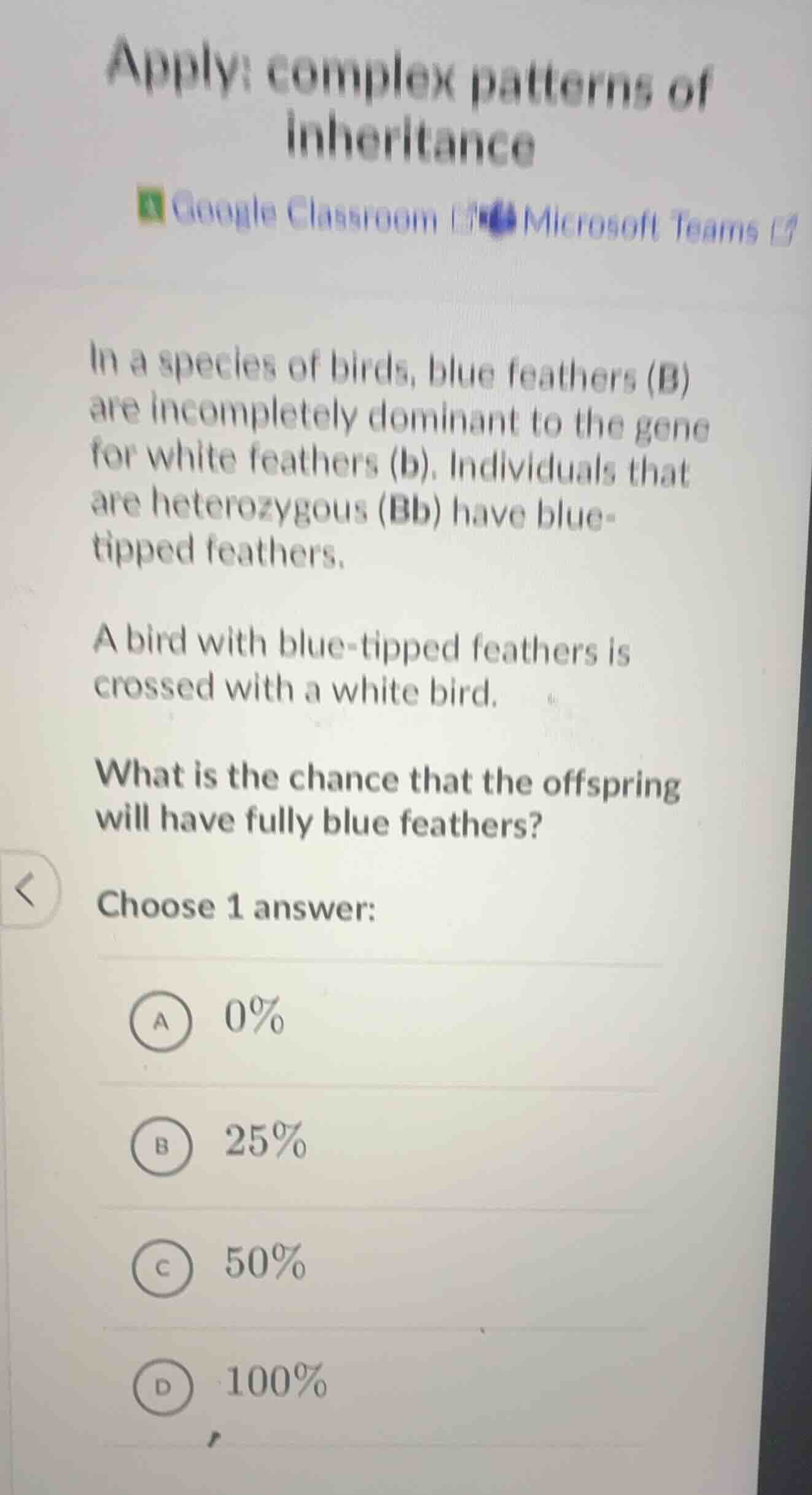
in a species of birds, blue feathers (b) are incompletely dominant to the gene for white feathers (b). individuals that are heterozygous (bb) have blue - tipped feathers.
a bird with blue - tipped feathers is crossed with a white bird.
what is the chance that the offspring will have fully blue feathers?
choose 1 answer:
a 0%
b 25%
c 50%
d 100%
Step1: Determine genotypes of parents
The blue - tipped feathered bird is heterozygous, so its genotype is \(Bb\). The white - feathered bird has the genotype \(bb\) (since white feathers are the recessive trait, and for a bird to have white feathers, it must be homozygous recessive).
Step2: Set up Punnett square
When we cross \(Bb\) and \(bb\), the possible gametes from the \(Bb\) parent are \(B\) and \(b\), and the possible gametes from the \(bb\) parent are \(b\) and \(b\).
The Punnett square will be:
| \(B\) | \(b\) | |
|---|---|---|
| \(b\) | \(Bb\) (blue - tipped) | \(bb\) (white) |
Step3: Analyze the offspring genotypes
From the Punnett square, the offspring genotypes are \(Bb\) (blue - tipped) and \(bb\) (white). There are no offspring with the genotype \(BB\) (which would be required for fully blue feathers). So the probability of having fully blue feathers (genotype \(BB\)) is \(0\).

Snap & solve any problem in the app
Get step-by-step solutions on Sovi AI
Photo-based solutions with guided steps
Explore more problems and detailed explanations
A. \(0\%\)