QUESTION IMAGE
Question
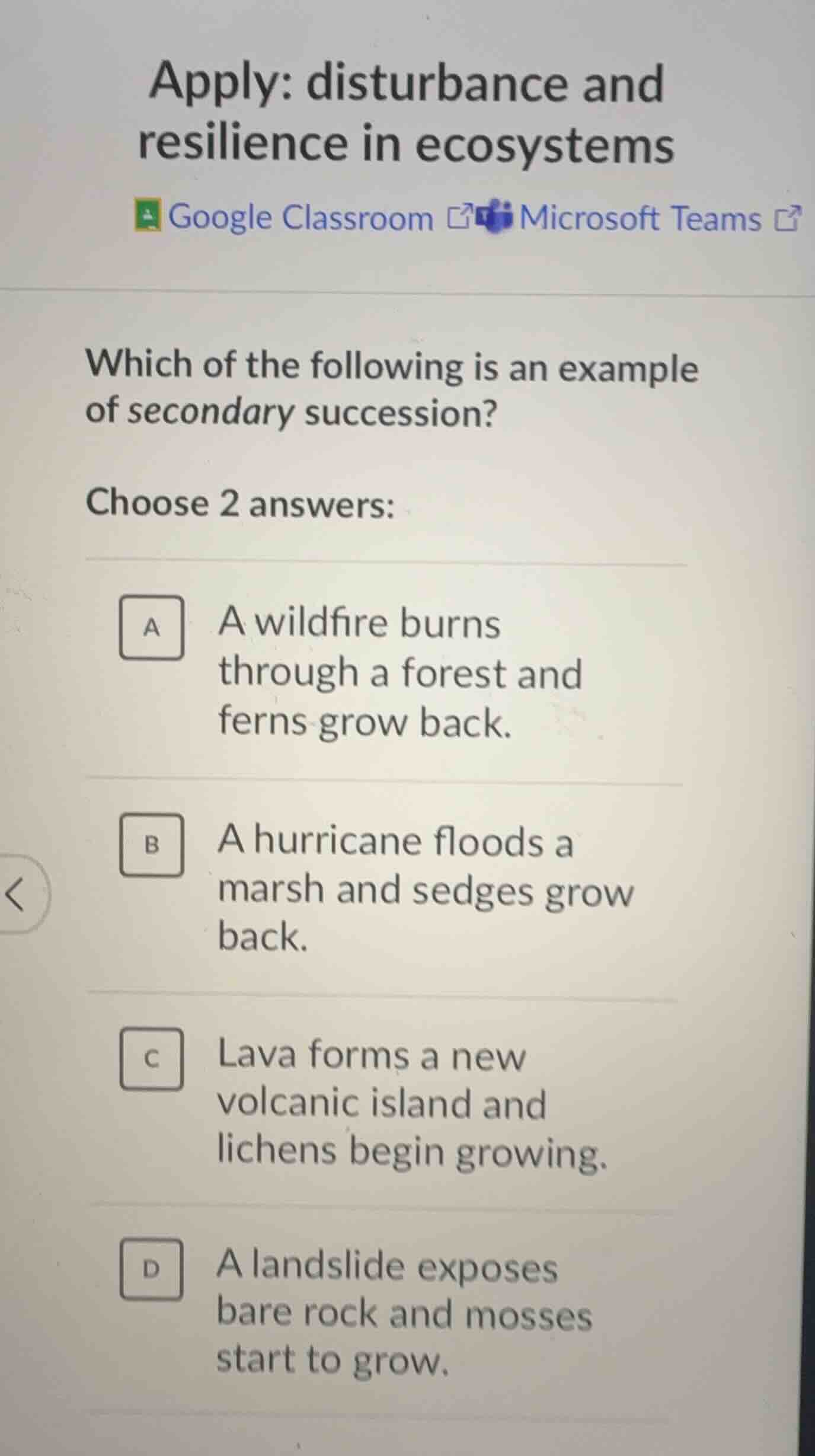
apply: disturbance and resilience in ecosystems google classroom microsoft teams which of the following is an example of secondary succession? choose 2 answers: a a wildfire burns through a forest and ferns grow back. b a hurricane floods a marsh and sedges grow back. c lava forms a new volcanic island and lichens begin growing. d a landslide exposes bare rock and mosses start to grow.
To determine secondary succession, we recall that it occurs in an area where a disturbance (like fire, flood) has destroyed an ecosystem but left the soil intact.
- Option A: Wildfire burns a forest (disturbance), soil remains, ferns grow back (succession with soil present) – secondary succession.
- Option B: Hurricane floods a marsh (disturbance), soil remains, sedges grow back – secondary succession.
- Option C: Lava forms a new island (no soil initially), lichens (pioneer species on bare rock) – primary succession (starts from bare rock/lava, no soil).
- Option D: Landslide exposes bare rock (no soil initially), mosses start – primary succession (starts on bare rock, no soil).
So A and B involve disturbances that leave soil, leading to secondary succession.

Snap & solve any problem in the app
Get step-by-step solutions on Sovi AI
Photo-based solutions with guided steps
Explore more problems and detailed explanations
A. A wildfire burns through a forest and ferns grow back.
B. A hurricane floods a marsh and sedges grow back.