QUESTION IMAGE
Question
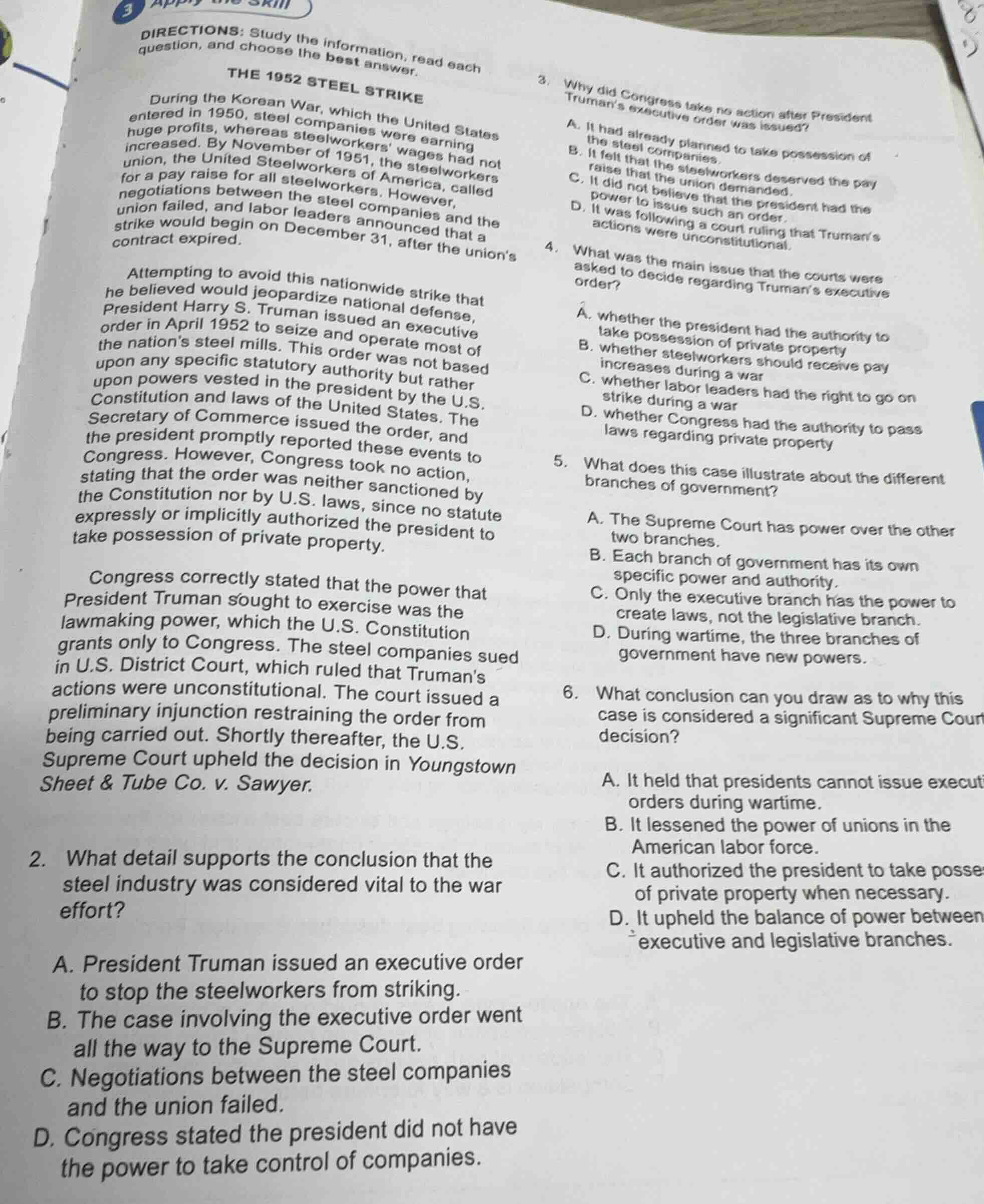
3 apply the skilldirections: study the information, read each question, and choose the best answer.the 1952 steel strikeduring the korean war, which the united states entered in 1950, steel companies were earning huge profits, whereas steelworkers wages had not increased. by november of 1951, the steelworkers union, the united steelworkers of america, called for a pay raise for all steelworkers. however, negotiations between the steel companies and the union failed, and labor leaders announced that a strike would begin on december 31, after the unions contract expired.attempting to avoid this nationwide strike that he believed would jeopardize national defense, president harry s. truman issued an executive order in april 1952 to seize and operate most of the nations steel mills. this order was not based upon any specific statutory authority but rather upon powers vested in the president by the u.s. constitution and laws of the united states. the secretary of commerce issued the order, and the president promptly reported these events to congress. however, congress took no action, stating that the order was neither sanctioned by the constitution nor by u.s. laws, since no statute expressly or implicitly authorized the president to take possession of private property.congress correctly stated that the power that president truman sought to exercise was the lawmaking power, which the u.s. constitution grants only to congress. the steel companies sued in u.s. district court, which ruled that trumans actions were unconstitutional. the court issued a preliminary injunction restraining the order from being carried out. shortly thereafter, the u.s. supreme court upheld the decision in youngstown sheet & tube co. v. sawyer.2. what detail supports the conclusion that the steel industry was considered vital to the war effort?a. president truman issued an executive order to stop the steelworkers from striking.b. the case involving the executive order went all the way to the supreme court.c. negotiations between the steel companies and the union failed.d. congress stated the president did not have the power to take control of companies.3. why did congress take no action after president trumans executive order was issued?a. it had already planned to take possession of the steel companies.b. it felt that the steelworkers deserved the pay raise that the union demanded.c. it did not believe that the president had the power to issue such an order.d. it was following a court ruling that trumans actions were unconstitutional.4. what was the main issue that the courts were asked to decide regarding trumans executive order?a. whether the president had the authority to take possession of private propertyb. whether steelworkers should receive pay increases during a warc. whether labor leaders had the right to go on strike during a ward. whether congress had the authority to pass laws regarding private property5. what does this case illustrate about the different branches of government?a. the supreme court has power over the other two branches.b. each branch of government has its own specific power and authority.c. only the executive branch has the power to create laws, not the legislative branch.d. during wartime, the three branches of government have new powers.6. what conclusion can you draw as to why this case is considered a significant supreme court decision?a. it held that presidents cannot issue executive orders during wartime.b. it lessened the power of unions in the american labor force.c. it authorized the president to take possession of private property when necessary.d. it upheld the balance of power between executive and legislative branches.
- Truman issued the order to avoid a strike he thought would harm national defense, showing steel's war importance.
- Congress said the order lacked constitutional/statutory authorization, so they did not act.
- The core court issue was if Truman had authority to seize private property via executive order.
- The case shows each branch has distinct, defined powers (Congress holds lawmaking power, courts rule on constitutionality, executive enforces laws).
- The case is significant because it upheld the separation of powers, balancing executive and legislative authority.

Snap & solve any problem in the app
Get step-by-step solutions on Sovi AI
Photo-based solutions with guided steps
Explore more problems and detailed explanations
- A. President Truman issued an executive order to stop the steelworkers from striking.
- C. It did not believe that the president had the power to issue such an order.
- A. whether the president had the authority to take possession of private property
- B. Each branch of government has its own specific power and authority.
- D. It upheld the balance of power between executive and legislative branches.