QUESTION IMAGE
Question
applying trigonometric ratios
in this activity, you will use your knowledge of
trigonometric ratios to solve problems.
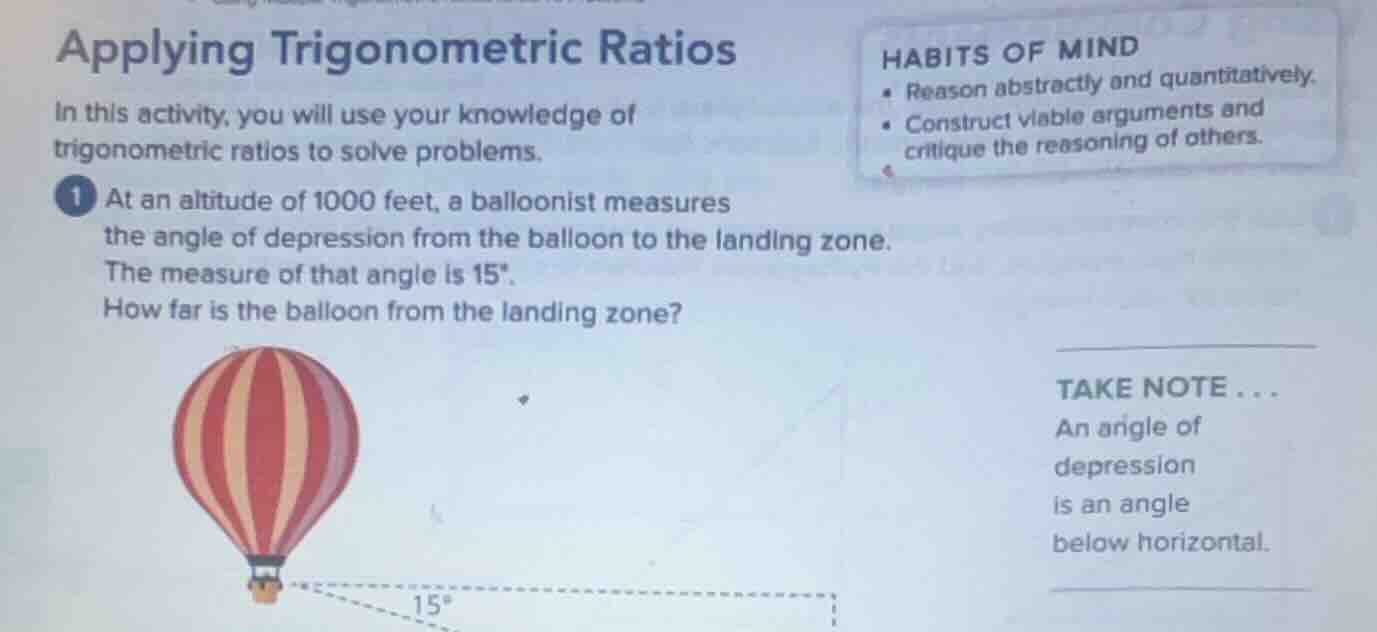
1 at an altitude of 1000 feet, a balloonist measures
the angle of depression from the balloon to the landing zone.
the measure of that angle is 15°.
how far is the balloon from the landing zone?
habits of mind
- reason abstractly and quantitatively.
- construct viable arguments and
critique the reasoning of others.
take note...
an angle of
depression
is an angle
below horizontal.
Step1: Identify the triangle type
We have a right triangle where the altitude (opposite side to the angle of depression) is 1000 feet, and we need to find the hypotenuse (distance from balloon to landing zone), let's call it \(d\). The angle of depression is \(15^\circ\), and the angle of depression is equal to the angle of elevation from the landing zone to the balloon (alternate interior angles). So we can use the sine function: \(\sin(\theta)=\frac{\text{opposite}}{\text{hypotenuse}}\).
Step2: Apply the sine formula
Given \(\theta = 15^\circ\), opposite side \(= 1000\) feet, hypotenuse \(= d\). So \(\sin(15^\circ)=\frac{1000}{d}\). We know that \(\sin(15^\circ)=\sin(45^\circ - 30^\circ)=\sin45^\circ\cos30^\circ-\cos45^\circ\sin30^\circ=\frac{\sqrt{2}}{2}\times\frac{\sqrt{3}}{2}-\frac{\sqrt{2}}{2}\times\frac{1}{2}=\frac{\sqrt{6}-\sqrt{2}}{4}\approx0.2588\).
Step3: Solve for \(d\)
From \(\sin(15^\circ)=\frac{1000}{d}\), we can rearrange to \(d = \frac{1000}{\sin(15^\circ)}\). Substituting \(\sin(15^\circ)\approx0.2588\), we get \(d=\frac{1000}{0.2588}\approx3863.7\) feet.

Snap & solve any problem in the app
Get step-by-step solutions on Sovi AI
Photo-based solutions with guided steps
Explore more problems and detailed explanations
The balloon is approximately \(\boldsymbol{3864}\) feet (rounded to nearest whole number) from the landing zone.