QUESTION IMAGE
Question
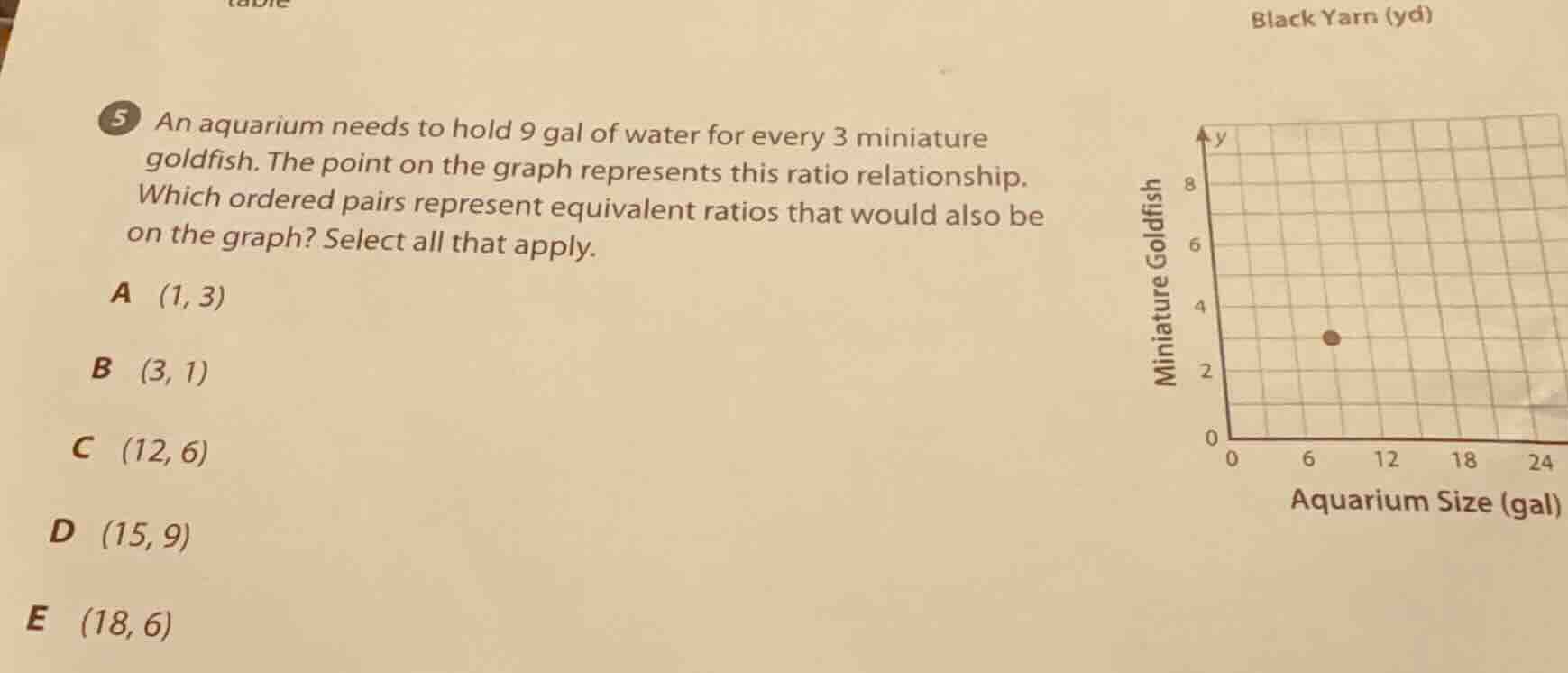
5 an aquarium needs to hold 9 gal of water for every 3 miniature goldfish. the point on the graph represents this ratio relationship. which ordered pairs represent equivalent ratios that would also be on the graph? select all that apply. a (1, 3) b (3, 1) c (12, 6) d (15, 9) e (18, 6)
Step1: Find the original ratio
The original ratio of aquarium size (gal) to miniature goldfish is \( \frac{9}{3}=3 \) (gal per goldfish), or the ratio of goldfish to aquarium size is \( \frac{3}{9}=\frac{1}{3} \) (goldfish per gal). Let's check each option:
Step2: Check Option A \((1, 3)\)
Ratio of goldfish to aquarium size: \( \frac{3}{1} = 3\), which is not equal to \( \frac{1}{3} \). Ratio of aquarium size to goldfish: \( \frac{1}{3}
eq3 \). So A is wrong.
Step3: Check Option B \((3, 1)\)
Ratio of goldfish to aquarium size: \( \frac{1}{3}\), which matches \( \frac{3}{9}=\frac{1}{3} \). So B is correct.
Step4: Check Option C \((12, 6)\)
Ratio of goldfish to aquarium size: \( \frac{6}{12}=\frac{1}{2}
eq\frac{1}{3} \). So C is wrong.
Step5: Check Option D \((15, 9)\)
Ratio of goldfish to aquarium size: \( \frac{9}{15}=\frac{3}{5}
eq\frac{1}{3} \). Wait, maybe I mixed x and y. Wait, the x - axis is Aquarium Size (gal), y - axis is Miniature Goldfish. So the original point: from the graph, when x = 9 (wait, no, the original ratio is 9 gal for 3 goldfish, so the point should be (9, 3)? Wait, maybe I misread the graph. Wait, the graph has x as Aquarium Size (gal), y as Miniature Goldfish. The original ratio is 9 gal (x) for 3 goldfish (y), so the ratio of y to x is \( \frac{3}{9}=\frac{1}{3} \), so y=\( \frac{1}{3}x \). Let's check each option:
Option A: (1, 3). y = 3, x = 1. \( 3=\frac{1}{3}\times1 \)? No.
Option B: (3, 1). y = 1, x = 3. \( 1=\frac{1}{3}\times3 \)? Yes, 1 = 1. Correct.
Option C: (12, 6). y = 6, x = 12. \( 6=\frac{1}{3}\times12 \)? \( \frac{1}{3}\times12 = 4
eq6 \). No.
Option D: (15, 9). y = 9, x = 15. \( 9=\frac{1}{3}\times15 \)? \( \frac{1}{3}\times15 = 5
eq9 \). No.
Option E: (18, 6). y = 6, x = 18. \( 6=\frac{1}{3}\times18 \)? \( \frac{1}{3}\times18 = 6 \). Yes! Wait, I missed E. Wait, the original ratio is 3 goldfish for 9 gal, so the rate is 3 goldfish / 9 gal = 1 goldfish / 3 gal. So for x gal, y = \( \frac{1}{3}x \).
Check E: x = 18, y = 6. \( \frac{1}{3}\times18 = 6 \). Correct.
Wait, maybe I made a mistake earlier. Let's re - calculate:
Original ratio: 9 gal (x) for 3 goldfish (y), so the ratio of y to x is \( \frac{3}{9}=\frac{1}{3} \), so the equation is \( y=\frac{1}{3}x \).
- Option A: (1, 3). \( 3=\frac{1}{3}\times1 \)? No.
- Option B: (3, 1). \( 1=\frac{1}{3}\times3 \)? Yes.
- Option C: (12, 6). \( 6=\frac{1}{3}\times12 \)? \( \frac{1}{3}\times12 = 4
eq6 \). No.
- Option D: (15, 9). \( 9=\frac{1}{3}\times15 \)? \( \frac{1}{3}\times15 = 5
eq9 \). No.
- Option E: (18, 6). \( 6=\frac{1}{3}\times18 \)? \( \frac{1}{3}\times18 = 6 \). Yes.
Wait, maybe the original point on the graph: looking at the graph, the point is at x = 9? No, the grid: x - axis is 0, 6, 12, 18, 24. y - axis is 0, 2, 4, 6, 8. The point is at (9? No, maybe (9, 3) is not on the grid. Wait, the point is at (9, 3)? But the grid has x at 6, 12, etc. Wait, maybe the original ratio is 9 gal for 3 goldfish, so when x = 9, y = 3. But on the graph, the point is at (9, 3)? But the grid lines: maybe the point is (9, 3), but the options:
Wait, maybe I misread the options. Let's check the ratio of goldfish to gallons: 3 goldfish / 9 gallons = 1 goldfish / 3 gallons. So for each gallon, 1/3 goldfish. So:
- Option B: (3, 1): 1 goldfish / 3 gallons. Correct.
- Option E: (18, 6): 6 goldfish / 18 gallons = 1 goldfish / 3 gallons. Correct.
Wait, the initial mistake was not checking E. Let's re - evaluate:
For a ratio \( \frac{y}{x}=\frac{3}{9}=\frac{1}{3} \) (y is goldfish, x is gallons).
- A: \( \frac{3}{1}=3
eq\fra…

Snap & solve any problem in the app
Get step-by-step solutions on Sovi AI
Photo-based solutions with guided steps
Explore more problems and detailed explanations
B. (3, 1), E. (18, 6)