QUESTION IMAGE
Question
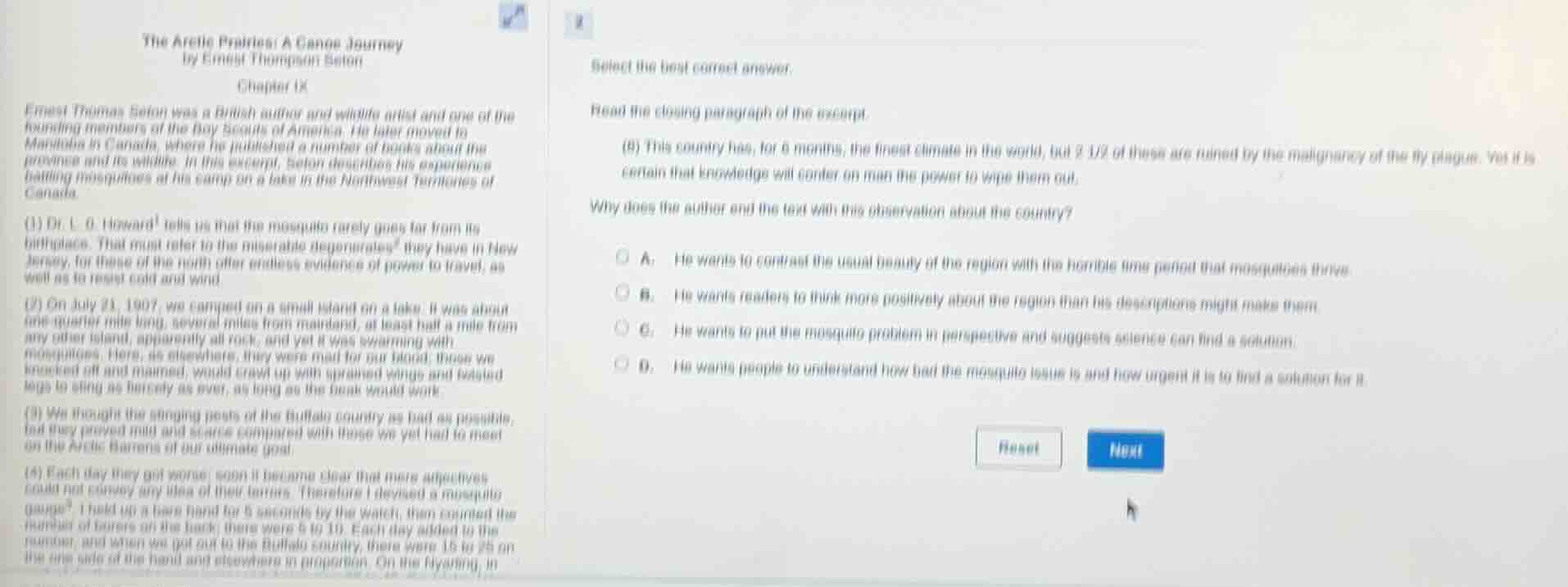
the arctic prairies: a canoe journeyby ernest thompson setonchapter ixernest thomas seton was a british author and wildlife artist and one of the founding members of the boy scouts of america. he later moved to manitoba in canada, where he published a number of books about the province and its wildlife. in this excerpt, seton describes his experience battling mosquitoes at his camp on a lake in the northwest territories of canada.(1) dr. l. 0. howard¹ tells us that the mosquito rarely goes far from its birthplace. that must refer to the miserable degenerates² they have in new jersey, for these of the north offer endless evidence of power to travel, as well as to resist cold and wind.(2) on july 21, 1907, we camped on a small island on a lake. it was about one-quarter mile long, several miles from mainland, at least half a mile from any other island, apparently all rock, and yet it was swarming with mosquitoes. here, as elsewhere, they were mad for our blood; those we knocked off and maimed, would crawl up with sprained wings and folded legs to sting as fiercely as ever, as long as the beak would work.(3) we thought the stinging pests of the buffalo country as bad as possible, but they proved mild and scarce compared with those we yet had to meet on the arctic barrens of our ultimate goal.(4) each day they got worse; soon it became clear that mere adjectives could not convey any idea of their terrors. therefore i devised a mosquito gauge³. i held up a bare hand for 5 seconds by the watch, then counted the number of borers on the back; there were 5 to 10. each day added to the number, and when we got out to the buffalo country, there were 15 to 25 on the one side of the hand and elsewhere in proportion. on the nyarling, in2select the best correct answer.read the closing paragraph of the excerpt.(8) this country has, for 6 months, the finest climate in the world, but 2 1/2 of these are ruined by the malignancy of the fly plague. yet it is certain that knowledge will confer on man the power to wipe them out.why does the author end the text with this observation about the country?a. he wants to contrast the usual beauty of the region with the horrible time period that mosquitoes thriveb. he wants readers to think more positively about the region than his descriptions might make them.c. he wants to put the mosquito problem in perspective and suggests science can find a solution.d. he wants people to understand how bad the mosquito issue is and how urgent it is to find a solution for it
The closing paragraph first notes the region has 6 months of fine climate, with only 2.5 ruined by mosquitoes, putting the problem in perspective. It then adds that science will give humans the power to wipe out mosquitoes, suggesting a solution. Option A only focuses on contrast, missing the science solution part. Option B is incorrect as the paragraph doesn't aim to make readers view the region more positively than prior descriptions. Option D overemphasizes the urgency and severity, while the paragraph balances the issue with the region's positive traits and a hopeful solution.

Snap & solve any problem in the app
Get step-by-step solutions on Sovi AI
Photo-based solutions with guided steps
Explore more problems and detailed explanations
C. He wants to put the mosquito problem in perspective and suggests science can find a solution.