QUESTION IMAGE
Question
2 area under the curve
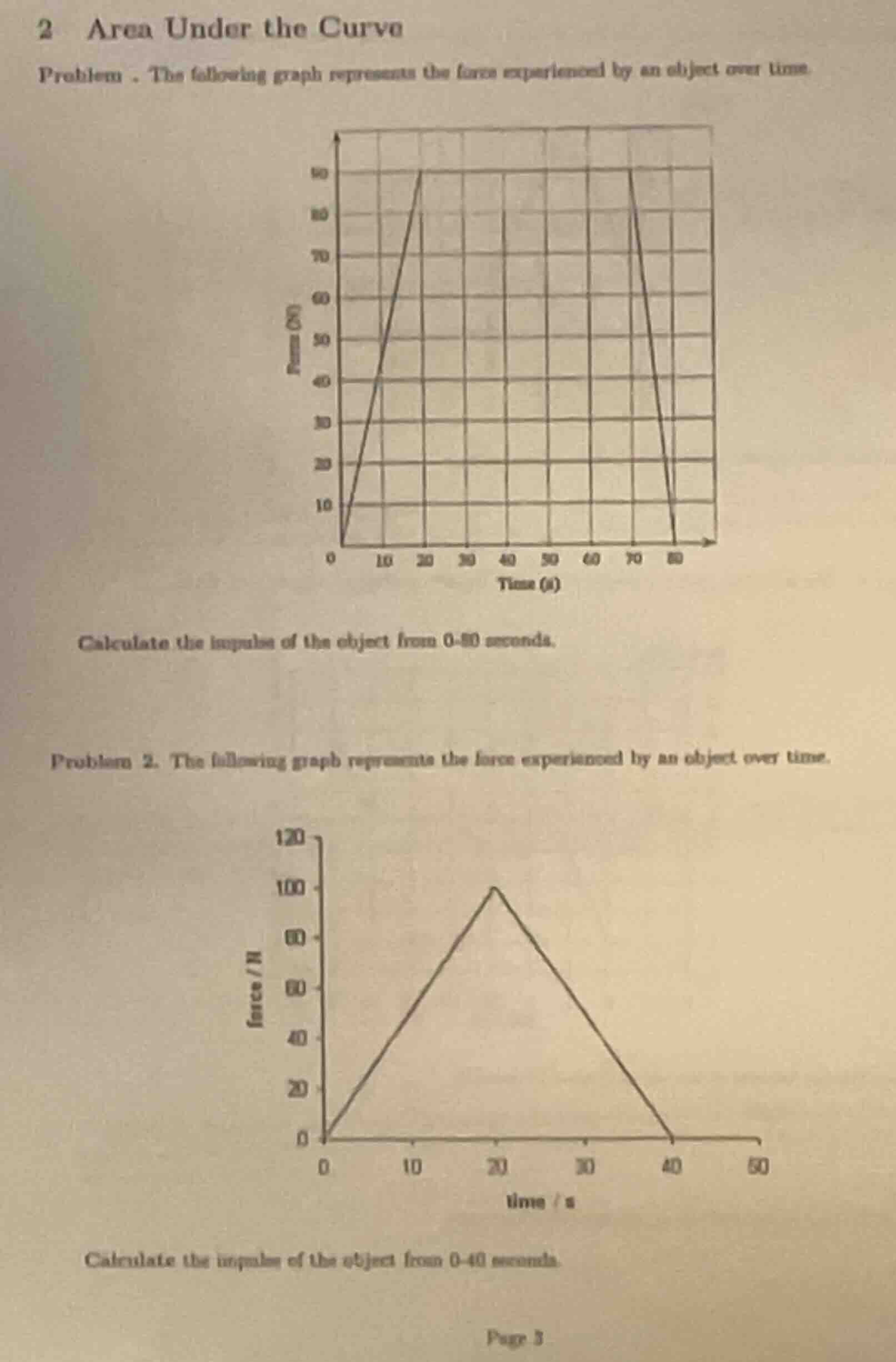
problem. the following graph represents the force experienced by an object over time.
calculate the impulse of the object from 0 - 80 seconds.
problem 2. the following graph represents the force experienced by an object over time.
calculate the impulse of the object from 0 - 40 seconds.
Problem 1 (0 - 80 seconds)
Step1: Analyze the graph's shape
The force - time graph from 0 - 80 s can be divided into three parts: a triangle from 0 - 20 s, a rectangle from 20 - 70 s, and a triangle from 70 - 80 s.
Step2: Calculate area of 0 - 20 s triangle
For a triangle, area formula is $A=\frac{1}{2}\times base\times height$. Base = 20 s, height = 90 N (assuming the peak force is 90 N from the graph). So area $A_1=\frac{1}{2}\times20\times90 = 900$ N·s.
Step3: Calculate area of 20 - 70 s rectangle
For a rectangle, area formula is $A = length\times width$. Length = 70 - 20 = 50 s, width = 90 N. So area $A_2=50\times90 = 4500$ N·s.
Step4: Calculate area of 70 - 80 s triangle
Base = 80 - 70 = 10 s, height = 90 N. Area $A_3=\frac{1}{2}\times10\times90=450$ N·s.
Step5: Total impulse (sum of areas)
Total impulse $I = A_1+A_2+A_3=900 + 4500+450=5850$ N·s. Wait, maybe the peak force is 90? Wait, looking at the first graph, maybe the peak is 90? Wait, maybe I misread. Let's re - check. The first graph: from 0 - 20 s, the force goes from 0 to 90? Wait, the y - axis has marks. Let's assume the grid: each square is, say, 10 N. At t = 20, force is 90? Wait, maybe the first graph's peak is 90? Alternatively, maybe the first graph is composed of a triangle (0 - 20), a rectangle (20 - 70), and a triangle (70 - 80). Let's recalculate. Wait, maybe the peak force is 90 N. So 0 - 20: triangle, base 20, height 90: $\frac{1}{2}\times20\times90 = 900$. 20 - 70: length 50, height 90: $50\times90 = 4500$. 70 - 80: triangle, base 10, height 90: $\frac{1}{2}\times10\times90 = 450$. Total: 900+4500 + 450=5850 N·s. But maybe the peak is 90? Alternatively, maybe the first graph's peak is 90.
Problem 2 (0 - 40 seconds)
Step1: Recognize the shape
The force - time graph from 0 - 40 s is a triangle.
Step2: Apply triangle area formula
For a triangle, area $A=\frac{1}{2}\times base\times height$. Base = 40 s, height = 100 N (from the graph, the peak force is 100 N). So area (impulse) $I=\frac{1}{2}\times40\times100 = 2000$ N·s.
Problem 1 Answer: 5850 N·s (assuming peak force is 90 N, if the peak is different, the answer will change. But based on the graph's grid, if each major grid is 10 N, and at t = 20, force is 90 N)
Problem 2 Answer: 2000 N·s
Wait, maybe the first graph's peak is 90? Let's re - examine the first graph. The y - axis has 10,20,30,40,50,60,70,80,90? Wait, the first graph: at t = 20, the force is 90? Then 20 - 70, it's constant at 90, then 70 - 80, it drops to 0. So the three regions: 0 - 20 (triangle), 20 - 70 (rectangle), 70 - 80 (triangle). So 0 - 20: $\frac{1}{2}\times20\times90 = 900$. 20 - 70: 50 s $\times$90 N = 4500. 70 - 80: $\frac{1}{2}\times10\times90 = 450$. Sum: 900 + 4500+450 = 5850 N·s.
For the second graph, it's a triangle with base 40 s and height 100 N. So impulse $I=\frac{1}{2}\times40\times100=2000$ N·s.

Snap & solve any problem in the app
Get step-by-step solutions on Sovi AI
Photo-based solutions with guided steps
Explore more problems and detailed explanations
Step1: Recognize the shape
The force - time graph from 0 - 40 s is a triangle.
Step2: Apply triangle area formula
For a triangle, area $A=\frac{1}{2}\times base\times height$. Base = 40 s, height = 100 N (from the graph, the peak force is 100 N). So area (impulse) $I=\frac{1}{2}\times40\times100 = 2000$ N·s.
Problem 1 Answer: 5850 N·s (assuming peak force is 90 N, if the peak is different, the answer will change. But based on the graph's grid, if each major grid is 10 N, and at t = 20, force is 90 N)
Problem 2 Answer: 2000 N·s
Wait, maybe the first graph's peak is 90? Let's re - examine the first graph. The y - axis has 10,20,30,40,50,60,70,80,90? Wait, the first graph: at t = 20, the force is 90? Then 20 - 70, it's constant at 90, then 70 - 80, it drops to 0. So the three regions: 0 - 20 (triangle), 20 - 70 (rectangle), 70 - 80 (triangle). So 0 - 20: $\frac{1}{2}\times20\times90 = 900$. 20 - 70: 50 s $\times$90 N = 4500. 70 - 80: $\frac{1}{2}\times10\times90 = 450$. Sum: 900 + 4500+450 = 5850 N·s.
For the second graph, it's a triangle with base 40 s and height 100 N. So impulse $I=\frac{1}{2}\times40\times100=2000$ N·s.