QUESTION IMAGE
Question
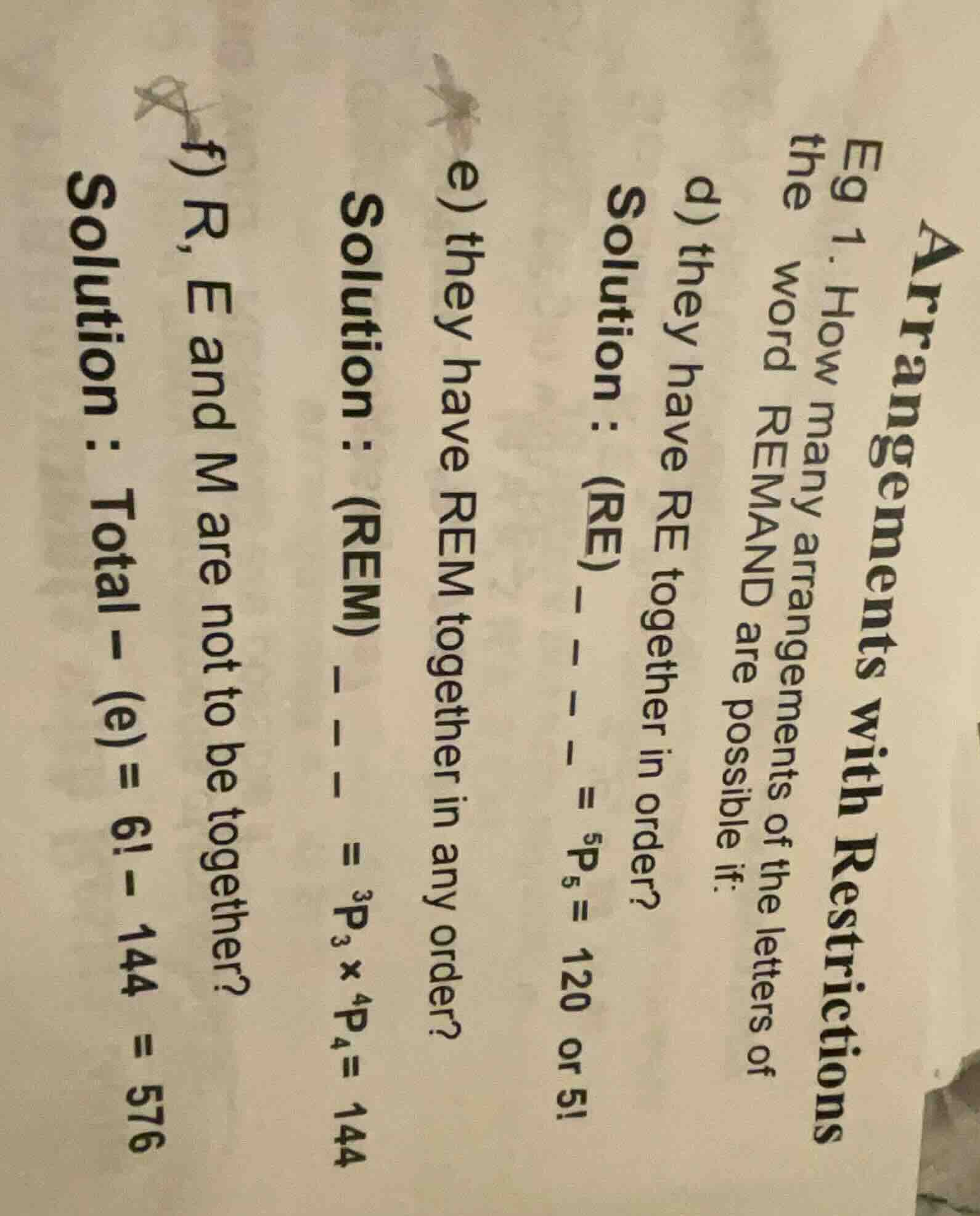
arrangements with restrictions eg 1. how many arrangements of the letters of the word remand are possible if: d) they have re together in order? solution : (re) ------ = ( _5p_5 )= 120 or 5! e) they have rem together in any order? solution : (rem) ------ = ( _3p_3 \times _4p_4 )= 144 f) r, e and m are not to be together? solution : total - (e) = 6! - 144 = 576
Part d: RE together in order
Step 1: Treat "RE" as a single entity
Since "RE" must be together in this specific order, we consider "RE" as one unit. Now, we have to arrange this "RE" unit along with the other letters. The original word is "REMAND", which has 6 letters. After treating "RE" as one unit, we have 5 units to arrange (RE, M, A, N, D).
Step 2: Calculate permutations of 5 units
The number of permutations of \( n \) distinct objects is \( n! \). Here, \( n = 5 \), so the number of arrangements is \( _5P_5=\frac{5!}{(5 - 5)!}=5!=120 \) (since \( 0!=1 \)).
Step 1: Treat "REM" as a single entity and permute within "REM"
First, we consider "REM" as one unit. But the letters R, E, M within "REM" can be arranged among themselves. The number of permutations of 3 distinct letters is \( _3P_3=\frac{3!}{(3 - 3)!}=3!=6 \).
Step 2: Arrange the "REM" unit with other letters
After treating "REM" as one unit, we have to arrange this unit along with the remaining letters (A, N, D) from "REMAND". So we have 4 units in total (REM, A, N, D). The number of permutations of 4 distinct units is \( _4P_4=\frac{4!}{(4 - 4)!}=4!=24 \).
Step 3: Multiply the two results
To get the total number of arrangements, we multiply the number of arrangements of the letters within "REM" and the number of arrangements of the "REM" unit with other letters. So total arrangements \( =_3P_3\times_4P_4 = 3!\times4!=6\times24 = 144 \).
Step 1: Calculate total permutations of all letters
The word "REMAND" has 6 distinct letters. The total number of permutations of 6 distinct letters is \( 6! = 720 \).
Step 2: Subtract the number of arrangements where R, E, M are together
From part (e), we know that the number of arrangements where R, E, M are together (in any order) is 144. So the number of arrangements where R, E, M are not together is total permutations minus the number of arrangements where they are together.
Step 3: Compute the result
\( 6!-144=720 - 144=576 \)

Snap & solve any problem in the app
Get step-by-step solutions on Sovi AI
Photo-based solutions with guided steps
Explore more problems and detailed explanations
120