QUESTION IMAGE
Question
arrow according to its type.
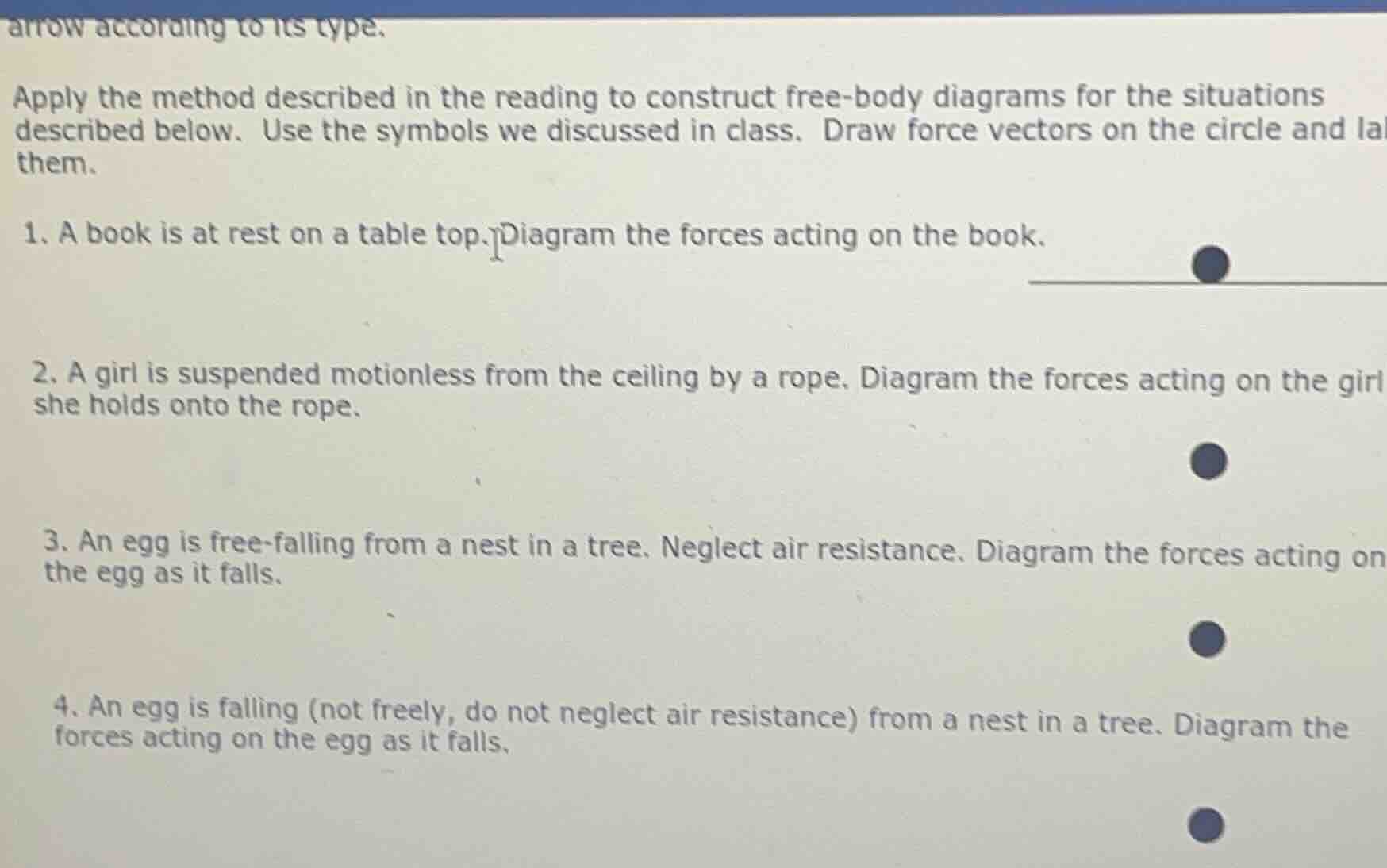
apply the method described in the reading to construct free - body diagrams for the situations
described below. use the symbols we discussed in class. draw force vectors on the circle and la
them.
- a book is at rest on a table top. diagram the forces acting on the book.
- a girl is suspended motionless from the ceiling by a rope. diagram the forces acting on the girl
she holds onto the rope.
- an egg is free - falling from a nest in a tree. neglect air resistance. diagram the forces acting on
the egg as it falls.
- an egg is falling (not freely, do not neglect air resistance) from a nest in a tree. diagram the
forces acting on the egg as it falls.
1. Book at rest on a table top
Step1: Identify forces
The book has two forces: gravitational force ($F_g$) downward and normal force ($F_N$) upward from the table.
Step2: Draw vectors
Draw a downward vector labeled $F_g$ (gravity) and an upward vector labeled $F_N$ (normal force) on the circle. The lengths of the vectors should be equal as the book is in equilibrium (at rest).
Step1: Identify forces
The girl has gravitational force ($F_g$) downward and tension force ($F_T$) upward from the rope.
Step2: Draw vectors
Draw a downward vector labeled $F_g$ (gravity) and an upward vector labeled $F_T$ (tension) on the circle. The lengths of the vectors should be equal as the girl is in equilibrium (motionless).
Step1: Identify forces
Only gravitational force ($F_g$) acts on the egg as air resistance is neglected.
Step2: Draw vector
Draw a downward vector labeled $F_g$ (gravity) on the circle.

Snap & solve any problem in the app
Get step-by-step solutions on Sovi AI
Photo-based solutions with guided steps
Explore more problems and detailed explanations
Forces: Gravitational force ($F_g$) downward, Normal force ($F_N$) upward (equal in magnitude, opposite in direction).