QUESTION IMAGE
Question
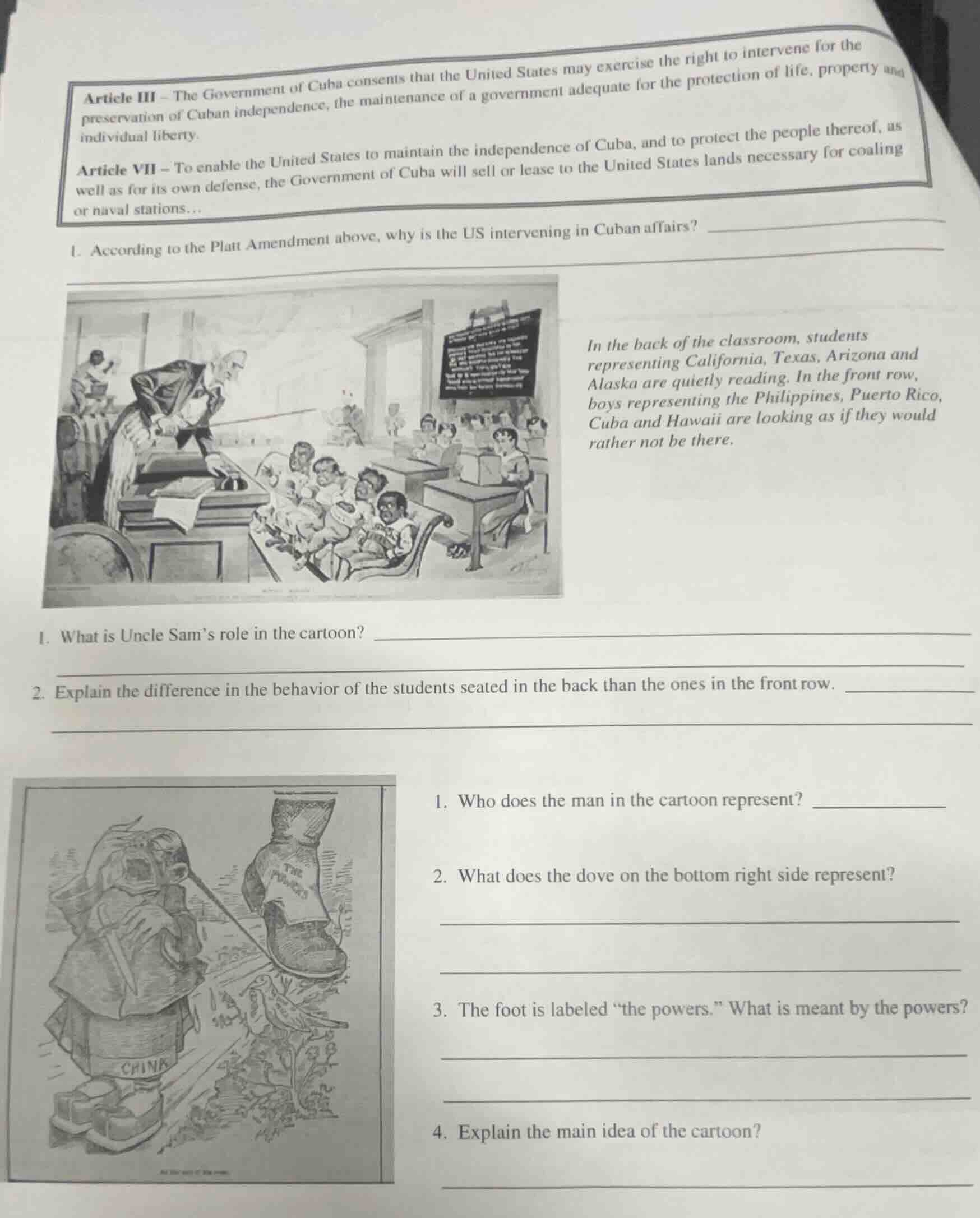
article iii - the government of cuba consents that the united states may exercise the right to intervene for the preservation of cuban independence, the maintenance of a government adequate for the protection of life, property and individual liberty.article vii - to enable the united states to maintain the independence of cuba, and to protect the people thereof, as well as for its own defense, the government of cuba will sell or lease to the united states lands necessary for coaling or naval stations...1. according to the platt amendment above, why is the us intervening in cuban affairs?in the back of the classroom, students representing california, texas, arizona and alaska are quietly reading. in the front row, boys representing the philippines, puerto rico, cuba and hawaii are looking as if they would rather not be there.1. what is uncle sams role in the cartoon?2. explain the difference in the behavior of the students seated in the back than the ones in the front row.1. who does the man in the cartoon represent?2. what does the dove on the bottom right side represent?3. the foot is labeled \the powers.\ what is meant by the powers?4. explain the main idea of the cartoon?
Platt Amendment Question
- The text explicitly states the US's stated justifications for intervention in Cuban affairs.
Classroom Cartoon Questions
- Uncle Sam is a longstanding symbolic representation of the United States government/authority in political cartoons.
- The back-row entities are established US states, fully integrated into the US system, while the front-row entities are territories the US acquired around the same period, which were not granted statehood and had little self-governance, reflecting their unwilling, subordinate status.
"The Powers" Cartoon Questions
- The figure labeled "CHINK" is a derogatory 19th/20th century caricature representing the Chinese government or Chinese people targeted by foreign intervention.
- Doves are a universal, long-established symbol of peace, especially in political commentary.
- In the context of 19th/early 20th century Chinese history, "the powers" refers to the dominant Western imperial nations (and Japan) that exerted political and economic control over China.
- The cartoon visualizes how imperial powers (labeled "the powers") were imposing control over China, crushing any hope of peace for the Chinese people in the process.

Snap & solve any problem in the app
Get step-by-step solutions on Sovi AI
Photo-based solutions with guided steps
Explore more problems and detailed explanations
Platt Amendment
- To preserve Cuban independence, maintain a government that protects life, property, and individual liberty in Cuba, and to maintain US naval/coaling stations for defense.
Classroom Cartoon
- He represents the United States government/authority.
- The back-row students are established US states that are fully integrated and compliant, while the front-row students are non-state US territories that were unwillingly under US control and not granted equal status.
"The Powers" Cartoon
- The Chinese government/Chinese people (represented by a derogatory caricature).
- The dove represents peace.
- "The powers" refers to the imperial Western nations (and Japan) that exerted colonial and economic control over China.
- The main idea is that imperial powers were dominating and oppressing China, destroying the possibility of peace for the Chinese population.