QUESTION IMAGE
Question
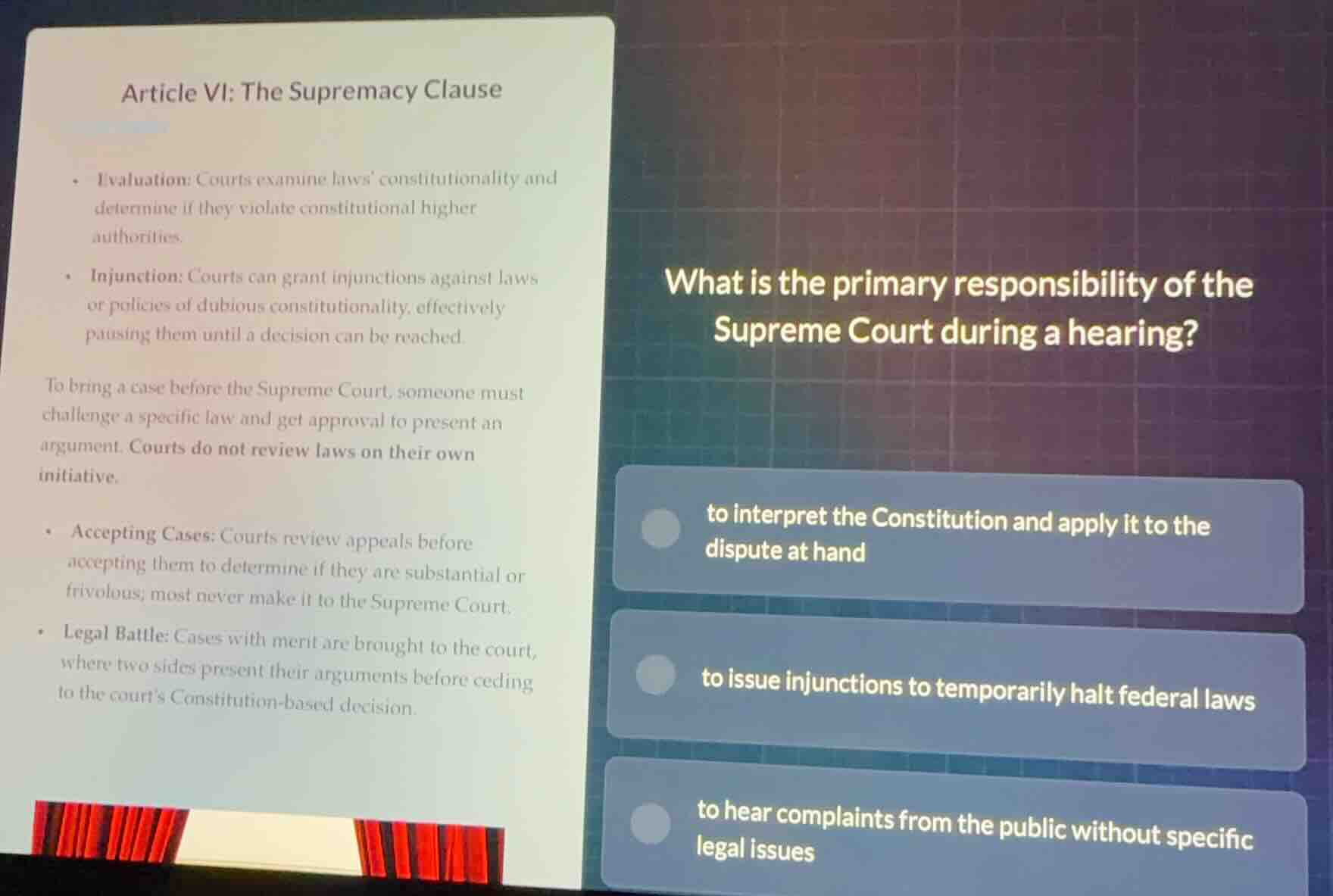
article vi: the supremacy clause
- evaluation: courts examine laws constitutionality and determine if they violate constitutional higher authorities.
- injunction: courts can grant injunctions against laws or policies of dubious constitutionality, effectively pausing them until a decision can be reached.
to bring a case before the supreme court, someone must challenge a specific law and get approval to present an argument. courts do not review laws on their own initiative.
- accepting cases: courts review appeals before accepting them to determine if they are substantial or frivolous; most never make it to the supreme court.
- legal battle: cases with merit are brought to the court, where two sides present their arguments before ceding to the courts constitution - based decision.
what is the primary responsibility of the supreme court during a hearing?
- to interpret the constitution and apply it to the dispute at hand
- to issue injunctions to temporarily halt federal laws
- to hear complaints from the public without specific legal issues
The provided text notes that courts evaluate laws' constitutionality, base decisions on the Constitution, and only hear cases with specific legal challenges. The Supreme Court's core role in hearings is to interpret the Constitution and apply it to the specific dispute. Issuing injunctions is a secondary power, and the Court does not hear public complaints without specific legal issues.

Snap & solve any problem in the app
Get step-by-step solutions on Sovi AI
Photo-based solutions with guided steps
Explore more problems and detailed explanations
to interpret the Constitution and apply it to the dispute at hand