QUESTION IMAGE
Question
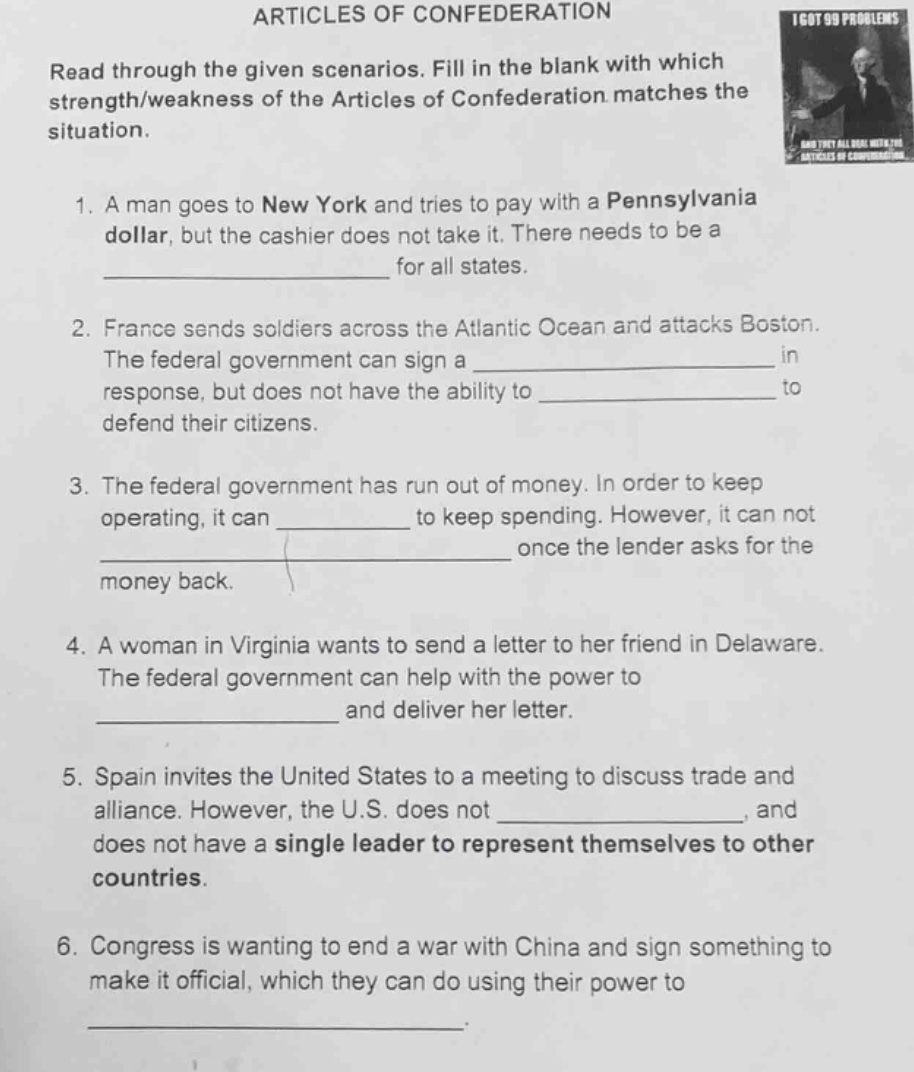
articles of confederation
read through the given scenarios. fill in the blank with which strength/weakness of the articles of confederation matches the situation.
- a man goes to new york and tries to pay with a pennsylvania dollar, but the cashier does not take it. there needs to be a ______________ for all states.
- france sends soldiers across the atlantic ocean and attacks boston. the federal government can sign a ____________ in response, but does not have the ability to ____________ to defend their citizens.
- the federal government has run out of money. in order to keep operating, it can ____________ to keep spending. however, it can not ____________ once the lender asks for the money back.
- a woman in virginia wants to send a letter to her friend in delaware. the federal government can help with the power to ______________ and deliver her letter.
- spain invites the united states to a meeting to discuss trade and alliance. however, the u.s. does not ______________, and does not have a single leader to represent themselves to other countries.
- congress is wanting to end a war with china and sign something to make it official, which they can do using their power to ______________.
To solve these questions, we analyze each scenario based on the strengths and weaknesses of the Articles of Confederation:
1.
- Explanation: Under the Articles, each state had its own currency. A weakness was the lack of a uniform currency across states.
- Blank: uniform currency (or common currency)
2.
- Explanation: The federal government could sign treaties (strength) but could not raise an army (weakness, as it relied on states for troops).
- Blanks: treaty (first blank); raise an army (or recruit soldiers) (second blank)
3.
- Explanation: The federal government could borrow money (action to keep spending) but could not tax (weakness, as it lacked power to tax to repay debts).
- Blanks: borrow money (first blank); tax (or collect taxes) (second blank)
4.
- Explanation: A strength of the Articles was the federal government’s power to establish a postal service.
- Blank: establish a postal service
5.
- Explanation: A weakness was the lack of a single leader (executive) or the ability to send a representative (like a president) to international meetings.
- Blank: have a president (or have a single leader/representative)
6.
- Explanation: A strength of the Articles was Congress’s power to sign treaties (to end wars and formalize agreements).
- Blank: sign treaties
Final Answers (filled blanks):
- uniform currency (or common currency)
- treaty; raise an army (or recruit soldiers)
- borrow money; tax (or collect taxes)
- establish a postal service
- have a president (or have a single leader/representative)
- sign treaties
(Note: Phrasing may vary slightly based on textbook definitions, but these capture the core concepts of the Articles’ strengths/weaknesses.)

Snap & solve any problem in the app
Get step-by-step solutions on Sovi AI
Photo-based solutions with guided steps
Explore more problems and detailed explanations
To solve these questions, we analyze each scenario based on the strengths and weaknesses of the Articles of Confederation:
1.
- Explanation: Under the Articles, each state had its own currency. A weakness was the lack of a uniform currency across states.
- Blank: uniform currency (or common currency)
2.
- Explanation: The federal government could sign treaties (strength) but could not raise an army (weakness, as it relied on states for troops).
- Blanks: treaty (first blank); raise an army (or recruit soldiers) (second blank)
3.
- Explanation: The federal government could borrow money (action to keep spending) but could not tax (weakness, as it lacked power to tax to repay debts).
- Blanks: borrow money (first blank); tax (or collect taxes) (second blank)
4.
- Explanation: A strength of the Articles was the federal government’s power to establish a postal service.
- Blank: establish a postal service
5.
- Explanation: A weakness was the lack of a single leader (executive) or the ability to send a representative (like a president) to international meetings.
- Blank: have a president (or have a single leader/representative)
6.
- Explanation: A strength of the Articles was Congress’s power to sign treaties (to end wars and formalize agreements).
- Blank: sign treaties
Final Answers (filled blanks):
- uniform currency (or common currency)
- treaty; raise an army (or recruit soldiers)
- borrow money; tax (or collect taxes)
- establish a postal service
- have a president (or have a single leader/representative)
- sign treaties
(Note: Phrasing may vary slightly based on textbook definitions, but these capture the core concepts of the Articles’ strengths/weaknesses.)