QUESTION IMAGE
Question
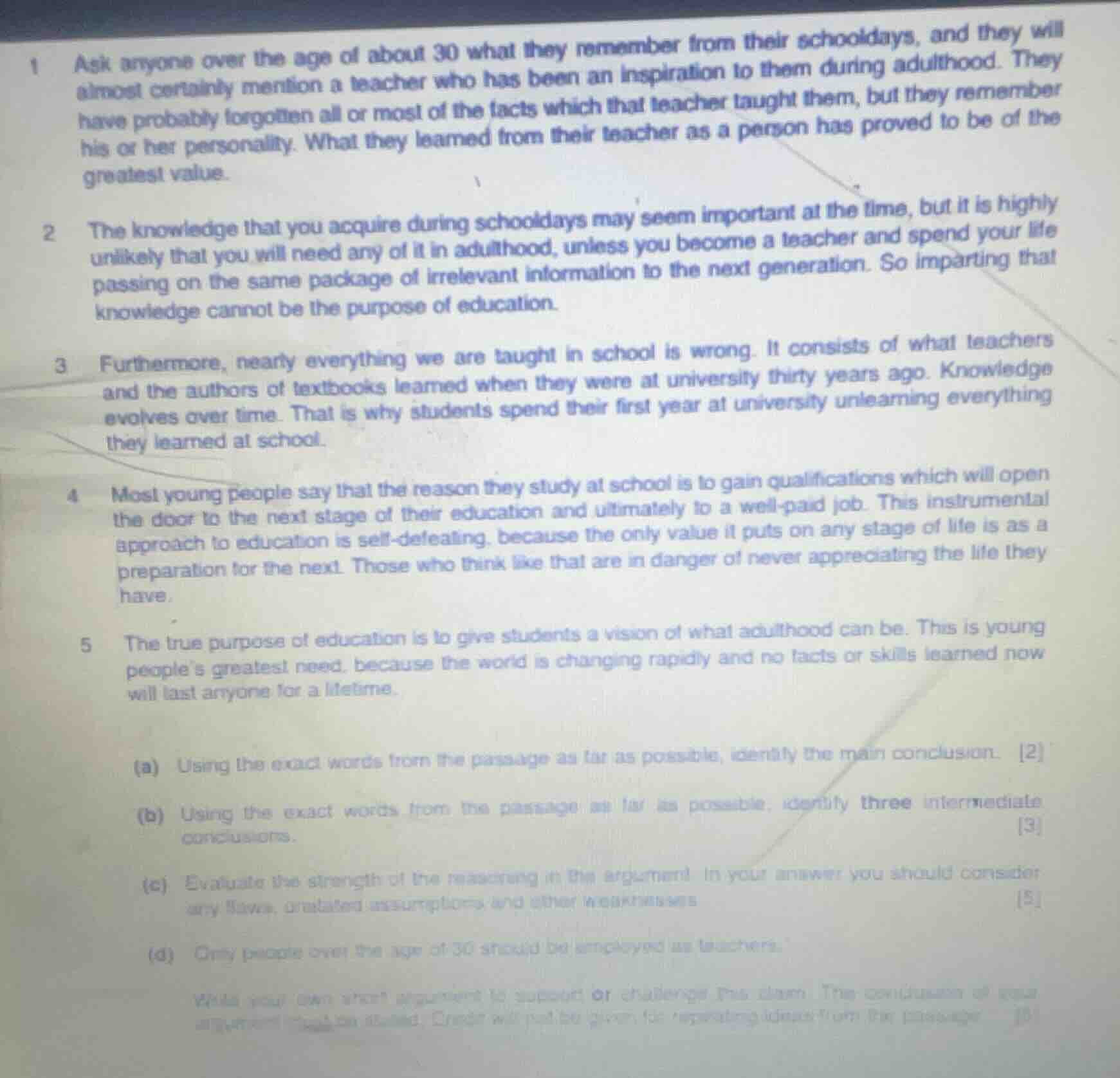
1 ask anyone over the age of about 30 what they remember from their schooldays, and they will almost certainly mention a teacher who has been an inspiration to them during adulthood. they have probably forgotten all or most of the facts which that teacher taught them, but they remember his or her personality. what they learned from their teacher as a person has proved to be of the greatest value.
2 the knowledge that you acquire during schooldays may seem important at the time, but it is highly unlikely that you will need any of it in adulthood, unless you become a teacher and spend your life passing on the same package of irrelevant information to the next generation. so imparting that knowledge cannot be the purpose of education.
3 furthermore, nearly everything we are taught in school is wrong. it consists of what teachers and the authors of textbooks learned when they were at university thirty years ago. knowledge evolves over time. that is why students spend their first year at university unlearning everything they learned at school.
4 most young people say that the reason they study at school is to gain qualifications which will open the door to the next stage of their education and ultimately to a well - paid job. this instrumental approach to education is self - defeating, because the only value it puts on any stage of life is as a preparation for the next. those who think like that are in danger of never appreciating the life they have.
5 the true purpose of education is to give students a vision of what adulthood can be. this is young people’s greatest need, because the world is changing rapidly and no facts or skills learned now will last anyone for a lifetime.
(a) using the exact words from the passage as far as possible, identify the main conclusion. 2
(b) using the exact words from the passage as far as possible, identify three intermediate conclusions. 3
(c) evaluate the strength of the reasoning in the argument. in your answer you should consider any flaws, unstated assumptions and other weaknesses 5
(d) only people over the age of 30 should be employed as teachers.
write your own short argument to support or challenge this claim. the conclusion of your argument should be stated. credit will not be given for repeating ideas from the passage 3
Part (a)
The main conclusion is the core claim the passage builds toward, stated directly in the final substantive paragraph.
Part (b)
Intermediate conclusions are claims that support the main conclusion, each acting as a smaller argumentative step within the passage.
Part (c)
The reasoning has strengths in highlighting education's non-instrumental value but relies on overgeneralizations, unstated assumptions, and lacks evidence for key claims.
Part (d)
A challenging argument is constructed by addressing gaps in the proposed claim, focusing on diverse teaching strengths and professional standards.

Snap & solve any problem in the app
Get step-by-step solutions on Sovi AI
Photo-based solutions with guided steps
Explore more problems and detailed explanations
(a) The true purpose of education is to give students a vision of what adulthood can be.
(b) 1. Imparting school knowledge cannot be the purpose of education.
- Nearly everything we are taught in school is wrong.
- This instrumental approach to education is self-defeating.
(c) The reasoning has significant weaknesses:
- Overgeneralization: It claims "nearly everything we are taught in school is wrong" and school knowledge is "irrelevant" for adulthood, which ignores foundational skills (e.g., literacy, numeracy) that are universally useful.
- Unstated assumptions: It assumes that outdated school knowledge means all school learning is worthless, without acknowledging that schools also teach critical thinking and adapt knowledge over time. It also assumes that instrumental goals (qualifications for jobs) inherently prevent appreciation of life, which is not a necessary link.
- Weak anecdotal evidence: The opening relies on the experience of people over 30 forgetting facts, but this does not negate the value of factual learning or prove personality is the only valuable takeaway.
- Contradiction risk: It argues against passing on "irrelevant information" but does not address how a "vision of adulthood" would be taught without any foundational knowledge.
The only strength is that it correctly identifies that education should have a broader, non-instrumental purpose beyond just facts or job qualifications, but this is undermined by the flawed supporting claims.
(d) Argument challenging the claim:
Conclusion: Limiting teaching roles to people over 30 is an unfair and ineffective policy.
- Teachers under 30 often have closer, more relatable connections with young students, as they are more familiar with current youth culture, technology, and the daily challenges students face. This can improve engagement and communication in the classroom.
- Many early-career teachers bring up-to-date, cutting-edge knowledge in their subject areas, especially in fast-changing fields like computer science or environmental science, which older teachers may not have learned in their own education.
- Age is not a reliable measure of teaching ability: effective teaching depends on training, empathy, communication skills, and subject expertise, all of which can be developed at any age. Barring younger people excludes talented, well-qualified educators who could make significant contributions to students' learning.