QUESTION IMAGE
Question
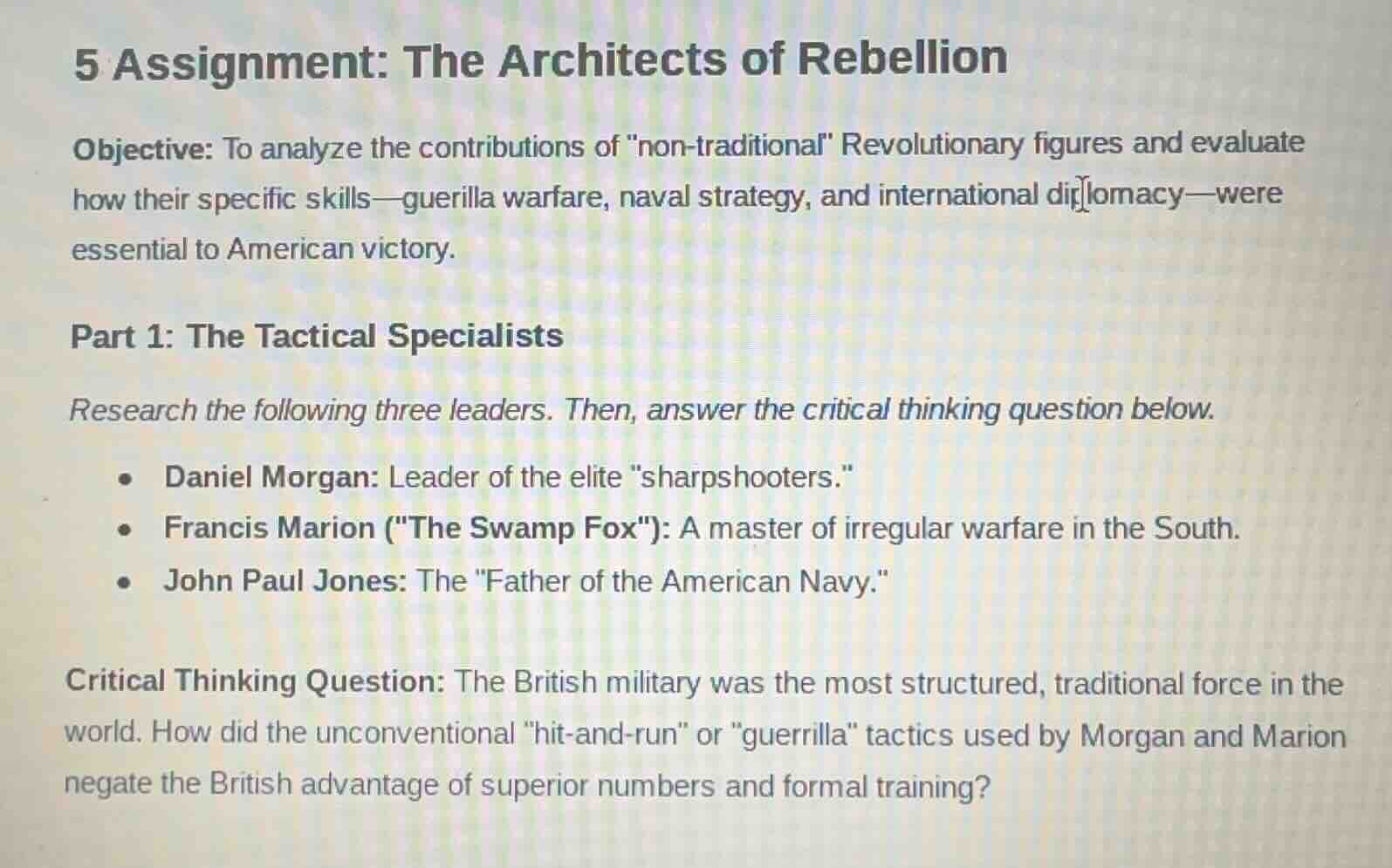
5 assignment: the architects of rebellion
objective: to analyze the contributions of
on - traditional\ revolutionary figures and evaluate how their specific skills—guerilla warfare, naval strategy, and international diplomacy—were essential to american victory.
part 1: the tactical specialists
research the following three leaders. then, answer the critical thinking question below.
- daniel morgan: leader of the elite \sharpshooters.\
- francis marion (\the swamp fox\): a master of irregular warfare in the south.
- john paul jones: the \father of the american navy.\
critical thinking question: the british military was the most structured, traditional force in the world. how did the unconventional \hit - and - run\ or \guerrilla\ tactics used by morgan and marion negate the british advantage of superior numbers and formal training?
To answer the critical thinking question, we analyze the nature of guerrilla tactics and British military structure:
- British Military Advantages: The British had superior numbers, formal training, and a structured, traditional approach. Their strength relied on large - scale, organized battles, supply lines, and set battle formations.
- Guerrilla Tactics (Hit - and - Run):
- Mobility and Flexibility: Morgan and Marion's forces were smaller and more mobile. They could quickly attack British outposts, supply lines, or small detachments and then retreat into difficult terrains (like swamps in Marion's case or rural areas for Morgan). The British, with their large, structured units, were less able to pursue these fast - moving, small groups.
- Psychological Impact: The constant, unpredictable attacks disrupted British morale and logistics. British soldiers, used to formal battles, found it hard to adapt to the irregular, sudden strikes.
- Negating Superior Numbers: By avoiding large - scale confrontations, the guerrilla forces didn't have to face the British's numerical advantage head - on. Instead, they chipped away at British resources (like supplies, communication lines) and manpower through small, repeated attacks.
- Formal Training Limitation: British formal training focused on linear tactics, discipline in formation, etc. Guerrilla warfare is irregular, with ambushes, sabotage, and unconventional fighting. The British soldiers' training didn't prepare them well for this type of warfare, so their formal training advantage was less effective against the guerrilla tactics.

Snap & solve any problem in the app
Get step-by-step solutions on Sovi AI
Photo-based solutions with guided steps
Explore more problems and detailed explanations
Guerrilla ("hit - and - run") tactics negated British advantages in the following ways:
- Mobility vs. Structure: Morgan/Marion’s small, mobile forces attacked British supply lines/outposts and retreated into difficult terrain (e.g., swamps, rural areas). The British, with large, structured units, struggled to pursue or adapt to this flexibility, limiting their ability to leverage superior numbers/formal training in open, traditional battles.
- Psychological/Logistical Disruption: Unpredictable attacks eroded British morale and disrupted logistics (supplies, communication). This weakened their ability to sustain operations, even with more troops or formal training.
- Avoiding Direct Confrontation: By refusing large - scale battles, guerrilla forces prevented the British from using their numerical superiority. British formal training (for linear, disciplined warfare) was ineffective against irregular tactics (ambushes, sabotage), reducing the value of their training advantage.