QUESTION IMAGE
Question
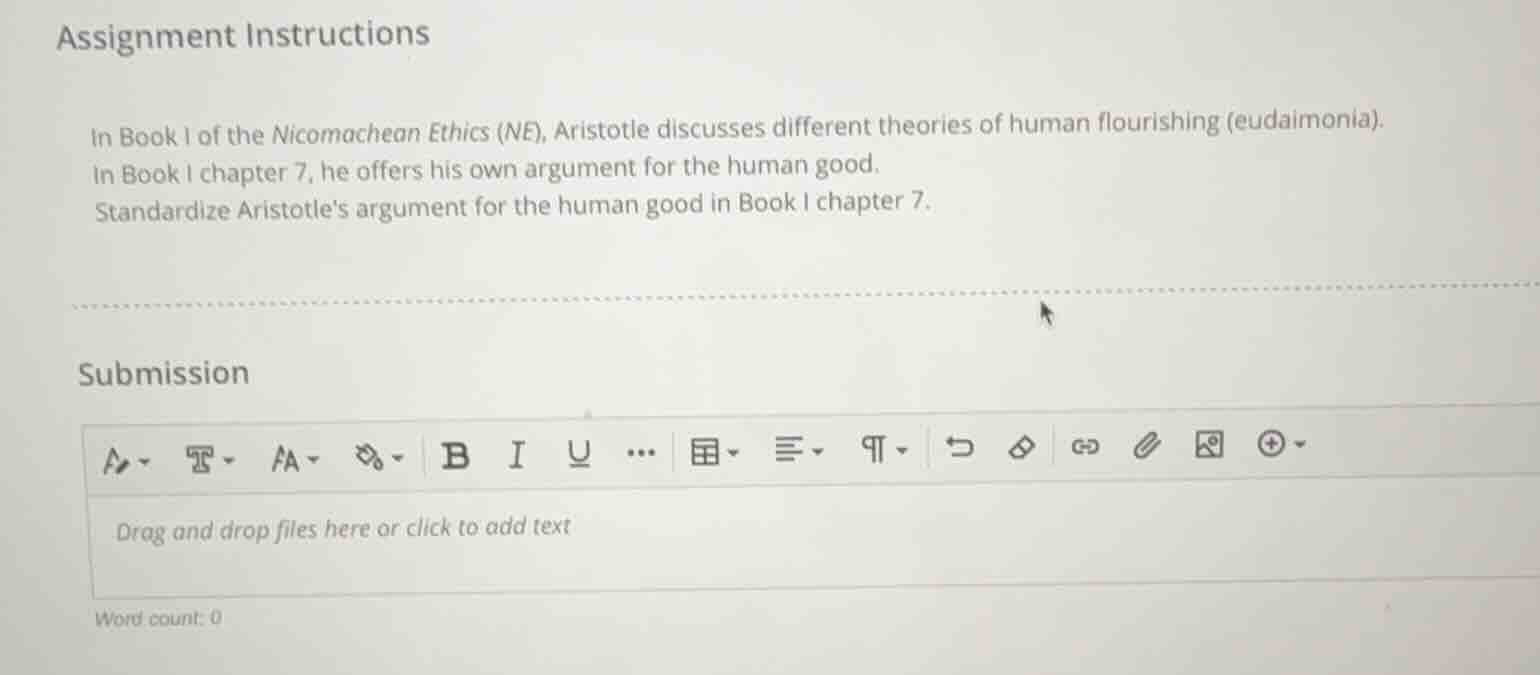
assignment instructions
in book i of the nicomachean ethics (ne), aristotle discusses different theories of human flourishing (eudaimonia).
in book i chapter 7, he offers his own argument for the human good.
standardize aristotles argument for the human good in book i chapter 7.
submission
drag and drop files here or click to add text
word count: 0
Brief Explanations
This standardization distills Aristotle's core deductive argument from Nicomachean Ethics I.7, focusing on his function argument for the human good:
- Every thing has a specific function (ergon) that defines its proper excellence.
- The human function is rational activity (activity of the soul in accordance with reason, or not without reason), as this is unique to humans (separating them from plants and non-rational animals).
- The good of a thing lies in performing its function well, in accordance with its proper virtue (arete).
- Therefore, the human good (eudaimonia) is activity of the soul in accordance with virtue, and if there are multiple virtues, in accordance with the highest and most complete virtue, over a complete life.

Snap & solve any problem in the app
Get step-by-step solutions on Sovi AI
Photo-based solutions with guided steps
Explore more problems and detailed explanations
Standardized Argument for the Human Good (Aristotle, Nicomachean Ethics I.7):
- Premise 1: All things with a function have their good in performing that function well.
- Premise 2: The human function is rational activity (activity of the soul involving reason), as it is the distinct, characteristic action of humans.
- Premise 3: Performing a function well means doing it in accordance with the appropriate virtue(s).
- Conclusion: The human good (eudaimonia) is activity of the soul in accordance with virtue, and with the highest, most complete virtue, over a complete lifetime.