QUESTION IMAGE
Question
associe chaque courbe à ses paramètres.
courbe 1
○
a=3; h=5; k=4
courbe 2
○
a=-3; h=-2; k=-4
courbe 3
○
a=4; h=-5; k=3
courbe 4
○
a=-4; h=2; k=-3
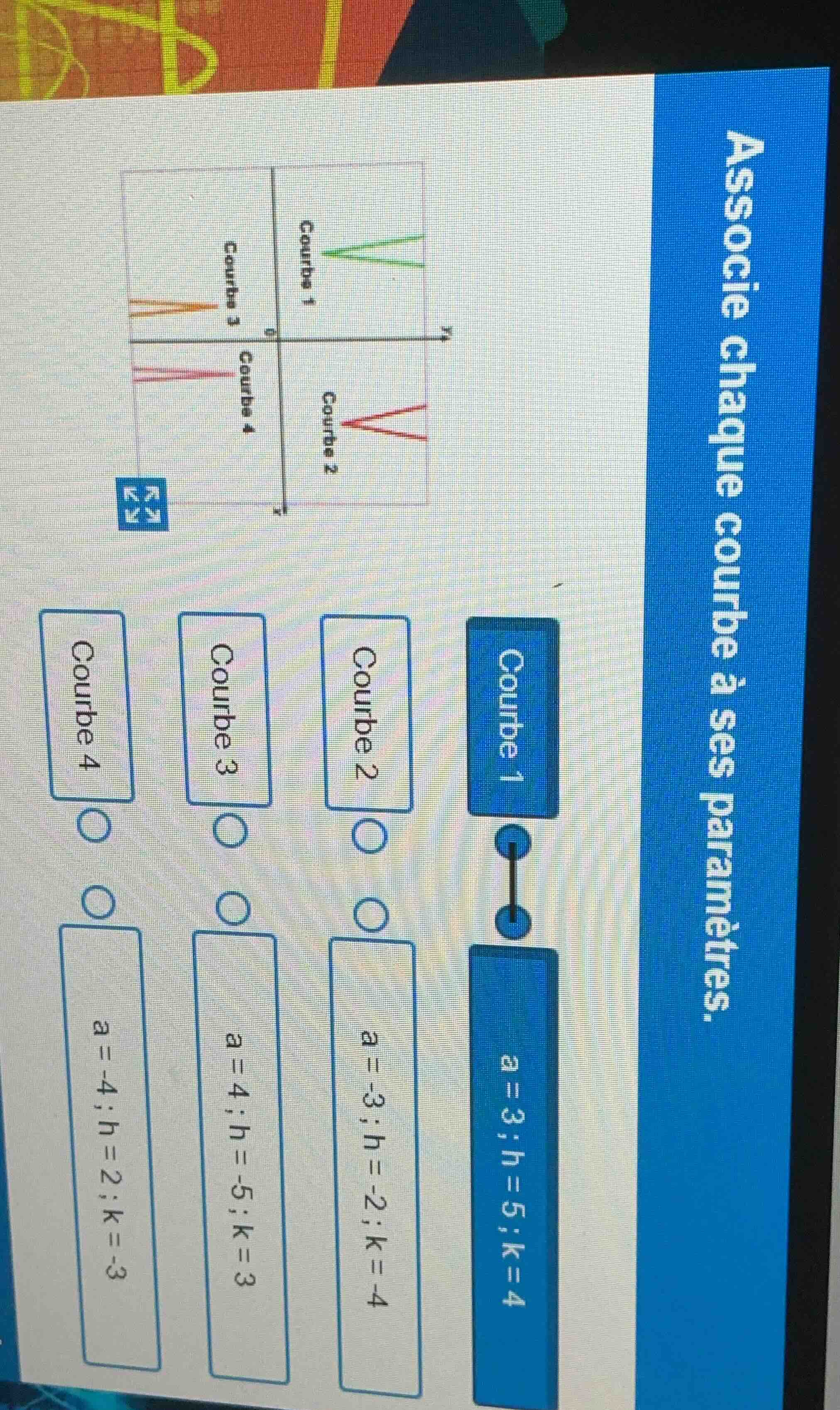
To solve this problem of associating each curve with its parameters, we analyze the direction (opening up or down) and the vertex position (horizontal and vertical shifts) of the absolute - value function - like curves (assuming the general form \(y = a|x - h|+k\)).
Courbe 1
For a curve with \(a = 3\), \(h = 5\), \(k = 4\):
- The value of \(a = 3>0\) means the curve opens upwards.
- The vertex of the absolute - value function \(y=a|x - h|+k\) is at \((h,k)=(5,4)\). Looking at the graph, Courbe 1 is in the first - quadrant - like region (positive \(x\) and positive \(y\) relative to the origin), opening upwards, which matches the parameters \(a = 3\); \(h = 5\); \(k = 4\).
Courbe 2
For a curve with \(a=- 3\), \(h=-2\), \(k = - 4\):
- The value of \(a=-3<0\) means the curve opens downwards.
- The vertex is at \((h,k)=(-2,-4)\). This curve should be in the third - quadrant - like region (negative \(x\) and negative \(y\) relative to the origin), opening downwards, which matches the parameters \(a=-3\); \(h = - 2\); \(k=-4\).
Courbe 3
For a curve with \(a = 4\), \(h=-5\), \(k = 3\):
- The value of \(a = 4>0\) means the curve opens upwards.
- The vertex is at \((h,k)=(-5,3)\). This curve is in the second - quadrant - like region (negative \(x\) and positive \(y\) relative to the origin), opening upwards, which matches the parameters \(a = 4\); \(h=-5\); \(k = 3\).
Courbe 4
For a curve with \(a=-4\), \(h = 2\), \(k=-3\):
- The value of \(a=-4<0\) means the curve opens downwards.
- The vertex is at \((h,k)=(2,-3)\). This curve is in the fourth - quadrant - like region (positive \(x\) and negative \(y\) relative to the origin), opening downwards, which matches the parameters \(a=-4\); \(h = 2\); \(k=-3\).

Snap & solve any problem in the app
Get step-by-step solutions on Sovi AI
Photo-based solutions with guided steps
Explore more problems and detailed explanations
- Courbe 1 : \(a = 3\); \(h = 5\); \(k = 4\)
- Courbe 2 : \(a=-3\); \(h=-2\); \(k=-4\)
- Courbe 3 : \(a = 4\); \(h=-5\); \(k = 3\)
- Courbe 4 : \(a=-4\); \(h = 2\); \(k=-3\)