QUESTION IMAGE
Question
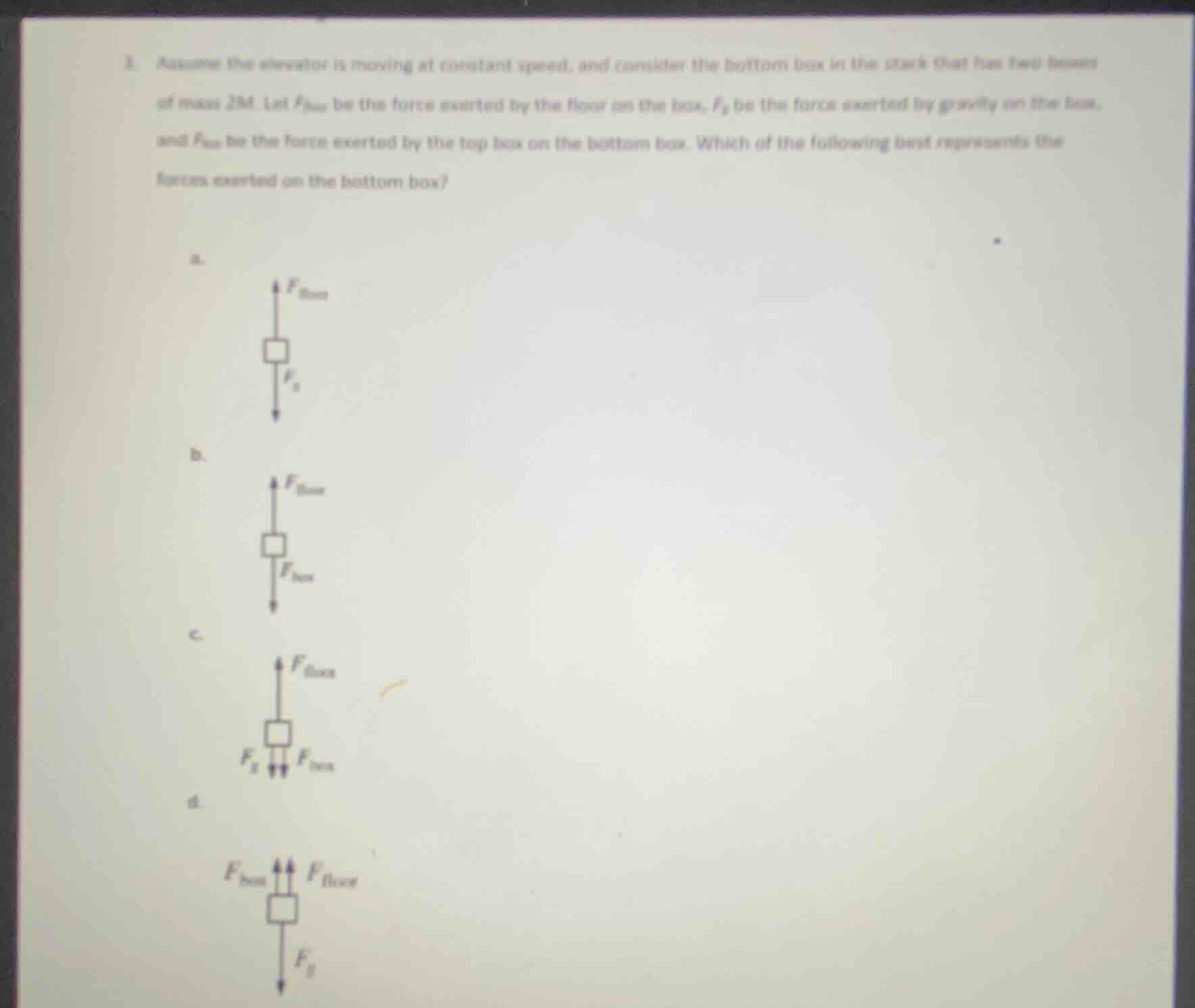
- assume the elevator is moving at constant speed, and consider the bottom box in the stack that has two boxes of mass 2m. let $f_{floor}$ be the force exerted by the floor on the box, $f_g$ be the force exerted by gravity on the box, and $f_{box}$ be the force exerted by the top box on the bottom box. which of the following best represents the forces exerted on the bottom box?
a. diagram with upward $f_{floor}$ and downward $f_g$ on a box
b. diagram with upward $f_{floor}$ and downward $f_{box}$ on a box
c. diagram with upward $f_{floor}$, downward $f_g$, and downward $f_{box}$ on a box
d. diagram with upward $f_{box}$, upward $f_{floor}$, and downward $f_g$ on a box
Step1: Identify forces on bottom box
The bottom box has three forces: upward normal force from the floor ($F_{floor}$), downward gravitational force ($F_g = 2Mg$), and downward normal force from the top box ($F_{box}$, equal to $Mg$ since the top box has mass $M$ and is in equilibrium).
Step2: Apply equilibrium condition
Since the elevator moves at constant speed, the box is in equilibrium. The sum of upward forces equals the sum of downward forces: $F_{floor} = F_g + F_{box}$.
Step3: Match to force diagram
Only option C shows an upward $F_{floor}$ and two downward forces ($F_g$ and $F_{box}$), which matches the force analysis.

Snap & solve any problem in the app
Get step-by-step solutions on Sovi AI
Photo-based solutions with guided steps
Explore more problems and detailed explanations
C. (The diagram with upward $F_{floor}$, and downward $F_g$ and $F_{box}$)