QUESTION IMAGE
Question
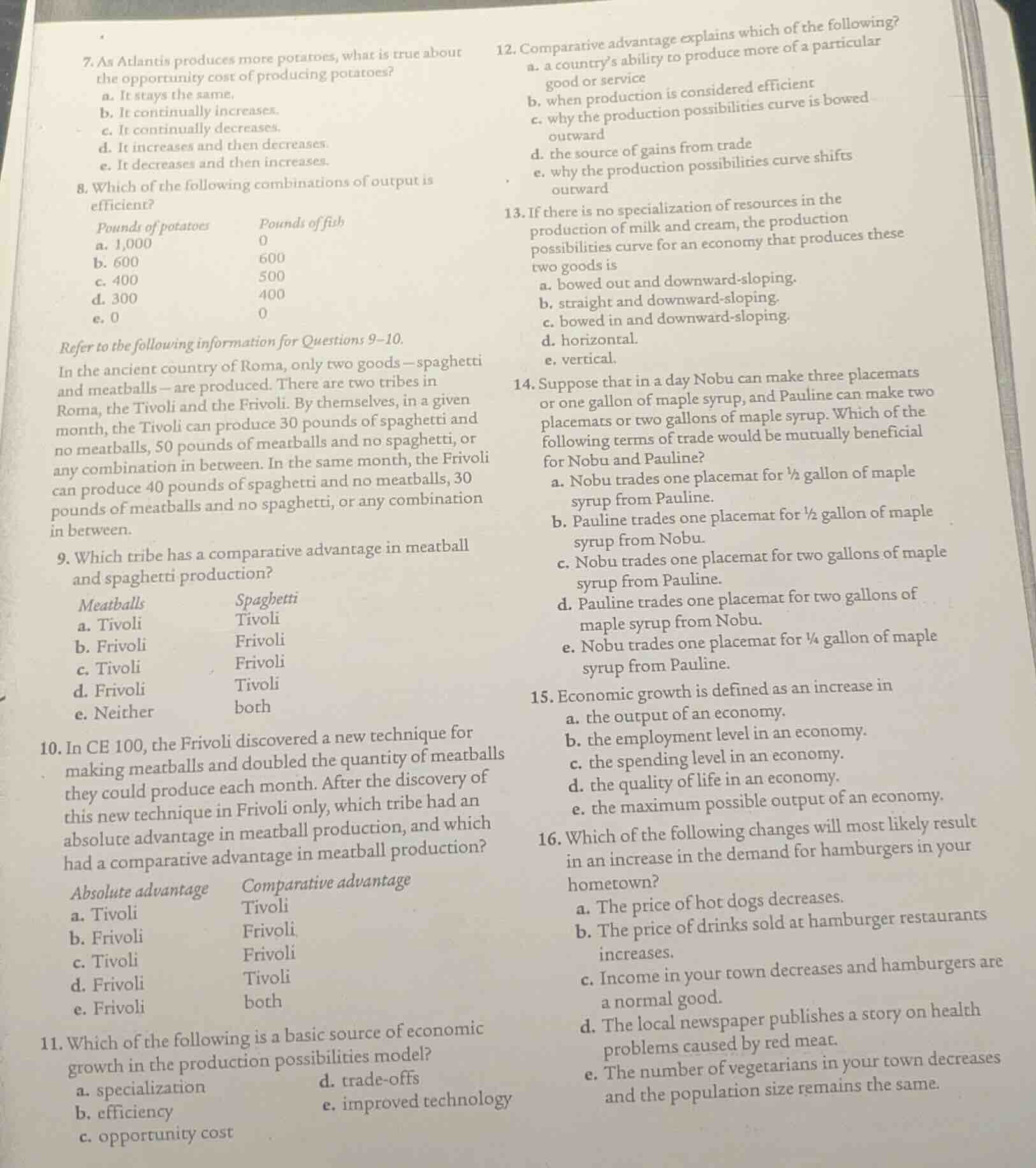
- as atlantis produces more potatoes, what is true about the opportunity cost of producing potatoes?a. it stays the same.b. it continually increases.c. it continually decreases.d. it increases and then decreases.e. it decreases and then increases.8. which of the following combinations of output is efficient?pounds of potatoes pounds of fisha. 1,000 0b. 600 600c. 400 500d. 300 400e. 0 0refer to the following information for questions 9-10.in the ancient country of roma, only two goods—spaghetti and meatballs—are produced. there are two tribes in roma, the tivoli and the frivoli. by themselves, in a given month, the tivoli can produce 30 pounds of spaghetti and no meatballs, 50 pounds of meatballs and no spaghetti, or any combination in between. in the same month, the frivoli can produce 40 pounds of spaghetti and no meatballs, 30 pounds of meatballs and no spaghetti, or any combination in between.9. which tribe has a comparative advantage in meatball and spaghetti production?meatballs spaghettia. tivoli tivolib. frivoli frivolic. tivoli frivolid. frivoli tivolie. neither both10. in ce 100, the frivoli discovered a new technique for making meatballs and doubled the quantity of meatballs they could produce each month. after the discovery of this new technique in frivoli only, which tribe had an absolute advantage in meatball production, and which had a comparative advantage in meatball production?absolute advantage comparative advantagea. tivoli tivolib. frivoli frivolic. tivoli frivolid. frivoli tivolie. frivoli both11. which of the following is a basic source of economic growth in the production possibilities model?a. specializationb. efficiencyc. opportunity costd. trade-offse. improved technology12. comparative advantage explains which of the following?a. a countrys ability to produce more of a particular good or serviceb. when production is considered efficientc. why the production possibilities curve is bowed outwardd. the source of gains from tradee. why the production possibilities curve shifts outward13. if there is no specialization of resources in the production of milk and cream, the production possibilities curve for an economy that produces these two goods isa. bowed out and downward-sloping.b. straight and downward-sloping.c. bowed in and downward-sloping.d. horizontal.e. vertical.14. suppose that in a day nobu can make three placemats or one gallon of maple syrup, and pauline can make two placemats or two gallons of maple syrup. which of the following terms of trade would be mutually beneficial for nobu and pauline?a. nobu trades one placemat for ½ gallon of maple syrup from pauline.b. pauline trades one placemat for ½ gallon of maple syrup from nobu.c. nobu trades one placemat for two gallons of maple syrup from pauline.d. pauline trades one placemat for two gallons of maple syrup from nobu.e. nobu trades one placemat for ¼ gallon of maple syrup from pauline.15. economic growth is defined as an increase ina. the output of an economy.b. the employment level in an economy.c. the spending level in an economy.d. the quality of life in an economy.e. the maximum possible output of an economy.16. which of the following changes will most likely result in an increase in the demand for hamburgers in your hometown?a. the price of hot dogs decreases.b. the price of drinks sold at hamburger restaurants increases.c. income in your town decreases and hamburgers are a normal good.d. the local newspaper publishes a story on health problems caused by red meat.e. the number of vegetarians in your town decreases and the population size remains the same.
Step1: Solve Q7: Opportunity cost trend
The bowed-out production possibilities curve means as more of a good is produced, the opportunity cost (what you give up) increases because resources are not perfectly adaptable.
Step2: Solve Q8: Efficient output combination
Efficient output lies on the production possibilities curve. The maximum fish for 1000 potatoes is 0, maximum potatoes for 0 fish is 1000; for 600 potatoes, max fish is 400, so 600 potatoes + 600 fish is unattainable. 400 potatoes + 500 fish is unattainable. 300 potatoes + 400 fish is on the curve (efficient).
Step3: Solve Q9: Comparative advantage calculation
Tivoli:
Opportunity cost of 1 meatball: $\frac{30}{50} = 0.6$ spaghetti
Opportunity cost of 1 spaghetti: $\frac{50}{30} \approx 1.67$ meatballs
Frivoli:
Opportunity cost of 1 meatball: $\frac{40}{30} \approx 1.33$ spaghetti
Opportunity cost of 1 spaghetti: $\frac{30}{40} = 0.75$ meatballs
Tivoli has lower opportunity cost for meatballs, Frivoli for spaghetti.
Step4: Solve Q10: New absolute/comparative advantage
Frivoli now makes 60 meatballs. Absolute advantage: Frivoli makes more meatballs (60 > 50).
New Frivoli opportunity cost:
1 meatball: $\frac{40}{60} \approx 0.67$ spaghetti, still higher than Tivoli's 0.6, so Tivoli has comparative advantage.
Step5: Solve Q11: Economic growth source
Improved technology expands the production possibilities curve, causing economic growth.
Step6: Solve Q12: Comparative advantage purpose
Comparative advantage is the foundation of gains from trade, as it shows who should produce which good to maximize total output.
Step7: Solve Q13: No specialization PPC shape
If resources are equally productive in both goods (no specialization), the PPC is a straight downward-sloping line (constant opportunity cost).
Step8: Solve Q14: Mutually beneficial terms of trade
Nobu's opportunity cost:
1 placemat = $\frac{1}{3}$ gallon syrup; 1 syrup = 3 placemats
Pauline's opportunity cost:
1 placemat = 1 gallon syrup; 1 syrup = 1 placemat
Mutually beneficial terms: 1 placemat trades for between $\frac{1}{3}$ and 1 gallon syrup.
Step9: Solve Q15: Economic growth definition
Economic growth is an increase in the maximum possible output (shifts PPC outward).
Step10: Solve Q16: Demand for hamburgers
Vegetarians avoid hamburgers; fewer vegetarians (same population) increases hamburger demand.

Snap & solve any problem in the app
Get step-by-step solutions on Sovi AI
Photo-based solutions with guided steps
Explore more problems and detailed explanations
- b. It continually increases.
- d. 300 Pounds of potatoes, 400 Pounds of fish
- c. Tivoli (Meatballs), Frivoli (Spaghetti)
- d. Frivoli (Absolute advantage), Tivoli (Comparative advantage)
- e. improved technology
- d. the source of gains from trade
- b. straight and downward-sloping.
- a. Nobu trades one placemat for ½ gallon of maple syrup from Pauline.
- e. the maximum possible output of an economy.
- e. The number of vegetarians in your town decreases and the population size remains the same.