QUESTION IMAGE
Question
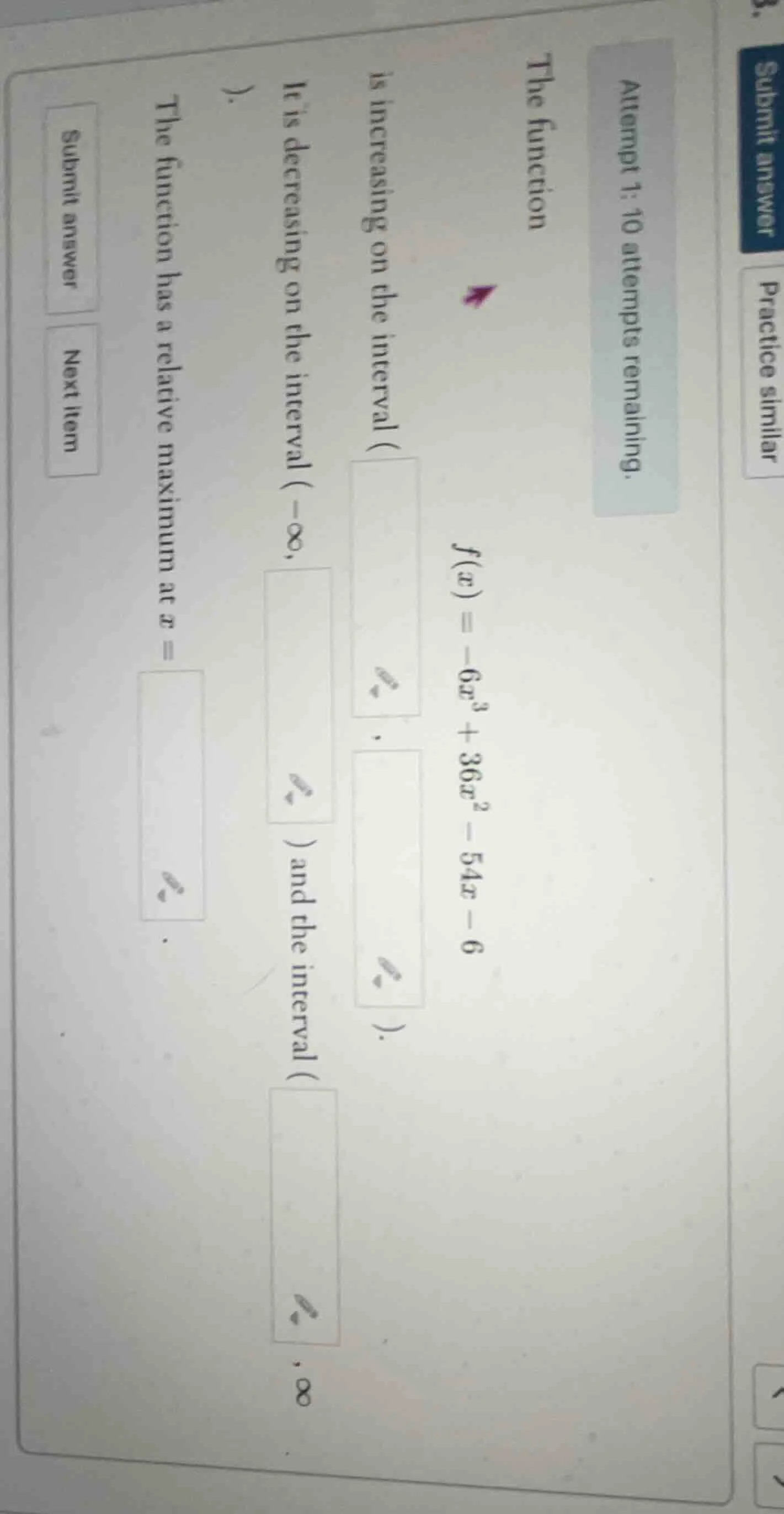
attempt 1; 10 attempts remaining. the function \\( f(x) = -6x^3 + 36x^2 - 54x - 6 \\) is increasing on the interval ( , ). it is decreasing on the interval (\\(-\infty\\), ) and the interval ( , \\(\infty\\) ). the function has a relative maximum at \\( x = \\) .
Step1: Find the derivative of \( f(x) \)
To determine where the function is increasing or decreasing, we first find the derivative of \( f(x) = -6x^3 + 36x^2 - 54x - 6 \). Using the power rule, the derivative \( f'(x) \) is:
\[
f'(x) = -18x^2 + 72x - 54
\]
Step2: Factor the derivative
Factor out a common factor of \(-18\) from \( f'(x) \):
\[
f'(x) = -18(x^2 - 4x + 3)
\]
Then factor the quadratic inside the parentheses:
\[
f'(x) = -18(x - 1)(x - 3)
\]
Step3: Find critical points
Set \( f'(x) = 0 \) to find the critical points:
\[
-18(x - 1)(x - 3) = 0
\]
This gives \( x = 1 \) and \( x = 3 \) as the critical points.
Step4: Determine intervals of increase/decrease
We test the intervals determined by the critical points: \( (-\infty, 1) \), \( (1, 3) \), and \( (3, \infty) \).
- For \( x < 1 \) (e.g., \( x = 0 \)): \( f'(0) = -18(0 - 1)(0 - 3) = -18(3) = -54 < 0 \), so the function is decreasing on \( (-\infty, 1) \).
- For \( 1 < x < 3 \) (e.g., \( x = 2 \)): \( f'(2) = -18(2 - 1)(2 - 3) = -18(-1) = 18 > 0 \), so the function is increasing on \( (1, 3) \).
- For \( x > 3 \) (e.g., \( x = 4 \)): \( f'(4) = -18(4 - 1)(4 - 3) = -18(3) = -54 < 0 \), so the function is decreasing on \( (3, \infty) \).
Step5: Find relative maximum/minimum
To find relative extrema, we use the first derivative test. Since the function changes from decreasing to increasing at \( x = 1 \), there is a relative minimum at \( x = 1 \). Since the function changes from increasing to decreasing at \( x = 3 \), there is a relative maximum at \( x = 3 \).

Snap & solve any problem in the app
Get step-by-step solutions on Sovi AI
Photo-based solutions with guided steps
Explore more problems and detailed explanations
- The function is increasing on the interval \( \boldsymbol{(1, 3)} \).
- It is decreasing on the interval \( \boldsymbol{(-\infty, 1)} \) and the interval \( \boldsymbol{(3, \infty)} \).
- The function has a relative maximum at \( \boldsymbol{x = 3} \).