QUESTION IMAGE
Question
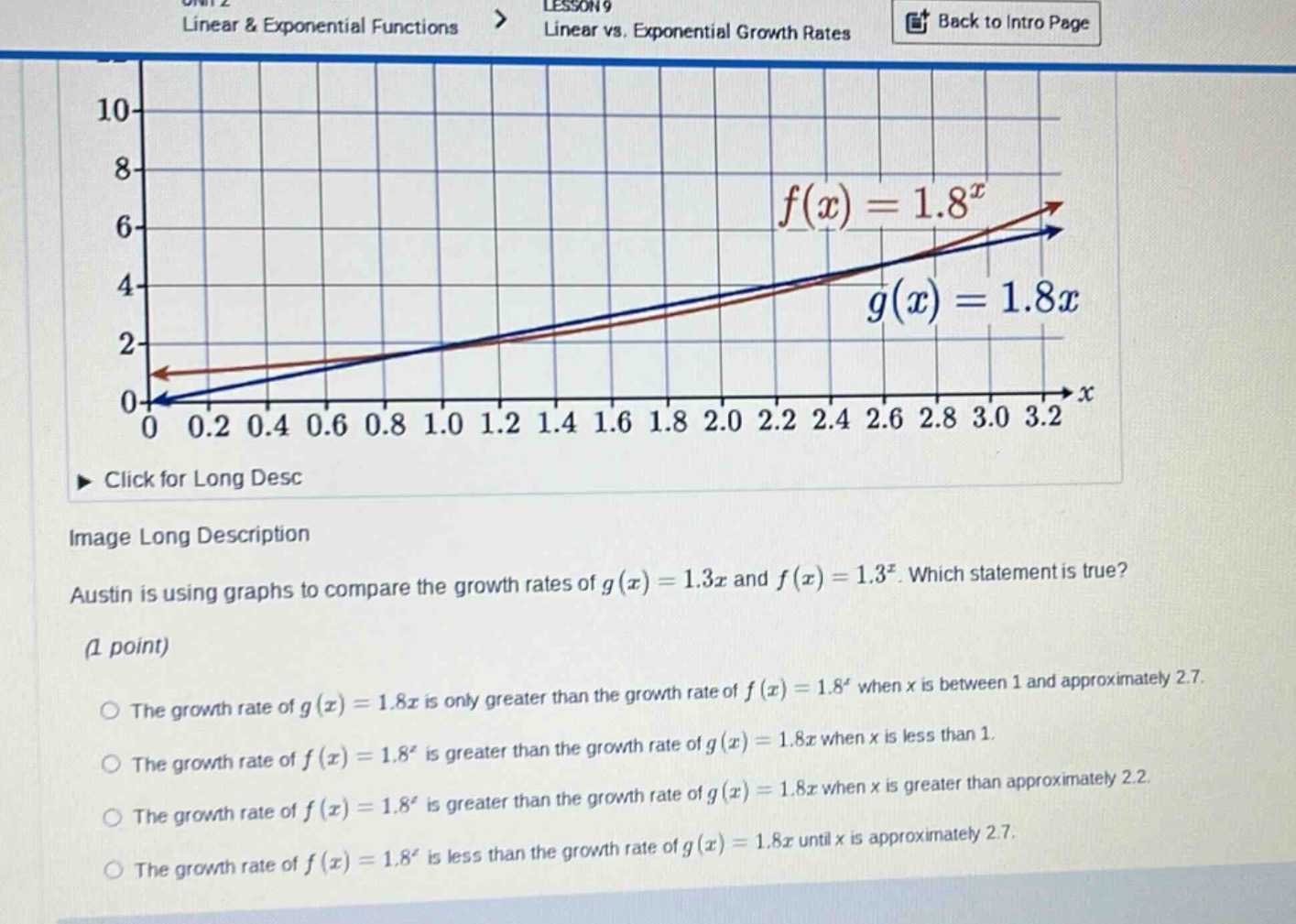
austin is using graphs to compare the growth rates of $g(x) = 1.3x$ and $f(x) = 1.3^x$. which statement is true? (1 point) \bigcirc the growth rate of $g(x) = 1.8x$ is only greater than the growth rate of $f(x) = 1.8^x$ when $x$ is between 1 and approximately 2.7. \bigcirc the growth rate of $f(x) = 1.8^x$ is greater than the growth rate of $g(x) = 1.8x$ when $x$ is less than 1. \bigcirc the growth rate of $f(x) = 1.8^x$ is greater than the growth rate of $g(x) = 1.8x$ when $x$ is greater than approximately 2.2. \bigcirc the growth rate of $f(x) = 1.8^x$ is greater than the growth rate of $g(x) = 1.8x$ when $x$ is greater than approximately 2.7. \bigcirc the growth rate of $f(x) = 1.8^x$ is less than the growth rate of $g(x) = 1.8x$ until $x$ is approximately 2.7.
To determine the correct statement, we analyze the growth rates of the linear function \( g(x) = 1.8x \) and the exponential function \( f(x) = 1.8^x \) using their graphs (or by understanding the nature of linear and exponential growth).
- For linear functions (like \( g(x) \)), the growth rate is constant (the slope, here \( 1.8 \)).
- For exponential functions (like \( f(x) \)), the growth rate increases over time (since the derivative of \( a^x \) is \( \ln(a) \cdot a^x \), which is an increasing function for \( a > 1 \)).
Looking at the graph (or reasoning about the functions):
- Initially (for small \( x \)), the linear function \( g(x) \) may grow faster than the exponential \( f(x) \) because exponential growth starts slowly.
- As \( x \) increases beyond a certain point, the exponential function’s growth rate (which is increasing) will surpass the linear function’s constant growth rate.
From the graph of \( f(x) = 1.8^x \) and \( g(x) = 1.8x \), we observe that \( f(x) \) (exponential) has a slower growth rate than \( g(x) \) (linear) until \( x \) reaches approximately \( 2.7 \). After that, \( f(x) \)’s growth rate becomes greater.
Now let's analyze each option:
- "The growth rate of \( g(x) = 1.8x \) is only greater than the growth rate of \( f(x) = 1.8^x \) when \( x \) is between 1 and approximately 2.7." → Incorrect. The linear growth rate is greater before \( x \approx 2.7 \) (not just between 1 and 2.7).
- "The growth rate of \( f(x) = 1.8^x \) is greater than the growth rate of \( g(x) = 1.8x \) when \( x \) is less than 1." → Incorrect. For \( x < 1 \), the linear function (with constant slope) grows faster than the exponential (which is still "ramping up").
- "The growth rate of \( f(x) = 1.8^x \) is greater than the growth rate of \( g(x) = 1.8x \) when \( x \) is greater than approximately 2.2." → Incorrect. The crossing point (where their growth rates become equal and then switch) is around \( x \approx 2.7 \), not 2.2.
- "The growth rate of \( f(x) = 1.8^x \) is greater than the growth rate of \( g(x) = 1.8x \) when \( x \) is greater than approximately 2.2." → Incorrect (similar to above).
- "The growth rate of \( f(x) = 1.8^x \) is less than the growth rate of \( g(x) = 1.8x \) until \( x \) is approximately 2.7." → Correct. This matches our analysis: the exponential grows slower (lower growth rate) than the linear until \( x \approx 2.7 \), after which the exponential’s growth rate (increasing) surpasses the linear’s (constant) growth rate.

Snap & solve any problem in the app
Get step-by-step solutions on Sovi AI
Photo-based solutions with guided steps
Explore more problems and detailed explanations
The growth rate of \( f(x) = 1.8^x \) is less than the growth rate of \( g(x) = 1.8x \) until \( x \) is approximately 2.7.